
In This Article
Somewhere in a garage in Seattle, a rain jacket is failing its owner right now. Maybe the seams are weeping at the shoulders. Maybe it’s so stiff with cold that putting it on feels like wrestling a pool float. Rain gear has a way of revealing its true character the moment you actually need it — not in the store, under fluorescent lights, but at minute forty of a downpour with your hands full of grocery bags.
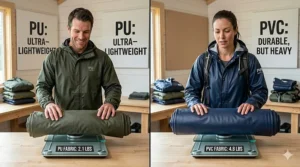
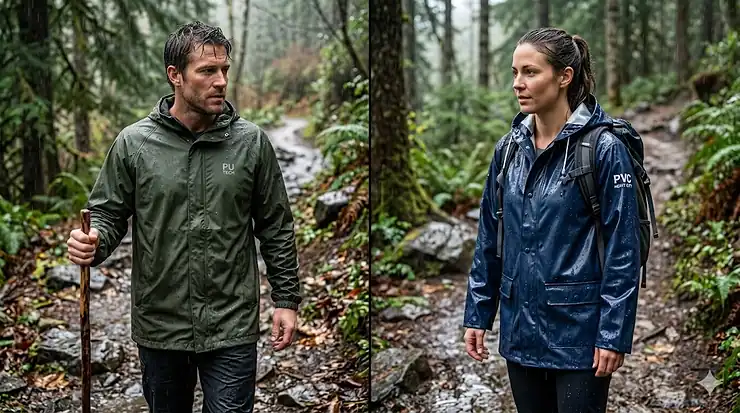
That’s the real question buried inside “PU raincoat vs PVC which is better”: not which material sounds more advanced on a label, but which one survives contact with actual weather. Polyurethane (PU) and polyvinyl chloride (PVC) are the two workhorse waterproofing technologies behind almost every raincoat sold in America, from $18 vinyl ponchos to $140 Norwegian-engineered shells. They solve the same problem — keeping water out — using completely different chemistry, and that difference shows up in weight, flexibility, smell, breathability, and how the jacket behaves on its hundredth wear versus its first.
This guide breaks down both materials honestly, walks through seven real raincoats currently sold on Amazon, and gives you a framework for choosing based on how you’ll actually use the thing — not how it photographs.
Quick Comparison Table
| Feature | PU-Coated Rainwear | PVC-Coated Rainwear |
|---|---|---|
| Weight | Lighter, more packable | Heavier, bulkier |
| Flexibility in cold | Stays supple | Can stiffen and crack |
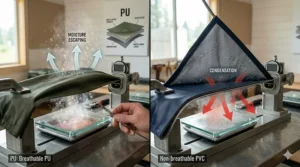
| Breathability | Moderate to good | Low (near-zero airflow) |
| Cost | Mid to premium | Budget-friendly |
| Durability over years | Coating can flake eventually | Resists abrasion, but cracks with age |
| Best for | Outdoor recreation, daily wear | Industrial work, emergency/disposable use |
Looking at the table, the split is pretty clean: PU earns its premium by staying flexible and wearable for hours, while PVC earns its low price tag by being a tougher, more disposable shield against the worst conditions. Neither material is “better” in a vacuum — a fisherman gutting catch on a trawler deck has different priorities than a commuter biking to the office, and the table above is really a map of trade-offs, not a winner’s podium.
💬 Just one click — help others make better buying decisions too!😊
Top 7 PU and PVC Raincoats: Expert Analysis
We pulled real, currently listed products from Amazon spanning both materials and every price tier, from disposable-grade vinyl to commercial fishing gear. Here’s how they stack up.
1. Stansport Men’s PVC Rainsuit with Hood
Stansport’s PVC Rainsuit is the raincoat equivalent of a fire extinguisher: you buy it hoping you won’t need it often, but you’re glad it’s in the trunk. Built from roughly .20mm PVC with electronically welded seams, it skips stitching entirely — and that matters more than it sounds, because stitch holes are exactly where cheap rain gear leaks first. What most buyers overlook about welded-seam construction is that it doesn’t degrade the way sewn seams do; there’s no thread to rot or pull loose.
This is a suit for the glovebox, the campsite, or the job site emergency kit — not for daily wear, since PVC at this weight doesn’t breathe and will have you sweating inside ten minutes of brisk walking. Reviewers consistently flag it as a “better safe than soaked” purchase rather than a wardrobe staple, with praise for how completely it blocks water and mild grumbling about a boxy, one-size-feels-large fit.
✅ Pros: Genuinely waterproof, welded seams won’t leak, extremely affordable
❌ Cons: Zero breathability, boxy fit
Price range: Around $15–$25 — about what you’d spend on a round of drinks, for gear that could keep you dry through a real storm.
2. RainRider Heavy Duty Raincoat (PVC Coated Polyester, 60-Inch)
At a full 60 inches, RainRider’s Heavy Duty Raincoat is less a jacket than a wearable tent — it’s designed to go over whatever you’re already wearing, coat included. The PVC-coated polyester shell uses electronically welded seams again, plus underarm and back ventilation cut into the fabric to fight the “trash bag” feeling that plagues most PVC gear.
In my experience, length is the underrated spec on raincoats like this one — most reviewers who complain about getting wet “anyway” are wearing a coat that’s too short, letting water run down past the hem and into their boots. This one solves that by going long. The trade-off is the snap closures, which several buyers note feel flimsy compared to a zipper and can pop open in strong wind, letting rain sneak in at the chest.
✅ Pros: Excellent coverage length, ventilated underarms, true waterproofing
❌ Cons: Snap closures can fail in wind, sizing runs generous
Price range: Around $15–$30 — one of the better coverage-per-dollar ratios in PVC rainwear.
3. MCR Safety 230CXL Classic Industry Standard PVC/Polyester Coat
MCR Safety’s 230CXL is built by a company that’s spent decades outfitting people whose jobs depend on their gear not failing — and it shows. At .35mm PVC over a polyester backing, this is noticeably heavier-duty than the budget options above, with a detachable hood that lets you skip the bulk when you don’t need it and heat-welded seams rated for sustained exposure rather than the occasional walk to the mailbox.
What the spec sheet won’t tell you: that 49-inch length plus a detachable hood is the combination utility crews and delivery drivers actually want, because it lets the coat double as a quick layer over a uniform without committing you to a permanent hood flapping around your collar. This is a “buy once” piece of rainwear for anyone outdoors on a schedule, not a backup.
✅ Pros: Industrial-grade thickness, detachable hood, heat-welded seams
❌ Cons: Heavier and less packable than recreational options
Price range: Around $20–$35 — genuinely punching above its price class for daily occupational use.
4. Tingley All Sport Rain Jacket
This is where the article crosses from PVC into PU territory, and the difference is immediate. Tingley’s All Sport Rain Jacket uses a .40mm polyurethane coating over stretch-knit polyester, and that stretch is the whole story — PU bonds to flexible base fabrics in a way PVC generally can’t, which is why this jacket moves with your shoulders instead of fighting them. The seams are RF/heat-sealed rather than just sewn, a detail worth caring about since taped or welded seams are the single biggest predictor of whether a “waterproof” jacket actually stays that way.
For anyone wondering whether a polyurethane rain jacket is breathable: this one is “breathable” only in the loosest sense — it won’t trap heat quite as aggressively as PVC, but it’s still a coated shell, not a membrane fabric, so expect some clamminess during real exertion. It earns its spot as the all-purpose option between disposable PVC and premium outdoor PU.
✅ Pros: Stretch fit, sealed seams, lightweight polyurethane build
❌ Cons: Not truly breathable despite the “sport” branding
Price range: Around $35–$55.
5. Helly Hansen Gale Rain Jacket
Helly Hansen’s Gale Rain Jacket is the jacket I’d point a beginner hiker toward without hesitation. Helly Hansen has been making Norwegian foul-weather gear since the 1800s, and the PU-coated polyester here is paired with neoprene cuffs — a detail that sounds minor until you’re in driving rain and realize your jacket sleeves aren’t acting as a funnel straight to your wrists. It’s also phthalate-free, which matters if you’ve read anything about the plasticizers historically used to keep PVC flexible (more on that below).
What most buyers overlook is the packable hood: it’s not just “has a hood,” it’s a hood designed to stow flat when you don’t need the bulk, which is the difference between a jacket you actually bring on a day hike and one that stays folded in a drawer. This is a “wear it for years” purchase rather than a seasonal one.
✅ Pros: Flexible and durable PU build, neoprene cuffs, phthalate-free materials
❌ Cons: Premium price for what is still a coated (not membrane) fabric
Price range: Around $90–$140 — the cost of a brand that’s been field-tested for over a century.
6. Grundéns Women’s Neptune Commercial Fishing Jacket
Grundéns’ Neptune Jacket comes from a brand whose actual customers gut fish on open decks for a living, which tells you everything about how seriously its medium-weight PU-coated polyester takes “100% waterproof.” This isn’t recreational gear wearing a tough-guy label — it’s commercial-grade rainwear that happens to also work beautifully for anyone who needs full mobility in sustained, heavy rain: dog walkers, gardeners, anyone standing outside for hours rather than just commuting through a drizzle.
The full zip and dedicated women’s cut solve a real gap in the rain jacket market, where “unisex” so often means “men’s sizing with a smaller label.” If your current rain jacket fights you every time you reach overhead or bend down, the freedom of movement here is the actual upgrade — not a new color, but a coat that doesn’t fight your body.
✅ Pros: Commercial-grade waterproofing, true freedom of movement, women’s-specific fit
❌ Cons: Higher price reflects its industrial fishing pedigree, more than a casual buyer needs
Price range: Around $100–$160.
7. WaterShed StormCreek Polyurethane Coated Nylon Jacket
WaterShed’s StormCreek Jacket is Made in the USA and built for exactly the environments its spec sheet lists: food processing, utilities, transportation — places where a jacket fails fast if the coating can’t handle repeated washing. PU-coated nylon at 32 inches keeps things shorter and lighter than the knee-length industrial coats above, with raglan sleeves cut for a wider range of overhead motion, double-stitched and sealed seams, and snap cuffs that actually cinch tight instead of just sitting loose.
The detail that matters here is “machine washable” — a lot of coated rainwear degrades fast in a washing machine, but this one is built to handle the repeated wash cycles that industrial and food-service jobs demand. If your current jacket can’t survive a normal laundry routine, that’s a maintenance failure waiting to happen, not a minor inconvenience.
✅ Pros: Made in USA, machine washable, raglan sleeves for mobility
❌ Cons: Shorter length than dedicated knee-length work coats
Price range: Around $40–$70.
✨ Don’t Miss These Exclusive Deals!
🔍 Take your rain gear search to the next level — click any highlighted pick above to check current pricing and availability before the next storm rolls in.
Practical Usage Guide: Getting the Most From Coated Rainwear
Coated rain jackets, whether PU or PVC, have a learning curve most people skip. First: never store one folded and damp in a trunk or gear bag for weeks — trapped moisture against a PU coating accelerates hydrolysis, the slow chemical breakdown that makes old rain jackets go tacky and start peeling from the inside. Hang it to dry fully before storage.
Second, skip fabric softener and high heat in the wash for any PU-coated piece; both break down the coating faster than normal wear would. A cool, gentle cycle (when the tag allows machine washing at all) and air drying is the safe default. Third, for PVC gear specifically, avoid storing it folded at sharp creases in cold environments — PVC stiffens below roughly 40°F, and a hard crease in stiff PVC is how cracks start. Roll rather than fold when you can. Finally, re-seal seams on heavy-use jackets once a year with a seam sealer if you notice any dampness creeping through at the stitch lines; it’s a five-minute fix that adds real years to the garment.
Real-World Scenario: Matching the Coat to the Person
The daily commuter biking or walking to work needs breathability and packability more than industrial toughness — something like the Tingley All Sport or Helly Hansen Gale fits a backpack and won’t leave you drenched in sweat by the time you arrive. The weekend tradesperson doing yard work, car repairs, or boat maintenance in the rain wants the MCR Safety coat or the WaterShed StormCreek: tougher coatings, washable, built to survive grime rather than just weather. The outdoor enthusiast hiking or fishing for hours wants the Grundéns Neptune or Helly Hansen Gale, where freedom of movement and sustained waterproofing matter more than price.
And then there’s the emergency-kit buyer — the person who wants a raincoat in the car, the camping bag, or the office desk drawer for the one day it’s needed unexpectedly. That’s exactly where the Stansport or RainRider PVC options shine: cheap enough to stash in multiples, tough enough to actually work when called on.
How to Choose Between PU and PVC Rainwear
- Start with frequency of use. Daily wear favors PU’s flexibility; occasional or emergency use favors PVC’s lower cost and durability in storage.
- Factor in climate. Cold-weather users should lean PU or PVC-with-care, since stiff PVC cracks faster below freezing.
- Weigh breathability needs. Anyone exerting themselves — walking, cycling, working — will feel PVC’s lack of airflow fast; PU is the more tolerable middle ground.
- Check the coating thickness. Thicker coatings (.35mm+) generally mean more durability but less flexibility — fine for static wear like fishing, less fine for active wear like hiking.
- Decide how long you want it to last. PVC resists abrasion well but becomes brittle with age; PU stays flexible longer but the coating itself can eventually flake.
- Match the fit to the body doing the work. A women’s-specific or stretch-knit cut, like the Grundéns or Tingley options, prevents the bunching that causes leaks at pressure points.
- Set a real budget — not just a sticker price. A $20 PVC coat replaced every two seasons may cost more over five years than a $100 PU jacket that lasts a decade.
Common Mistakes When Buying Rain Gear
The most common mistake is buying based on the word “waterproof” alone, without checking seam construction — a coated fabric with sewn-but-unsealed seams will leak at every stitch line no matter how good the base material is. The second is choosing length based on looks rather than coverage; a jacket that stops at the hip looks sportier but lets rain run straight onto pants and into boots. The third is ignoring fit for movement: a rain jacket that’s tight across the shoulders will eventually leak at the seams under stress, simply from the fabric being pulled taut in a downpour.
A fourth, sneakier mistake: assuming all “PU coated” listings mean the same thing. Coating thickness, base fabric, and seam treatment vary enormously between a $20 PU jacket and a $120 one, and the word “polyurethane” on its own tells you almost nothing about how the finished garment performs.
PU vs PVC: The Real Differences That Matter
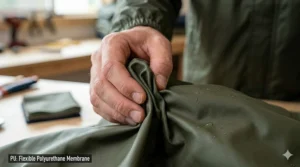
Polyurethane is a flexible plastic polymer applied as a thin coating, usually laminated onto polyester or nylon. PVC — polyvinyl chloride — is a rigid plastic by nature that requires plasticizer chemicals to stay soft and wearable; without them, it would behave more like PVC pipe than rainwear. That single fact explains most of the practical differences buyers notice: PU’s flexibility is built into the polymer itself, while PVC’s flexibility is borrowed from additives, which is part of why aged PVC gear tends to stiffen and crack as those plasticizers slowly migrate out over years of sun and wear, according to background on the chemistry of polyvinyl chloride.
In terms of waterproof coating types more broadly, outdoor gear testers note that PU films sit between basic coated fabrics and premium ePTFE membranes like Gore-Tex — PU laminates tend to be lighter and stretchier than membrane-only builds, while simple coated fabrics (PU or PVC) are generally the budget tier with lower long-term breathability and durability. None of this makes PVC “worse” outright; it just means PVC is optimized for raw waterproof toughness at a low price, while PU is optimized for wearable comfort over time.
What to Expect: Real-World Performance
In light-to-moderate rain, both materials perform almost identically — water beads and rolls off either coating without issue. The difference shows up in two specific conditions: sustained activity and temperature extremes. Wear a PVC coat on a brisk walk and you’ll feel the heat build-up within minutes, since the material essentially traps air against your body like a plastic bag. PU performs marginally better here, though “marginally” is the honest word — it’s still a coating, not a breathable membrane, so don’t expect Gore-Tex-level comfort from any PU-coated jacket in this price range.
In cold weather, PVC’s stiffening becomes noticeable below freezing — buttons and snaps get harder to manage, and sharp folds risk cracking. PU stays more workable in the cold, which is part of why outdoor brands favor it for jackets meant to be worn rather than just stored.
Long-Term Cost & Maintenance
A $20 PVC raincoat used occasionally can realistically last five-plus years if stored properly, making its cost-per-use extremely low for emergency or backup use. The same coat used daily, exposed to UV and repeated folding, may show cracking within one to two seasons — UV exposure breaks down both PVC and PU coatings over time, but PVC’s plasticizer-dependent flexibility makes it more vulnerable to that specific failure mode.
A $100+ PU jacket, by contrast, holds up to daily wear far longer if it’s properly cared for (cool washes, full drying before storage), often delivering five-plus years of regular use before the coating needs attention. When you divide price by expected wear-days rather than sticker price alone, premium PU gear frequently turns out cheaper per use than buyers assume — the upfront number is just more visible than the long-term math.
Features That Actually Matter (And Those That Don’t)
Sealed or welded seams matter enormously; “fully taped seams” or “RF welded” on a listing is worth more than almost any other spec. Coating thickness in millimeters matters for durability but trades off against flexibility — there’s no free lunch here. Adjustable cuffs and a properly cut hood matter because they’re where most leaks actually start.
What matters less than marketing suggests: color (waterproofing is identical across colors), claimed “breathability” on basic coated jackets (real breathability requires a membrane, not just a thinner coating), and brand prestige alone, since a $25 welded-seam PVC coat can out-waterproof a $150 jacket with poor seam construction.
Safety, Regulations & Workwear Compliance
For anyone buying rain gear for occupational use — construction, utility work, roadside response — high-visibility rainwear is governed by ANSI/ISEA 107, the American standard for visibility apparel that the U.S. Occupational Safety and Health Administration references for worker safety on roadways and job sites. PVC remains common in this category specifically because of its abrasion resistance and resistance to oils, chemicals, and grime — properties that matter more on a job site than breathability does. If your rainwear doubles as PPE, check the listing for an ANSI class rating rather than assuming any yellow coat qualifies.
Eco-Friendly Rain Jacket Materials: How PU and PVC Compare
This is where the comparison gets more complicated than marketing copy usually admits. PVC’s flexibility traditionally depends on phthalate plasticizers, and regulatory bodies have spent years studying their effects. The U.S. Food and Drug Administration notes that certain phthalates are under continued evaluation for cumulative health effects, while the Consumer Product Safety Commission has worked on standards to detect and limit phthalate levels in consumer plastic products, including rainwear. Reputable brands increasingly sell phthalate-free PVC and PU rain gear — the Helly Hansen jacket reviewed above is one example — so the real eco-friendly move isn’t necessarily avoiding PVC entirely, but checking specifically for a phthalate-free claim on the listing.
PU, meanwhile, doesn’t require the same plasticizer chemistry, though it carries its own environmental footprint in manufacturing. Neither material biodegrades, and both are typically not recyclable through standard curbside programs — if sustainability is a top priority, look for brands explicitly marketing recycled-content shells or take-back programs rather than assuming either base material wins on its own.
Frequently Asked Questions
❓ Is a polyurethane rain jacket breathable?
❓ What is the actual difference between PU and PVC raincoats?
❓ Which is more eco-friendly, PU or PVC rain jacket material?
❓ How long does a PVC raincoat actually last?
❓ Can you machine wash a polyurethane coated rain jacket?
Conclusion
There’s no universal winner in the PU raincoat vs PVC debate — there’s just a better match for your specific rain. If you need something to live in your trunk for the one day a storm catches you off guard, a welded-seam PVC coat like the Stansport or RainRider delivers outsized value for almost no money. If you’re putting a jacket through real daily mileage — commuting, hiking, working outdoors — PU’s flexibility and slightly better comfort over PVC earns its higher price tag, especially from proven brands like Helly Hansen or Grundéns.
The honest move is matching the material to how often you’ll actually wear it, not which one sounds more technical on the label. Check seam construction first, coating thickness second, and let your actual weather and routine make the final call.
Recommended for You
- 7 Best Rubber Raincoat Fishing Picks That Keep You Dry (2026)
- Best PVC Raincoat for Work in 2026: 7 Heavy-Duty Picks Reviewed
- Most Waterproof Rain Jacket: 7 Best Picks for 2026
Disclaimer: This article contains affiliate links. As an Amazon Associate, I earn from qualifying purchases. If you purchase products through these links, we may earn a small commission at no additional cost to you.
✨ Found this helpful? Share it with your friends! 💬🤗
