
In This Article
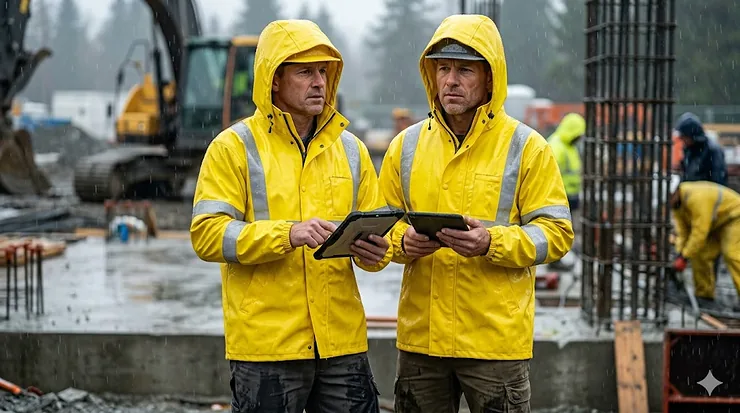
You’ve been there. Standing on a job site at 7 a.m., wearing what the packaging promised was a “waterproof jacket,” watching rainwater quietly soak through your collar and down the back of your neck. Not a great start to the day. Here’s the brutal truth: most consumer rain jackets aren’t built for the kind of relentless, all-day downpour that outdoor workers face shift after shift.
That’s where a PVC raincoat for work changes everything.
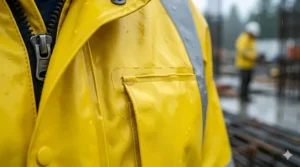
A PVC raincoat for work is specifically engineered as a waterproof barrier between you and the elements — using polyvinyl chloride (PVC) coatings bonded to polyester or nylon fabric to create a surface that rain literally cannot penetrate. Unlike DWR-treated jackets that stop working after a dozen washes, or flimsy ponchos that flip up in a breeze, a true heavy-duty PVC rain jacket is built like a shield. Sealed seams, snap or zip fronts, and thick PVC coatings in the 0.28mm–0.38mm range mean water doesn’t just bead off; it never even gets close. According to the Occupational Safety and Health Administration (OSHA), employers are required to provide appropriate personal protective equipment (PPE) when workers face exposure to wet weather hazards — and the right rain gear is part of that picture.
In this guide, I’ve done the legwork: researched real products currently available on Amazon, dug into customer feedback, and applied practical field knowledge to bring you seven genuine picks at every price point. Whether you’re in construction, landscaping, warehouse logistics, fishing, or municipal maintenance, there’s a pick here for you. Let’s stop talking about soggy commutes and start fixing them.
Quick Comparison: PVC Raincoats for Work at a Glance
| Product | Material | Thickness | Best For | Price Range |
|---|---|---|---|---|
| MCR Safety 200C Classic | PVC/Polyester | 0.35mm | General work, value | Under $30 |
| Portwest US440 Classic | PVC-Coated Polyester | 210g | Outdoor labor, packability | $20–$35 |
| Tingley J41008 Safetyflex FR | Specialty PVC/Polyester | 17 mil | Chemical environments, FR | $80–$120 |
| Helly-Hansen Impertech Long | Stretch PU/Knit Polyester | 0.24mm | Professional outdoor trades | $100–$150 |
| Wealers Heavy Duty PVC Trench | Heavy PVC | N/A | Budget emergency, all-purpose | Under $25 |
| Pioneer 3-PC PVC Work Suit | PVC/Polyester | 0.35mm | Full-body coverage, construction | $35–$55 |
| MCR Safety 2003 3-Piece Suit | PVC/Polyester | 0.35mm | Budget full-suit option | Under $20 |
Analysis: Looking at this comparison, the MCR Safety 2003 delivers the most coverage for the money — especially for workers needing head-to-toe protection on a tight budget. For anyone working around chemicals, the Tingley Safetyflex is in a completely different league; the extra spend isn’t optional, it’s a safety decision. The Helly-Hansen Impertech earns its premium price tag with superior flexibility and construction quality that budget PVC simply can’t match.
💬 Just one click — help others make better buying decisions too! 😊
Top 7 PVC Raincoats for Work: Expert Analysis
1. MCR Safety 200C Classic PVC-Coated Raincoat
The MCR Safety 200C is the workhorse of the industrial rain gear world — the jacket you see on construction sites from Maine to Mississippi because it simply does what it promises.
Built from 0.35mm PVC-coated polyester, it clocks in at a fabric weight of about 3.0 oz per square yard. That thickness matters: at 0.35mm, this jacket is stiff enough to deflect sustained rain without ever soaking through, whereas the 0.20mm options you’ll find on discount racks start seeping after an hour of heavy downpour. The 49-inch length covers you past the hips — critical for anyone who bends, crouches, or climbs while working. Available in yellow (high-visibility friendly) with a detachable hood and snap closures. Sizes run from S through 5XL.
In my estimation, this is the best all-round PVC raincoat for work on the market under $30. MCR Safety has been producing PPE for over 49 years, and their Classic line reflects that institutional knowledge: the seam construction here is stitched and taped, not just glued. The corduroy-lined collar is a genuinely useful detail that cheaper alternatives skip entirely — it keeps the stiff PVC collar from chafing your neck during a 10-hour shift.
Customers consistently praise the durability and the realistic sizing (runs true). Some note that, like all PVC gear, you will sweat — but that’s the physics of a liquid-proof barrier, not a defect.
✅ Proven industrial-grade construction
✅ Detachable hood + corduroy collar
✅ Wide size range through 5XL
❌ No interior ventilation system
❌ Stiff initially — needs a few days to break in
In the under-$30 category, this is hard to beat. Excellent value for general contractors, road workers, and agricultural workers.
2. Portwest US440 Classic Rain Jacket
Small enough to stuff in a jacket pocket, tough enough for a full day in the rain. The Portwest US440 is a legitimate workhorse hiding in an unusually compact package.
Constructed from 100% polyester with a PVC coating (210g shell), the US440 features sealed seams, an inner elasticated cuff to block water from sneaking up your sleeves, and a vented back yoke with eyelets — a feature most cheap rain jackets completely omit. That back ventilation is the difference between arriving to your afternoon meetings smelling like a gym bag versus arriving relatively fresh. Comes in Navy, Olive Green, Orange, Black, and Yellow across sizes XS to 5XL. The 50+ UPF fabric rating is a bonus for anyone working in sunny-but-unpredictable climates.
What most buyers overlook about this model is the pack-away hood. When the sun re-emerges, you’re not stuck tied to a bulky hood — it tucks cleanly into the collar. That sounds trivial until you’re doing it six times in one shift because British Columbia decided to have all four seasons in one afternoon. Portwest is an Irish workwear brand with serious distribution and quality control infrastructure, and the US440 reflects that: the PVC coating is REACH compliant (meaning it meets strict EU chemical safety standards — something cheaper brands don’t always verify).
Customer reviews are overwhelmingly positive. Buyers highlight the generous fit and the fact that the jacket genuinely repels water through sustained downpours, not just light showers.
✅ Pack-away hood + back ventilation
✅ REACH-compliant PVC coating
✅ Available in 5 colors, sizes XS–5XL
❌ Lighter construction than pure PVC options — less protection in chemical splash scenarios
❌ Can feel clammy in warm weather
In the $20–$35 range, this is ideal for landscapers, delivery drivers, and anyone who needs something packable they can wear every day.
3. Tingley J41008 Safetyflex FR PVC Rain Jacket
This is where we stop talking about rain gear and start talking about chemical armor.
The Tingley J41008 Safetyflex is built from specialty FR (flame-resistant) PVC on polyester — a 17-mil construction that resists industrial acids, caustics, oils, alcohols, and salts. The Therm-O-Rad sealed seams mean there is literally no pathway for liquid to enter; every seam is thermally bonded into a continuous barrier. The jacket is self-extinguishing — per ASTM D6413 testing, flameout and afterglow occur in under 2 seconds after the ignition source is removed. That spec isn’t marketing fluff — it’s a measurable, tested standard.
The 90° sleeve-to-body angle shoulder cut is the practical engineering detail that separates this jacket from all the others on this list. Most rain jackets are cut like dress shirts — arms angling slightly downward. The Safetyflex cuts the sleeves at a full perpendicular angle to the torso, which means you can raise your arms overhead without the entire jacket riding up and exposing your midsection. For anyone working in chemical handling, petrochemical refineries, environmental cleanup, or industrial processing, this is exactly the kind of engineering that matters.
The high collar with hook-and-loop closure provides splash protection that most jackets simply don’t offer. Non-conductive, non-corrosive snaps add another layer of safety in electrical environments.
Workers in chemical plants and refineries frequently report that this jacket outperforms alternatives multiple times its price — and the FR rating gives supervisors compliance confidence.
✅ Flame-resistant (ASTM D6413)
✅ Chemical-resistant to acids, caustics, oils
✅ 90° sleeve cut for full overhead mobility
❌ Higher price point — not for general-purpose use
❌ Safety green color is non-negotiable (some workers prefer other options)
In the $80–$120 range. For chemical environments, this investment is a no-brainer. Trying to save money on chemical PPE is the wrong game.
4. Helly-Hansen Impertech Waterproof Long Coat
When Norwegian maritime professionals need rain gear, this is what they reach for. And that pedigree shows up immediately the moment you put the Impertech on.
The Impertech uses 0.24mm circular knit polyester with a stretch polyurethane coating — technically not straight PVC, but rated under EN 343 certification for full waterproof protection at temperatures as low as 5°C. The key word in that last sentence is stretch. Unlike the stiff, crinkly feel of traditional PVC, the Impertech flexes with your body. That full-mobility stretch means you can reach, climb, and haul without fighting your jacket. The coat extends to knee length, the back cape vents eliminate the greenhouse effect inside, and the MicroWeld seam construction eliminates leak points entirely.
What most buyers overlook about this model is the side-access zippers — a detail that lets you reach into layered garments underneath without removing your rain jacket. On a cold, wet morning at a worksite, this is the difference between keeping warm and losing your core temperature every time you need your radio or your wallet.
Helly-Hansen has been engineering professional waterproof gear since 1877, and that legacy is not marketing language — it’s manifested in material science and design refinement across 140+ years. Professional fishermen, maritime crews, and construction foremen are the core audience here, and reviewers consistently praise how well the jacket holds up through seasons of daily use.
✅ Full-stretch waterproof construction (EN 343 certified)
✅ MicroWeld seams + knee-length coverage
✅ Side zippers for layered-garment access
❌ Premium price point ($100–$150 range)
❌ Polyurethane, not traditional PVC — unsuitable for specific chemical resistance requirements
Ideal for tradespeople, commercial fishermen, and outdoor professionals who need real performance and long-term value.
5. Wealers Emergency Heavy Duty PVC Trench Raincoat
Don’t underestimate this one just because the price is low.
The Wealers PVC Trench Raincoat is constructed from heavy-duty PVC with electronically welded seams (meaning heat-bonded, not stitched — stitching creates needle holes; welded seams do not). Available in yellow, blue, and black across Small, Medium, and Large, the coat runs a full 44 inches in length — enough to protect your thighs in most work scenarios. The drawstring hood is adjustable, wrist snaps keep sleeves sealed, and both side pockets have flap covers to keep contents dry. It folds down small enough to fit in a standard backpack.
Here’s the honest appraisal: this jacket is not a replacement for a professional-grade MCR or Tingley product for daily industrial use. What it is — and what it does exceptionally well — is serve as the backup jacket you keep in your truck, your locker, or your emergency kit. When an unexpected system rolls in and your regular gear is at home, this is what saves your afternoon. At its price point, buying two and stashing them in different locations is a completely rational strategy.
Customer feedback is mostly positive, with some noting it runs slightly large. Multiple buyers confirm it holds up well through a full workday of rain and makes excellent emergency kit gear.
✅ Electronically welded seams
✅ Compact and packable — comes with carrying bag
✅ Excellent value for emergency backup
❌ Lighter construction than professional-grade options
❌ Limited to three sizes — larger workers may find the fit restrictive
In the under-$25 range, this is the best backup PVC raincoat for work on this list. Stock two.
6. Pioneer Waterproof PVC Work Suit — 3-PC Set with Detachable Hood
If your job description involves standing in rain for 6+ hours, a jacket alone isn’t solving the problem. Your lower half needs armor too.
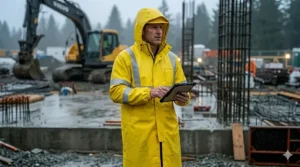
The Pioneer 3-PC Set includes a PVC-coated jacket, bib pants, and a detachable hood — complete head-to-waist-to-ankle coverage in one package. The 0.35mm PVC/polyester construction mirrors what you get in professional single-piece jackets, and the bright safety yellow colorway doubles as visibility gear in low-light conditions. The jacket features a snap front, adjustable wrists, and two front pockets; the bib pants have adjustable shoulder straps and pass-through pockets for tool access. Available in sizes Small through 3XL.
What most buyers overlook about this set is the bib design of the pants specifically. Bib pants sit higher than regular work trousers, which means when you’re squatting, kneeling, or bending forward (as most outdoor workers constantly do), there’s no gap between the jacket hem and the pant waistband. That gap is exactly where rain gets in on two-piece suits with regular waistband pants. The bib eliminates that vulnerability entirely.
For construction laborers, landscapers, municipal workers, and agricultural workers who spend entire shifts in rain, the Pioneer 3-PC represents a complete weather solution for a remarkably reasonable price.
Customers consistently highlight the durability and the excellent fit of both pieces, noting that the suit genuinely holds up through months of regular outdoor use.
✅ Full 3-piece set: jacket + bib pants + detachable hood
✅ Bib design eliminates jacket-pant gap vulnerability
✅ High-visibility yellow
❌ 0.35mm PVC isn’t rated for chemical environments
❌ Bib pants can feel warm in milder conditions
In the $35–$55 range for a complete suit. This is genuinely one of the best value propositions for full-body waterproof work protection.
7. MCR Safety 2003 Classic Series 3-Piece Rain Suit
The most affordable full-suit option on this list — and a legitimate option, not a compromise.
MCR’s 2003 series brings the same 0.35mm PVC/polyester construction as the more expensive MCR jackets and packages it into a complete three-piece set: jacket, pants, and detachable hood. The construction includes electronically welded seams, snap front closures, and take-up snaps at the cuffs. Yellow, multiple sizes. This is the workhorse entry that makes sense when you’re outfitting an entire crew on a construction budget.
The honest truth about this suit: it’s not glamorous, and it’s not pretending to be. At its price point, MCR Safety is engineering for function, not finish. The seams are solid, the waterproofing is real, and the coverage is complete. What you sacrifice is the ergonomic refinements (no articulated knees, no stretch fabric, no ventilation system) that the premium options provide.
For site managers equipping multiple workers or for workers whose rain gear gets heavy abuse and needs replacement without budget drama, the MCR 2003 is the rational, practical, proven choice.
Customers report that the suit holds up surprisingly well through a season of regular use and that the sizing runs true to the MCR standard.
✅ Complete 3-piece suit at a remarkable price
✅ MCR Safety brand quality and reliability
✅ Electronic welded seams
❌ No ventilation or ergonomic features
❌ Runs stiff — less comfortable for active, high-mobility work
Under $20 for a full three-piece suit. For crew outfitting or heavy-turnover environments, this is the smart play.
✨ Don’t Miss These Exclusive Deals!
🔍 Take your waterproof protection to the next level with these carefully selected products. Click on any highlighted item to check current pricing and availability. These tools will help you stay dry and productive no matter what the weather throws at you!
Real-World Scenario Guide: Which PVC Rain Jacket Fits Your Job
Not every job site is the same. Here’s how to match the right jacket to the right situation.
The Construction Laborer (Daily, Heavy Rain, High Mobility) You’re moving fast, lifting materials, and working in exposure to standing water and wind. You need full-body coverage, durability, and something that doesn’t restrict your movement. Best pick: Pioneer 3-PC PVC Work Suit. The bib pants eliminate the gap problem, the 0.35mm PVC handles sustained downpours, and the price point means replacement is painless. If budget allows, step up to the Portwest US440 for the jacket and add separate rain pants — the ventilation system in the US440 makes long shifts more bearable.
The Grounds Maintenance or Landscaping Worker (Moderate Rain, All Day) You’re mowing, trimming, and hauling — constantly bending and reaching. The Helly-Hansen Impertech’s stretch construction is built exactly for this scenario. The knee-length coverage protects you when you crouch, and the full-mobility cut means your jacket moves with you instead of fighting you. Yes, it’s the most expensive option here, but it’s the one you’ll still be wearing in three years.
The Chemical Plant or Refinery Worker (Splash Risk, Chemical Exposure) Standard PVC raincoats are not appropriate here. You need the Tingley Safetyflex J41008. Full stop. The FR rating, Therm-O-Rad sealed seams, and chemical resistance to industrial acids are not luxuries in this environment — they are safety requirements. In facilities where OSHA’s hazardous materials standards apply, using undersized rain protection creates genuine liability.
The Delivery Driver or Logistics Worker (Light-to-Moderate Rain, Occasional Use) You need something packable, easy to throw on, and capable of lasting through a shift. The Portwest US440’s pack-away hood and compact design make it the perfect jacket-on-demand. Keep it under the seat; reach for it when the weather turns.
The Budget-Conscious Outdoor Worker (Any Rain, Multiple Workers) If you’re equipping a team or replacing gear that keeps getting damaged on site, the MCR Safety 2003 3-Piece Suit delivers professional-grade waterproofing at a price that makes sense for bulk purchasing. No other option on this list provides a complete three-piece suit at that price point.
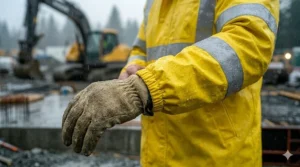
How to Choose a PVC Raincoat for Work: 6 Criteria That Actually Matter
Choosing the right waterproof PVC rain gear for men (or women) on the job comes down to a specific set of criteria that most buyer guides conveniently skip.
1. Material Thickness and Construction Type PVC rain jackets come in a range from about 0.10mm (lightweight, consumer-grade) to 0.38mm+ (industrial). For work use, you want a minimum of 0.28mm. Below that threshold, the material is susceptible to puncture from tools, rough surfaces, and repeated flexing. At 0.35mm, you’re in the professional grade. Anything marketed as 17 mil (like the Tingley Safetyflex) is in the specialty chemical-resistant category. Always check whether seams are stitched, stitched-and-taped, electronically welded, or Therm-O-Rad sealed — in that order of waterproofing effectiveness.
2. Seam Integrity This is where cheap jackets fail. Stitched seams create needle holes; rain finds them every time. Look for electronically welded or Therm-O-Rad sealed seams for the highest protection. The Tingley and MCR lines use these construction methods as a standard across their professional range.
3. Length and Coverage A 49-inch or longer jacket covers you past the hip and into the upper thigh — crucial when you’re working in environments with standing water or significant splash. Knee-length coats (like the Helly-Hansen Impertech) offer even more coverage for workers in especially wet conditions. Anything shorter than mid-hip for outdoor work is a compromise.
4. Chemical vs. Water Resistance Standard PVC raincoats are extremely effective against water. They are NOT tested or rated for chemical splash. If your work environment involves industrial acids, caustics, solvents, or biological materials, you need a jacket specifically rated for chemical resistance — like the Tingley Safetyflex or similar EN 374-rated gear. The National Institute for Occupational Safety and Health (NIOSH) provides comprehensive guidance on chemical-resistant PPE selection.
5. Ventilation This is the feature most buyers forget until they’ve drowned in their own sweat at hour three. PVC is by definition a two-way barrier — it keeps water out and perspiration in. Look for back vents, underarm gussets, or mesh lining to allow some airflow. The Portwest US440 and Helly-Hansen Impertech both include back ventilation as standard features.
6. Mobility and Fit Raincoats for heavy work environments need to accommodate layering (thermals, fleece mid-layers) underneath without strangling your arm movement. A generous cut is almost always preferable to a fitted style. For high-activity roles, the articulated cuts and stretch fabrics (as in the Impertech) make a tangible difference in fatigue at the end of a shift.
PVC vs. Rubber Rain Jacket for Outdoor Work: The Full Breakdown
This comparison comes up constantly, and it deserves a direct answer.
| Feature | PVC Rain Jacket | Rubber/Neoprene Rain Jacket |
|---|---|---|
| Waterproofing | ✅ Excellent | ✅ Excellent |
| Chemical Resistance | ✅ Good (specialty PVC = excellent) | ✅ Very good |
| Weight | ✅ Lighter | ❌ Heavier |
| Flexibility in Cold | ❌ Stiffens below 20°F | ✅ Stays flexible |
| Cost | ✅ Lower | ❌ Higher |
| Durability | ✅ Very good | ✅ Excellent |
| UV Resistance | ✅ Good (with UPF coating) | ✅ Good |
| Best For | General work, construction, logistics | Fishing, marine, extreme cold |
Analysis: PVC wins on weight and cost for most outdoor work scenarios. The lightweight PVC rain gear men’s options at 0.35mm provide more than sufficient protection for construction, maintenance, and logistics roles. Rubber rainwear earns its keep in extreme cold (below -20°F), where PVC can stiffen significantly and lose flexibility. For typical American worksite conditions — temperatures above 20°F, rain, and wind — PVC is the smarter, more economical choice. The exception is marine environments with prolonged cold-water exposure, where neoprene’s thermal properties justify the extra weight and cost.
Polyvinyl chloride (PVC) as a material has been refined for industrial applications over decades, making modern PVC coatings significantly more flexible, durable, and performance-oriented than early formulations.
Common Mistakes When Buying Heavy-Duty PVC Rain Gear
Let’s talk about how smart people waste money on rain gear.
Mistake #1: Buying for the store, not the job site. Consumer rain jackets from outdoor recreation brands are engineered for hikers who need breathable, lightweight protection for a few hours. They’re not designed for eight-hour shifts in sustained heavy rain with physical labor. The DWR (durable water repellent) finishes that make outdoor jackets feel waterproof in the store wash out after repeated use and eventually require re-treatment. A 0.35mm PVC coating doesn’t wash out. Ever. It also doesn’t require re-treatment.
Mistake #2: Ignoring seam construction. You can buy the thickest PVC jacket on the market and still get soaked if the seams are simply stitched. Every needle hole is a potential water entry point. This is not theoretical — it’s the most common source of failure in mid-range rain jackets. Always check whether seams are welded or thermally sealed before purchasing.
Mistake #3: Skimping on coverage length. A jacket that hits at the hip looks fine standing up. The moment you bend to pick something up, climb a ladder, or step over an obstacle, the jacket rides up and rain runs directly down your lower back into your pants. For any active work environment, mid-thigh coverage minimum. Knee-length for particularly wet conditions.
Mistake #4: Using standard PVC in chemical environments. Standard PVC raincoats are rated for water and wind. They are not rated for chemical splash. This is an important distinction, not a subtle one. If you work around acids, caustics, or petroleum products, you need specifically rated chemical resistant rain gear like the Tingley Safetyflex — and you need to verify the chemical resistance chart for your specific exposures. The OSHA Hazard Communication Standard provides guidance on understanding chemical hazard information in workplace settings.
Mistake #5: Buying too small to layer underneath. Rain gear for cold environments is worn over base layers and often a mid-layer fleece. If you buy a “perfect fit” in a rain jacket, you’ll be buying again when temperatures drop and you need to add layers. Sizing up one or two is standard practice for workers in northern climates.
Long-Term Cost and Maintenance: What PVC Rain Gear Really Costs You Over Time
Let’s do the actual math that most rain gear articles never touch.
A $15 consumer rain poncho lasts, at best, one season of regular use. After 40–50 hours of working exposure, seams start leaking, snaps break, and the thin PVC begins cracking. Cost per effective hour of protection: rough estimate of $0.30–$0.40.
A $30 MCR Safety 200C Classic, used regularly on a job site, typically lasts 2–3 seasons with basic maintenance. That works out to somewhere in the $0.05–$0.10 range per hour of protection. Significantly more economical per hour — even before accounting for the better protection quality.
The Tingley Safetyflex at $80–$120 in a chemical environment isn’t even a cost comparison — it’s a liability comparison. A single chemical splash incident that penetrates non-rated PPE can result in injury, workers’ compensation claims, and OSHA citations that dwarf the cost of proper gear.
Maintenance tips that actually extend PVC jacket life:
- Store hanging, not folded — permanent crease lines weaken PVC over time
- Rinse with cool water after exposure to salt water, chemicals, or mud — residues degrade PVC faster than use does
- Avoid storing near sharp objects that could puncture the material
- Never machine-wash on hot — cool/delicate cycle only, or hand wash
- Inspect seams seasonally; a small area of seam tape can repair minor separation before it becomes a leak
According to research from ASTM International, proper maintenance of PVC workwear can extend product service life by 30–50% — which translates directly into long-term cost savings for both individual workers and crews.
Features That Actually Matter (And Those That Don’t)
Features worth paying for:
- Electronically welded or Therm-O-Rad sealed seams
- Detachable hood (more versatile than fixed)
- Underarm or back ventilation
- Articulated sleeve cut (90° for maximum arm mobility)
- Elasticated inner cuffs (blocks water from sneaking up sleeves)
- Chemical-resistance rating (if applicable to your environment)
Features that sound great but rarely affect real-world performance:
- “Breathability ratings” on PVC jackets — PVC is a solid barrier and the breathability claims are often exaggerated. Accept that you’ll perspire and choose ventilation features instead.
- Excessive pocket counts — two deep, covered pockets beat six shallow ones on a rain jacket. Pockets that aren’t waterproof sealed are just places for water to collect.
- “Reflective piping” as a visibility substitute — High-contrast colors (yellow, orange) provide daylight visibility; reflective tape matters for low-light environments. Thin reflective strips on an otherwise dark jacket are better than nothing, but don’t treat them as ANSI-compliant high-visibility protection.
- Ultra-lightweight claims — for chemical resistant rain gear and heavy-duty PVC coating applications, some weight is inherent in proper material thickness. Jackets marketed as ultra-light at 0.10mm or below are not industrial-grade tools.
FAQ
❓ What is the best PVC raincoat for work in chemical environments?
❓ How thick should a PVC rain jacket be for heavy-duty work?
❓ Can I wear a PVC raincoat for work in cold weather?
❓ What's the difference between PVC rain gear and rubber rain gear for outdoor work?
❓ Do PVC work rain jackets need to meet OSHA standards?
Conclusion: Stop Tolerating Wet Shifts
Here’s what it comes down to. You spend a third of your waking life on the job. Getting soaked through, working in wet clothes, and dealing with the physical misery of a malfunctioning rain jacket isn’t a minor inconvenience — it’s a productivity drain, a health risk (hypothermia in cold conditions is no joke), and completely unnecessary given the options now available.
A quality PVC raincoat for work isn’t a luxury purchase. It’s a professional tool. The same way you wouldn’t compromise on work boots or safety glasses, you shouldn’t compromise on rain protection. The seven picks in this guide cover every budget and every work environment, from the $20 MCR 2003 three-piece suit for budget-conscious crew management to the $100+ Helly-Hansen Impertech for professionals who need performance that lasts for years.
Do yourself a favor: match the pick to your actual working conditions, invest once, and stop dreading rainy season.
✨ Don’t Miss These Exclusive Deals!
🔍 Ready to upgrade your rain protection? Click on any highlighted product in this guide to check current pricing and availability on Amazon. These picks are the real deal — tested, reviewed, and ready to keep you dry shift after shift.
Recommended for You
- Most Waterproof Rain Jacket: 7 Best Picks for 2026
- Gore-Tex vs Non Gore-Tex Rain Jacket: 7 Best Picks (2026)
- 7 Best GORE-TEX Rain Jackets Under $200 in 2026
Disclaimer: This article contains affiliate links. As an Amazon Associate, I earn from qualifying purchases. If you purchase products through these links, we may earn a small commission at no additional cost to you.
✨ Found this helpful? Share it with your friends! 💬🤗
