

In This Article
Why Cooling Bands Deserve a Spot in Your Heat Kit
Picture the worst five minutes of your summer. The car is a toaster oven, the parking lot is a griddle, and your neck feels like it’s wearing a wool scarf. Now picture a thin strip of fabric that turns that moment from miserable into merely warm. That’s the pitch for cooling bands. It’s why they’ve graduated from gym-bag novelty to everyday gear for roofers, runners, gardeners, and anyone whose body picks the worst possible moment to overheat.

What Are Cooling Bands?
Cooling bands are wearable wraps, headbands, wristbands, and neck collars that pull heat off your skin at key spots. They use evaporation, phase-change gel, frozen packs, or a small thermoelectric chip. They are hands-free, reusable, and far cheaper to run than air conditioning.
Here’s what most product pages skip: not all cooling bands cool the same way. The right one depends on your climate more than your budget. A water-soaked wrap that feels glorious in a dry desert town can feel like a damp dish towel in a Gulf Coast August. This guide sorts that out with real specs, aggregated review themes, and honest analysis. No invented test drives, no fake quotes.
One caveat before we dive in. The CDC’s heat safety guidance boils prevention down to staying cool, staying hydrated, and staying informed. Cooling bands help with the first one. They don’t replace the other two.
You’ll find seven real products below, spread across budget, mid-range, and premium. You’ll also get practical usage guides, a science explainer, a cost breakdown, and a decision framework you can use in thirty seconds. Whether you’re hunting for the best cooling bands for work, sport, or hot flashes, start with the quick comparison.
Cooling Bands at a Glance: Quick Comparison
| Product | Type | Cooling Method | Typical Price Range | Best For |
|---|---|---|---|---|
| KOOLGATOR Evaporative Cooling Neck Wrap | Neck wrap | Evaporative (polymer) | Under $15 | Casual, dry-weather use |
| Ergodyne Chill-Its 6700CT Cooling Bandana | Bandana/headband | Evaporative (PVA) | Under $15 | Job sites, hard-hat wearers |
| HyperKewl 6573 Evaporative Cooling Wrist Wraps | Wristbands (pair) | Evaporative (mesh) | Under $20 | Pulse-point cooling under sleeves |
| MISSION Cooling Tapered Headband | Headband | Wet-to-cool fabric | Around $10–$20 | Runners, golfers, sun exposure |
| Polar Products Kool Max Cooling Neck Wrap | Neck wrap | Frozen water-based packs | Roughly $20–$40 | Strongest short-burst chill |
| NOVOKOOL Neck Cooling Tube (2-Pack with Insulated Bag) | Neck tube | Phase-change material | Roughly $15–$30 | Humid climates, rotation use |
| TORRAS COOLiFY Air | Powered neck band | Thermoelectric + fan | Roughly $100–$150 | Long days, tech lovers |
Looking at the table, the real dividing line is how each band creates cold. The evaporative options (KOOLGATOR, Ergodyne Chill-Its 6700CT, HyperKewl 6573, MISSION Tapered Headband) are cheap and need only water, but they lose steam in humid air. The pack and gel options (Kool Max Neck Wrap, NOVOKOOL tube) work regardless of humidity but need a fridge or freezer. COOLiFY Air is the only one that actively makes its own cold, and it charges accordingly.
💬 Just one click — help others make better buying decisions too!😊
Top 7 Cooling Bands: Expert Analysis
1. KOOLGATOR Evaporative Cooling Neck Wrap — cheapest way to cool your neck all day
Simplicity is the whole trick: no freezer, no charger, no batteries, just a sink and a couple of minutes.
The wrap runs about 26 inches long and weighs next to nothing, roughly 0.04 pounds. Inside a cotton-polyester shell sit water-absorbing polymers that swell when soaked, then release moisture slowly as it evaporates. It closes with a snap. In practice, that means cooling right where large blood vessels run close to the skin. The trade-off is built into the physics: evaporation thrives in dry air and struggles in humid air, so performance swings with your weather.
Based on the spec comparison, this is the one to point at for casual, high-frequency use: dog walks, yard work, golf, sideline sports. It’s less convincing as your only defense during a ten-hour shift in muggy conditions.
Reviewers on marketplace listings consistently praise the easy activation and the pleasant chill on hot, dry days. One listing mirror shows roughly four stars across several thousand ratings. The recurring complaints are cooling that fades sooner than hoped (one reviewer described about 30 minutes on a dog walk), some dripping when freshly soaked, and hygiene worries when it’s stored damp.
Pros:
- ✅ Soak-and-wear activation, no freezer needed
- ✅ Feather-light with a secure snap closure
- ✅ Reusable, with a tiny cost per use
Cons:
- ❌ Cooling window shrinks in humid weather
- ❌ Drips and feels damp right after soaking
Expect roughly $10–$15 for a single wrap at the time of research, with multi-packs available. Prices may vary, so check the current price. Strong value for occasional heat, though heavy daily users should budget for a spare.
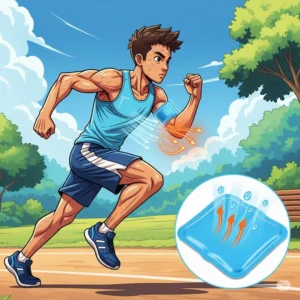
2. Ergodyne Chill-Its 6700CT Cooling Bandana — washable, slim, hard-hat friendly
The standout move here is practicality: it was built for people who sweat for a living.
The 6700CT is a cotton tie bandana with a cooling towel liner. It has a one-size-fits-most fit and a quick soak of about a minute. The manufacturer’s maximum cooling time is up to four hours, and it’s machine washable. That last detail matters more than it sounds. Evaporative gear that can’t be laundered becomes a science project by week three. A slim profile also means it slides under a hard hat or helmet without adding bulk.
On paper, “up to four hours” is a best-case ceiling. Real-world duration tracks heat, airflow, and humidity, so treat it as a re-soak-every-couple-of-hours tool in harsh conditions. Because it ties, you can wear it as a headband, neck wrap, or skull-cap liner, which makes it the most flexible product on this list.
Review data is encouraging but thin. Retail listings at one office-supply seller show ratings in the 4-to-4.8 range, though on small review counts. Style roundups also single out the Chill-Its line for lightweight comfort. I couldn’t verify large-sample review totals for this exact model, so weigh those scores accordingly.
Pros:
- ✅ Machine washable for repeated use
- ✅ Slim enough to wear under helmets
- ✅ Fast activation, about a minute
Cons:
- ❌ Needs re-wetting every few hours
- ❌ Tie closure takes longer to adjust than snaps
Typically under $15 for one, with bulk packs cheaper per unit. Check the current price. This is the best value-per-dollar pick for work settings.
3. HyperKewl 6573 Evaporative Cooling Wrist Wraps — pulse-point cooling that hides under a sleeve
Wrists are the underdog of cooling, and this pair makes the case for them.
These are 100% polyester mesh wraps with hook-and-loop closures, sold as a pair. You soak them for one to two minutes, wring them gently, and strap them on. The manufacturer promises 5 to 10 hours of cooling per soak, with no gel or crystals involved. The theory is that cooling blood near the skin surface at the wrist helps comfort overall, though a wrist wrap has far less surface area than a neck wrap. Expect a comfort boost, not a miracle.
That “5 to 10 hours” claim deserves a raised eyebrow. One reviewer who rides a motorcycle in dry 100°F-plus heat reported getting about one to two hours before swapping to a spare set. Other reviewers loved the wraps, especially when paired with a neck wrap and cooling hat. Sizing is the other theme. One reviewer with small wrists struggled to get a comfortable closure, so measure before you buy.
For uniforms, long sleeves, or desk jobs where a neck wrap would raise eyebrows, these are quietly effective. They’re also the best add-on to any neck band on this list.
Pros:
- ✅ Pair included, ready to layer with other gear
- ✅ Gel-free mesh construction, no swelling
- ✅ Discreet under cuffs and sleeves
Cons:
- ❌ Real-world cooling time is shorter than claimed
- ❌ Fit can be tricky on very small wrists
Generally under $20 for the pair at most sellers at the time of research. Prices may vary. A smart, cheap upgrade to your setup.
4. MISSION Cooling Tapered Headband — sun protection plus wet-to-cool comfort
Think of it as a sweatband that went to engineering school.
This headband uses MISSION’s wet-to-cool fabric, a polyester blend about four inches wide. The listing specs include UPF 50 sun protection, an odor-resistant finish, and machine washability. The tapered cut is meant to stay put without squeezing. The manufacturer-style listings claim cooling for up to two hours when wet. Treat that as a ceiling rather than a promise, like every evaporative product.
What does that mean for you? A headband covers the forehead and temples, which is great for perceived comfort and keeping sweat out of your eyes. But it has far less cooling area than a neck wrap. If you run, golf, hike, or lift outdoors, the combination of UPF protection and a light cooling effect is the real draw. If you need to survive a day of heavy physical labor, pair it with something bigger.
Review evidence is limited but positive in tone. One buyer called it very thin and a perfect solution. I couldn’t find large, verified review counts for this exact style, so durability and long-term cooling performance are less documented than for the other picks.
Pros:
- ✅ UPF 50 coverage for sunny workouts
- ✅ Thin, stretchy taper that resists slipping
- ✅ Machine washable and odor-resistant
Cons:
- ❌ Cooling window around two hours
- ❌ Covers a small area compared to neck wraps
Roughly $10–$20 range. Check the current price. Good value for athletes, less so for heavy-duty heat.
5. Polar Products Kool Max Cooling Neck Wrap — the strongest cold in a soft wrap
When you want actual cold rather than gentle evaporation, frozen packs deliver.
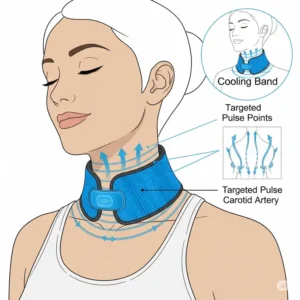
This wrap holds three segmented 3-by-9-inch Kool Max packs filled with a water-based solution, in a one-size-fits-most design. Polar Products says it cools the major arteries in the neck and offers constant cooling for up to two hours. The segmentation lets the packs flex around your neck instead of sitting like a rigid brick. Polar has specialized in medical and industrial cooling for decades, which shows in the engineering.
The honest trade-off is logistics. These packs need freezer time, so you’re planning ahead. Frozen water is intensely cold, so wearing the wrap over a thin collar or shirt is the smart move rather than pressing it against bare skin. Unlike evaporative bands, the pack approach doesn’t care about humidity, which makes it a standout for muggy regions.
I could not find verified consumer reviews for this specific neck wrap; the seller listing I checked showed none yet. The brand’s reputation rests on its vests and industrial customers, so treat it as a proven technology in a lightly reviewed package.
Pros:
- ✅ Strongest cooling punch on this list
- ✅ Works the same in humid or dry air
- ✅ Segmented packs flex to fit
Cons:
- ❌ Needs freezer access and prep time
- ❌ Roughly two-hour cooling cap
Pack-style neck wraps commonly land around $20–$40, but check the current price. Worth it for short, intense heat.
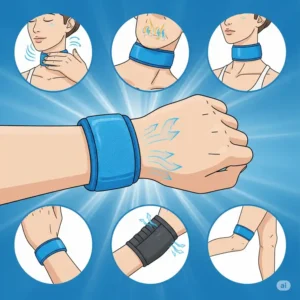
6. NOVOKOOL Neck Cooling Tube (2-Pack with Insulated Bag) — rotate one, chill one
The clever bit is the pair: wear one, keep the other cold, and you’ve got near-continuous cooling.
This set uses a phase-change material (PCM) that solidifies below about 64°F, so an ordinary refrigerator is enough to recharge it, no deep freezer required. A single charge gives up to two hours, per the listing. The included insulated bag keeps the spare cold on the go. That one accessory changes the math from “two hours and done” to “all afternoon.”
PCM works by absorbing heat as it melts, holding a steady, gentler temperature rather than blasting you with ice. That makes it more comfortable against the skin than a frozen pack, and it avoids the condensation dampness of ice. Based on category reporting, expect cooling to drop faster in direct sun and a bulkier feel on smaller necks.
I couldn’t verify review totals for this exact listing. Across PCM neck tubes generally, reviewers praise the dry, no-drip feel and complain about fit and cooling time swinging with weather. These tubes are also a common recommendation for people who want discreet cooling during hot flashes.
Pros:
- ✅ Refrigerator-friendly 64°F activation
- ✅ Two tubes plus insulated bag for rotation
- ✅ Dry cooling with no dripping
Cons:
- ❌ Cooling fades faster in direct sun
- ❌ Can feel bulky on smaller necks
Expect roughly $15–$30 for the set, though prices vary. A top pick for humid climates.
7. TORRAS COOLiFY Air — premium thermoelectric cooling with a fan
This is the one that behaves like a tiny air conditioner for your neck.
According to the manufacturer, the COOLiFY Air has three modes (cool, fan, heat) across nine power levels, a 5,000 mAh battery, and USB-C charging. Battery life ranges from about 2.5 to 24 hours depending on mode and speed, and it weighs roughly 395 grams. Noise is listed around 31 dB. Active thermoelectric cooling means it can keep working in humid air where evaporative bands stall. An independent review of an earlier COOLiFY model noted a cooling mode that actually chills air rather than just moving it.
Weight is the catch. One buying guide suggests that anything above roughly 180 grams invites neck fatigue after 90-plus minutes, and this device is more than double that. A testimonial on the manufacturer’s own page admits it’s “a little bit heavy,” so treat that quote as vendor-selected. Best Buy’s listing shows a strong score on a very small review count.
If you can wear it comfortably, the upside is real: continuous, adjustable cooling without a freezer, and a heat mode for chilly mornings.
Pros:
- ✅ Active cooling that ignores humidity
- ✅ Three modes including heat
- ✅ Long runtime on low settings
Cons:
- ❌ Heavier than other neck options
- ❌ Highest price on this list
Roughly $100–$150 range at the time of research, and thermoelectric bands as a category run about $59–$149. Check the current price. Premium value if you wear it daily.
Top 7 Cooling Bands Compared: Specs and Review Signals
| Product | Activation | Cooling Window | Upkeep | Review Signal |
|---|---|---|---|---|
| KOOLGATOR Evaporative Cooling Neck Wrap | Water soak | Claimed hours; reviewers report 30 min to a few hours | Rinse and air dry | Positive, large sample, mixed on longevity |
| Ergodyne Chill-Its 6700CT Cooling Bandana | 1-minute soak | Up to 4 hours (maker) | Machine wash | Positive, small samples |
| HyperKewl 6573 Evaporative Cooling Wrist Wraps | 1–2 minute soak | 5–10 hours claimed; 1–2 hours reported in dry heat | Spot or hand wash | Positive, fit issues noted |
| MISSION Cooling Tapered Headband | Wet fabric | Up to 2 hours (listing) | Machine wash | Positive tone, limited data |
| Polar Products Kool Max Cooling Neck Wrap | Freeze packs | Up to 2 hours (maker) | Refreeze packs | No verified reviews found |
| NOVOKOOL Neck Cooling Tube (2-Pack with Insulated Bag) | Chill below 64°F | Up to 2 hours per tube | Refrigerate | Category-level only |
| TORRAS COOLiFY Air | USB-C charge | 2.5–24 hours of battery | Charge, wipe clean | Strong but tiny sample |
The pattern is clear: cheap, evaporative bands trade cooling time for convenience, while pack and powered options trade convenience for consistency. Ergodyne Chill-Its 6700CT wins for washability, HyperKewl 6573 claims the longest window on paper, and COOLiFY Air wins for runtime. Treat every maximum as a best case, then plan for roughly half of it in harsh conditions.
✨ Ready to Cool Down Smarter?
🔍 Match your climate to the right type, then click any highlighted product name to check current pricing and availability. A few small, well-chosen cooling bands can make the hottest part of your day genuinely easier to enjoy!
How to Activate, Wear, and Maintain Cooling Bands: A Practical Usage Guide
Buying the right product is half the job. Using it properly is the other half, and this is where Amazon listings usually go quiet.
Evaporative bands (KOOLGATOR, Ergodyne Chill-Its 6700CT, HyperKewl 6573, MISSION Tapered Headband):
- Soak in cool tap water for the time on the label, usually one to two minutes.
- Wring out the excess so the fabric is damp, not dripping.
- Give it a quick snap or shake if the maker suggests it, which spreads moisture evenly.
- Place it at the neck, wrists, or forehead where it touches skin.
- Re-wet when the chill fades.
Pack and PCM bands (Kool Max Neck Wrap, NOVOKOOL tube): chill them fully before wearing, and keep the spare in the insulated bag. A thin layer between pack and skin makes frozen packs more comfortable.
Powered bands (COOLiFY Air): charge fully before a long day and wipe the contact plate with a damp cloth after use.
Common mistakes in the first 30 days: balling up a damp band in a gym bag (hello, mildew), wearing a wet band under a heavy jacket that blocks airflow, and expecting an evaporative band to work in a sauna-level humid room. Rinse bands after sweaty sessions, dry them out of direct sun, and keep spares so one is always ready.
Real-World Scenarios: Matching Cooling Bands to Your Day
Specs are abstract. Your life isn’t. Here are three profiles to make the choice concrete.
The landscaper in a dry climate. Budget under $40, outdoors eight to ten hours, five days a week. Pair a Ergodyne Chill-Its 6700CT bandana with a pair of HyperKewl 6573 wrist wraps, carry a second bandana, and re-soak at every break. Dry air is where evaporative gear shines, and machine-washable cotton survives constant use.
The humid-climate commuter or student. Budget around $30, walking two miles each way, with access to a fridge at home and school. The NOVOKOOL tube set is the logical fit: one tube on, one in the insulated bag, and no reliance on dry air. Humidity makes evaporative wraps underperform, so the PCM approach keeps this from becoming a damp-towel experience.
The office worker with unpredictable hot flashes. Budget up to $30, indoor setting, short bursts of heat. A discreet NOVOKOOL tube or the Kool Max Neck Wrap (if a freezer is nearby) gives quick relief without a visible gadget. If you prefer subtle, wrists are quieter still.
The weekend athlete or golfer. Budget around $25, mostly sun exposure. A MISSION Tapered Headband plus a KOOLGATOR wrap handles a round or a long run, with UPF 50 protection as a bonus.
For anyone wearing a pack all day, consider the COOLiFY Air, if its weight suits your neck.
Problem → Solution Guide: Fixing the Usual Cooling Band Complaints
Every product category has recurring headaches. Here are the ones reviewers mention most, and how to handle them.
“It stopped cooling after 30 minutes.” Evaporative bands fade as they dry. Start with a thorough soak, wear the band under a light layer so it doesn’t dry too fast, and carry water to re-wet. If it keeps failing, humidity is the culprit, so switch to a NOVOKOOL tube or Kool Max Neck Wrap.
“It’s dripping down my shirt.” Wring more firmly, or dab with a dry towel before wearing. The KOOLGATOR is the most commonly mentioned drip offender when freshly soaked.
“It smells funky.” Rinse after every sweaty use, then air dry flat. The Ergodyne Chill-Its 6700CT and MISSION Tapered Headband are machine washable, which makes odor management easy.
“The wrist wraps won’t close.” Measure your wrist before buying HyperKewl 6573, and consider whether a headband or neck band suits you better.
“The neck band feels heavy.” Powered options like COOLiFY Air weigh far more than passive wraps. If fatigue sets in, alternate with lighter bands.
How to Choose Cooling Bands: 6 Steps That Actually Matter
What’s the best way to choose cooling bands? Work through these six steps in order.
- Check your humidity first. Evaporative bands need dry air to shine. In humid regions, favor PCM, frozen pack, or powered options.
- Decide where it will sit. Necks give the biggest effect, wrists are discreet, and foreheads help comfort and sweat control.
- Estimate your cooling window. If you need eight hours of heat relief, plan for re-soaks, spares, or a powered band.
- Confirm your access to a fridge or outlet. No freezer means skip pack bands. No outlet means skip powered ones.
- Mind the weight. One buying guide suggests that anything over about 180 grams causes fatigue after 90-plus minutes, which matters for powered bands.
- Check washability and fit. Machine-washable fabric and adjustable closures save headaches later.
Do these six steps and you’ll probably narrow seven products to two.
How Cooling Bands Work: The Science Behind the Chill
Cooling bands rely on four basic mechanisms, and each one has quirks.
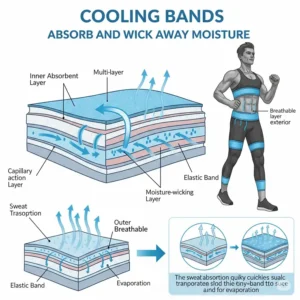
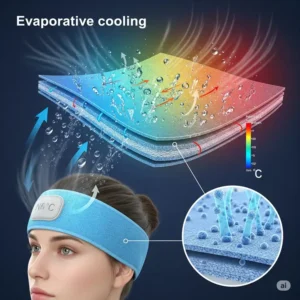
Evaporation. Water in the fabric absorbs heat as it evaporates. It takes the same trick your sweat uses, just on purpose. Evaporative cooling falls off as humidity rises.
Phase change. PCM melts at a set temperature, absorbing heat the whole time. That produces a steady, moderate chill.
Frozen packs. Ice-like packs conduct heat away fast, then warm up.
Thermoelectric. A powered chip moves heat from one side to the other.
The research here is mostly on larger garments, so interpret it carefully. In a thermal-manikin study from Cornell, researchers found that a conductive cooling vest delivered a strong but short-lived effect, while an evaporative vest cooled more gradually. A separate Lund University study found that vests with phase change materials added insulation and restricted sweat evaporation. They helped in hot humid conditions but backfired in hot dry ones.
Bands are much smaller than vests, so don’t expect lab-grade core cooling. Think comfort, not medical intervention. The pairing rule still holds: dry heat favors evaporative, humid heat favors gels, packs, and powered bands.
Cooling Bands vs Traditional Alternatives
| Option | Upfront Cost | Portability | Cooling Strength | Best For |
|---|---|---|---|---|
| Cooling bands (e.g., KOOLGATOR, NOVOKOOL tube) | Low | Excellent | Mild to moderate | Everyday outdoor and work heat |
| Handheld or neck fans | Low to medium | Good | Airflow only | Quick breezes |
| Powered neck bands (e.g., COOLiFY Air) | High | Good | Moderate to strong | Long days, humid climates |
| Cooling vests | Medium to high | Fair | Strong, whole torso | Heavy industrial heat |
| Air conditioning or shade | Varies | None | Strongest | Primary relief |
The takeaway is that cooling bands win on price and portability, while vests and air conditioning win on raw power. Powered options like COOLiFY Air sit in the middle. Fans help comfort but, as the CDC reminds us, shouldn’t be your main cooling device during extreme heat. Use bands as part of a layered plan, not a lone hero.
Common Mistakes When Buying Cooling Bands
Five mistakes crop up again and again.
Ignoring your climate. An evaporative wrap in a humid city is the classic regret purchase.
Trusting the maximum hours. Claims like 5 to 10 hours are best-case figures. Real reports are often a fraction of that.
Skipping spares. One band means one chill window. Two bands means all afternoon.
Overlooking care instructions. Some bands are machine washable, others are spot-clean only. That difference shapes how long they last.
Buying on looks alone. Patterns and colors are fun, but fit, closure, and cooling method matter more.
Long-Term Cost & Maintenance
Cost per use is where cooling bands quietly shine. This is illustrative math, not exact pricing.
An evaporative wrap in the low teens used 60 times works out to roughly 20 cents per use. A PCM neck band in the $18–$42 category range that holds up for about 50 freeze cycles, as one buying guide estimates, lands around 40 to 80 cents per use. A thermoelectric band in the $59–$149 range might keep over 80% battery capacity for 12 to 18 months with proper care, so heavy daily users can still land near a dollar or less per day.
Maintenance is minimal if you stay consistent. Rinse and dry evaporative bands, refrigerate PCM tubes properly, and charge powered bands before long days. Replace when cooling visibly declines or fabric breaks down.
Heat Safety: When Cooling Bands Aren’t Enough
Cooling bands are comfort tools, not medical devices. If you’re working or exercising in serious heat, they work best layered with the basics. OSHA’s long-standing message is “Water. Rest. Shade.” and its heat resources point to drinking water regularly, taking breaks in shade, and building tolerance gradually.
The CDC also notes that older adults, small children, and people with chronic conditions face higher risk. If you or someone nearby shows signs of heat exhaustion or heat stroke, such as confusion, fainting, or a very high body temperature, stop, get to a cooler place, and seek medical help. A band does not substitute for that.
FAQ
❓ Do cooling bands work in high humidity?
❓ How long do cooling bands stay cold?
❓ Can I wash my cooling bands?
❓ Are cooling bands good for hot flashes?
❓ Which cooling bands are best for long workdays?
Conclusion
Cooling bands won’t turn a 100-degree day into a spa weekend, but they can make the difference between gritting your teeth and getting on with your life. The smartest approach is matching the method to the weather. Dry heat suits evaporative picks like Ergodyne Chill-Its 6700CT, KOOLGATOR, and HyperKewl 6573. Humid heat favors NOVOKOOL tube and Kool Max Neck Wrap. If you want powered, adjustable cooling and can handle the weight, COOLiFY Air is the premium route. For sun-heavy workouts, MISSION Tapered Headband earns its place.
Whatever you choose, treat the listed cooling times as ceilings, carry a spare, and pair your bands with water, shade, and common sense. Do that, and these small strips of fabric and gel punch well above their weight.
✨ Don’t Miss These Picks!
🔍 Take your heat plan to the next level with these carefully selected cooling bands. Click any highlighted product name to check current pricing and availability, and stay comfortable all season long!
Recommended for You
Check out these related articles for more summer comfort solutions:
- Cool Dog Bandanas: Complete Guide to Stylish Pet Accessories in 2025
- 10 Best Nike Cooling Vest Options for Ultimate Performance in 2025
- 7 Best Techniche Cooling Vest Options For Extreme Heat Relief in 2025
Disclaimer: This article contains affiliate links. If you purchase products through these links, we may earn a small commission at no additional cost to you.
Disclaimer: This article contains affiliate links. As an Amazon Associate, I earn from qualifying purchases. If you purchase products through these links, we may earn a small commission at no additional cost to you.
✨ Found this helpful? Share it with your friends! 💬🤗
