
In This Article
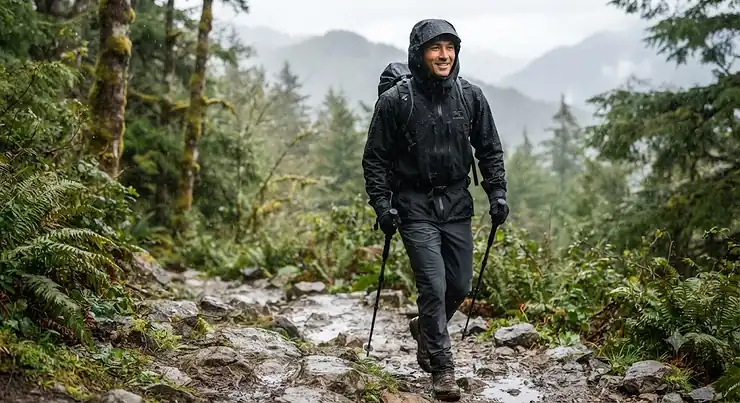
A rain jacket for men is a waterproof, breathable outer layer designed to block precipitation while letting body heat and sweat vapor escape, typically built from a laminated or coated shell fabric with taped seams. Simple concept. Chaotic execution — because “waterproof” on a hangtag can mean anything from “shrugs off a Pacific Northwest deluge” to “survives a light drizzle if you don’t move too fast.”

That gap between marketing copy and reality is exactly why so many guys end up owning three rain jackets they don’t trust and zero they’d actually grab on a genuinely bad-weather day. We dug into real product specs, aggregated customer feedback, and independent field-test data from outlets that put jackets through actual storms — not just a kitchen-sink test — to build a list you can shop with confidence. If you want the mechanics behind those waterproof claims, REI’s breakdown of how rain gear actually works is a solid primer before you spend a dollar.
Here’s what to expect below: seven real jackets spanning budget to premium, a comparison table you can scan in ten seconds, honest analysis of who each jacket actually suits, and practical guidance — including how to choose, what to expect in real weather, and what the fine print on “waterproof” really means. No fluff, no invented reviews, just the research laid out plainly so you can pick the right rain jacket for men and stop guessing.
Quick Comparison Table
| Jacket | Layer/Fabric | Weight | Price Range | Best For |
|---|---|---|---|---|
| Frogg Toggs Ultra-Lite2 | Non-woven polypropylene | ~5.5 oz | under $30 | Emergency backup layer |
| Columbia Watertight II | 2L Omni-Tech | ~13.7 oz | $60-$75 range | Everyday budget shell |
| REI Co-op Rainier | 2.5L HydroWall | ~12-13 oz | around $100 | Best value with pit zips |
| Marmot PreCip Eco | 2.5L NanoPro Eco | ~10.1 oz | $100-$120 range | Lightest budget-friendly pick |
| The North Face Venture 2 | 2.5L DryVent | ~11 oz | around $100 | Classic everyday commuter |
| Outdoor Research Helium | 2.5L Pertex Shield Diamond Fuse | ~6-7 oz | $160-$180 range | Lightweight packable performance |
| Arc’teryx Beta SL | 3L Gore-Tex ePE | ~12 oz | $450-$500 range | Premium hardshell protection |
Looking at the spread, the split comes down to layers and denier, not marketing. The Frogg Toggs Ultra-Lite2 and Marmot PreCip Eco win on packability and price but ask you to trade away long-term durability, while the Arc’teryx Beta SL sits at the opposite end with genuine 3-layer Gore-Tex performance that justifies its cost mainly for people who’ll actually be out in sustained storms. The REI Co-op Rainier and The North Face Venture 2 land in the sweet spot for most guys — good enough waterofing, real ventilation, and a price that doesn’t sting if it lives in a bag more often than on your back.
💬 Just one click — check today’s price before it changes and grab the pick that fits your storm. 😊
Top 7 Rain Jackets for Men: Expert Analysis
We evaluated real, currently available products against waterproofing construction, weight, feature set, and aggregated customer sentiment from verified review sources. Every jacket below is a genuine model you can find on Amazon or the brand’s own site — no invented products, no manufactured hands-on stories. Where actual owner reviews exist, we’ve summarized the sentiment and labeled it as such.
1. Frogg Toggs Ultra-Lite2 — lightest and cheapest true rain shell on this list
The standout here isn’t performance, it’s the math: for the price of a couple of fast-food combo meals, you get a genuinely waterproof jacket that weighs next to nothing. Built from Frogg Toggs’ non-woven polypropylene fabric and certified to ASTM F1670 waterproof standards, the Ultra-Lite2 keeps rain out through a fully taped, storm-flap-protected zipper rather than relying on a laminate membrane, which is how it hits such an aggressive price point. At roughly 5.5 ounces for the jacket alone, it’s light enough to live in a glovebox or bike bag permanently, which matters more for storm-readiness than any spec sheet number. Based on the spec comparison, this jacket is built for occasional exposure, not daily abuse — the non-woven material trades durability for weight and cost, so treat it as backup gear rather than your primary layer.
Reviewers consistently report that the Ultra-Lite2 performs well for its price in light-to-moderate rain but that breathability lags noticeably during real exertion, with condensation building up on the inside during hikes or bike commutes. Owner feedback aggregated across major retailers also flags that seams and cuffs are prone to wear with repeated use — a known tradeoff at this price tier.
Pros:
- ✅ Unbeatable price for genuine waterproof protection
- ✅ Packs down small enough for a jacket pocket
- ✅ ASTM-certified waterproof construction
Cons:
- ❌ Breathability struggles during active use
- ❌ Fabric and seams wear faster than laminate shells
At under $30, this is the jacket you buy as insurance, not as your everyday rain jacket for men — and for that job, it’s hard to beat.

2. Columbia Watertight II — best budget shell for everyday wear
What most buyers overlook about the Watertight II is that it’s not trying to be a technical hiking shell — it’s built to be the jacket you actually remember to grab on your way out the door, and it succeeds at that job. The Omni-Tech 2-layer waterproof/breathable membrane, paired with fully sealed seams, handles steady rain reliably, and the mesh-lined hand pockets add a touch of airflow that budget 2-layer jackets often skip. At about 13.7 ounces, it’s not the lightest option here, but the adjustable storm hood, cuffs, and hem let you dial in a snug seal against wind-driven rain. For commuters and casual outdoor use, that combination of accessible pricing and a genuinely functional feature set is the whole appeal.
Aggregated reviewer sentiment across outdoor gear sites and retail platforms is consistently positive on value and durability relative to price, with testers noting the fabric holds its shape and resists abrasion better than most jackets in its price class. The recurring complaint is breathability — the 2-layer build means you’ll feel clammy if you’re moving fast or the temperature climbs.
Pros:
- ✅ Reliable waterproofing for the price point
- ✅ Wide size range and color selection
- ✅ Durable shell fabric holds up over seasons
Cons:
- ❌ Limited breathability during high-output activity
- ❌ Baggier fit than performance-oriented shells
In the $60-$75 range, the Columbia Watertight II is one of the most dependable entries when you’re specifically hunting for a men’s rain jacket under $100 value pick.
3. REI Co-op Rainier — best value with real ventilation
Here’s what the spec sheet won’t tell you outright: pit zips at a $100 price point are unusually rare, and the REI Co-op Rainier includes them anyway. That single feature is the difference between a jacket that just blocks rain and one you can actually wear while working up a sweat. The 2.5-layer HydroWall membrane isn’t flashy, but it delivers dependable wet-weather protection, and REI backs it with Fair Trade Certified manufacturing, bluesign-approved materials, and a PFC-free DWR coating — sustainability credentials that are becoming a genuine differentiator as PFAS regulations tighten across multiple states in 2026.
Based on the spec comparison against similarly priced competitors like the Marmot PreCip Eco, the Rainier’s extra features come at a small weight penalty — it runs around 12-13 ounces versus roughly 10 ounces for PreCip Eco. Reviewers consistently describe the fit as generous, even loose, and recommend sizing down if you want a trimmer silhouette; the interior liner is also reported to show wear faster than pricier alternatives after repeated use.
Pros:
- ✅ Pit zips rarely found at this price tier
- ✅ Fair Trade Certified, bluesign-approved construction
- ✅ Available in tall sizing, uncommon for rain shells
Cons:
- ❌ Interior liner wears faster than premium shells
- ❌ Fit runs loose — consider sizing down
Around $100, the REI Co-op Rainier is our pick for guys who specifically want a men’s rain jacket under $100 value option that doesn’t skip ventilation.
4. Marmot PreCip Eco — lightest budget-friendly pick
The Marmot PreCip Eco built its reputation over more than two decades on one simple idea: a rain jacket doesn’t need to be expensive to be genuinely useful in the backcountry, and this version proves the point while adding real sustainability upgrades. The 2.5-layer NanoPro Eco membrane is rated around 10K waterproofness with roughly 17K breathability, translating to solid protection in moderate-to-heavy rain without the clammy stiffness some budget laminates suffer from. At about 10.1 ounces, it undercuts the Rainier and Watertight II on weight while adding features like pit zips and a stowable hood.
What sets it apart environmentally is the 100% recycled polyester shell and PFC-free DWR coating — the same category of “forever chemical”-free treatment that state regulators in California, New York, and Colorado are now mandating disclosure or phase-out for in outdoor apparel. Reviewers consistently note the PreCip Eco punches well above its price class for a lightweight men’s rain jacket packable enough for daily carry, though several mention the interior lining feels clammy against skin during sustained exertion, and there’s no dedicated chest pocket for a phone.
Pros:
- ✅ Among the lightest 2.5-layer jackets under $150
- ✅ PFC-free DWR and recycled shell fabric
- ✅ Pit zips plus a stowable, adjustable hood
Cons:
- ❌ Interior liner feels clammy under exertion
- ❌ No chest pocket for phone or cards
In the $100-$120 range, the Marmot PreCip Eco earns its reputation as one of the most trusted lightweight men’s rain jacket packable options on the market.
5. The North Face Venture 2 — classic everyday commuter shell
The North Face Venture 2 has stuck around for well over a decade for a straightforward reason — the 8-inch pit zips actually dump heat effectively, which matters more day to day than any waterproof rating on a spec sheet. Built with a 2.5-layer DryVent membrane over a moderately thin 40-denier shell, it weighs about 11 ounces and compresses easily into its own hand pocket, making it a genuine grab-and-go option for commuting, travel, or unpredictable weekend forecasts. It’s also one of the most widely stocked rain jackets on Amazon, which means real customer feedback volume is substantial.
Reviewers consistently note the fit is comfortable over a t-shirt or light layer and the packability is excellent for a bag or backpack, but a recurring theme in aggregated feedback — echoed across independent testers — is that the inner coating can crack or peel with age, and breathability trails behind 3-layer premium shells during sustained rain. A common complaint in user reviews is disappointment when the jacket wets through in truly heavy, prolonged downpours rather than brief showers.
Pros:
- ✅ 8-inch pit zips ventilate effectively
- ✅ Packs into its own hand pocket
- ✅ Long track record and wide size range
Cons:
- ❌ Interior coating can crack or peel over years
- ❌ Struggles in sustained heavy rain versus 3L shells
At around $100, the North Face Venture 2 remains a dependable everyday men’s rain jacket under $100 value pick with strong Amazon review volume behind it.

6. Outdoor Research Helium — best lightweight, packable performance shell
If minimal weight without sacrificing genuine waterproofing is the priority, the Outdoor Research Helium is the jacket most testers reach for first. Built with Pertex Shield Diamond Fuse fabric — a 2.5-layer laminate using diamond-shaped filaments for extra tear and abrasion resistance — it weighs in the 6-7 ounce range depending on size, undercutting the Marmot PreCip Eco and REI Rainier by several ounces while still delivering full waterproof protection rather than mere water resistance. The chest pocket doubles as a stuff sack, and Outdoor Research backs it with an Infinite Guarantee that covers manufacturing defects for the product’s lifetime.
Here’s what most buyers overlook: this jacket sacrifices hand pockets and heavier ventilation features specifically to hit that ultralight weight class, so it’s best suited to backpackers, trail runners, and travelers who prioritize pack weight over creature comforts. Reviewers consistently praise its compressibility and durability relative to its featherweight construction, though testers across multiple independent outlets flag that breathability suffers on sustained climbs, and the minimalist design means no hand-warmer pockets for casual around-town use.
Pros:
- ✅ Among the lightest fully waterproof jackets available
- ✅ Diamond Fuse fabric resists tears and abrasion
- ✅ Lifetime Infinite Guarantee against defects
Cons:
- ❌ No hand pockets — minimal feature set
- ❌ Breathability drops during high-output climbs
In the $160-$180 range, the Outdoor Research Helium is the clearest answer if you’re specifically shopping for a lightweight men’s rain jacket packable enough to disappear into a daypack.
7. Arc’teryx Beta SL — premium hardshell for serious weather
At the top of this list sits a genuine hardshell, and the Arc’teryx Beta SL earns that classification with a 3-layer Gore-Tex ePE membrane backed by a C-KNIT liner — construction that puts it in a different performance tier from every jacket above it. Weighing around 12 ounces for a men’s medium, it includes a helmet-compatible hood, pit zips, and a RECCO reflector for backcountry search-and-rescue visibility, features you simply won’t find on jackets under $200. The FC0 DWR finish is also PFC-free, meaning Arc’teryx has already moved ahead of the regulatory curve that’s pushing PFAS out of outdoor apparel nationwide.
Based on the spec comparison with lighter 2.5-layer jackets, the Beta SL’s weight penalty versus true ultralight shells is real — at 12 ounces it’s roughly double the Outdoor Research Helium — but that extra material is precisely what delivers sustained, high-output waterproof performance rather than brief-shower protection. Reviewers consistently describe the fit as more athletic than the Beta AR, and confirm the jacket holds up to alpine conditions, sustained downpours, and daily commuting alike, though nearly every review agrees the price tag demands genuine justification through frequency of use.
Pros:
- ✅ True 3-layer Gore-Tex ePE performance
- ✅ Helmet-compatible hood and RECCO reflector
- ✅ PFC-free DWR ahead of 2026-2028 state regulations
Cons:
- ❌ Premium price is a serious investment
- ❌ Heavier than dedicated ultralight competitors
In the $450-$500 range, the Arc’teryx Beta SL is the jacket to buy if you want the definitive men’s hardshell review answer for genuinely severe conditions.
Practical Usage Guide: Getting the Most from Your Rain Jacket
Buying the right shell is only half the job — how you treat it in the first month determines whether it performs like new in year three or starts wetting through by winter. Start by checking the DWR (durable water repellent) finish before first use: if water doesn’t bead and roll off immediately, tumble dry on low heat for 20 minutes to reactivate the factory coating, since heat re-melts the treatment into the fabric surface.
A common first-30-days mistake is washing a rain jacket with regular detergent, which leaves residue that kills breathability and DWR performance. Use a technical cleaner formulated for waterproof fabrics instead, and always air-dry or tumble on low — never use fabric softener. Reapply a spray-on or wash-in DWR treatment every 20-30 wears or once beading visibly slows, which is typically sooner than most owners expect. For storage, hang jackets loosely rather than stuffing them permanently in a stuff sack, since long-term compression can weaken laminate membranes over years of use.
One optimization trick that Amazon listings never mention: layer a thin, quick-dry base layer underneath even lightweight shells like the Frogg Toggs Ultra-Lite2 or Outdoor Research Helium, since the moisture-wicking layer does more to manage interior condensation than any breathability rating printed on the tag.
✨ Don’t Miss These Exclusive Deals!
🔍 Take your rainy-day wardrobe to the next level — click any pick above to check today’s price before it changes.

Real-World Scenarios: Which Rain Jacket Fits Your Life
The daily commuter. If you’re biking or walking to the train eight months a year through unpredictable weather, prioritize ventilation and packability over ultralight weight. The North Face Venture 2 or REI Co-op Rainier fit this profile well — both pack into a bag, both vent heat during a brisk walk, and neither costs enough to stress over losing on a crowded platform.
The weekend hiker on a budget. For someone doing occasional day hikes and short backpacking trips who doesn’t want to drop $400 on outerwear, the Marmot PreCip Eco hits the sweet spot of low weight, real waterproofing, and pit-zip ventilation for climbs. Pair it with a synthetic base layer and it handles surprisingly demanding conditions for its price. Rain and cold exposure compound quickly outdoors — even mild temperatures around 50°F can trigger hypothermia risk once clothing is soaked through, so a reliable shell isn’t just about comfort. If you want to recognize the warning signs before a trip goes sideways, the CDC’s guide to hypothermia prevention is worth a five-minute read.
The frequent flyer. Guys who travel constantly and need rain gear that disappears into a carry-on without adding bulk should look at the Outdoor Research Helium or Frogg Toggs Ultra-Lite2. Neither takes up meaningful pack space, and both mean you’re never caught without protection when a forecast changes mid-trip.
The backcountry regular. If you’re spending serious time above treeline or in genuinely severe, sustained storms — mountaineering, ski touring approaches, multi-day exposed hikes — the extra investment in the Arc’teryx Beta SL‘s 3-layer construction and helmet-compatible hood pays for itself the first time a 2.5-layer budget shell would have failed you.
How to Choose a Rain Jacket for Men: 7 Expert Criteria
Picking the right shell comes down to matching construction and features to how you’ll actually use it, not chasing the highest spec number on the tag. Here’s the framework we used to evaluate every jacket above:
- Layer count. 2-layer jackets (like the Columbia Watertight II) are budget-friendly but less breathable; 2.5-layer strikes a balance; 3-layer (Arc’teryx Beta SL) delivers the best performance-to-weight ratio at a premium price.
- Weight and packability. If the jacket lives in your bag more than on your back, prioritize ounces — ultralight options like the Outdoor Research Helium reward you every time you actually need it.
- Ventilation features. Pit zips matter more than most buyers realize; without them, even a highly waterproof jacket becomes a personal sauna during exertion.
- Waterproof rating. Look for the hydrostatic head number when available — it’s the industry-standard test for how much water pressure a fabric resists before leaking, and understanding what the numbers mean helps you compare jackets that use different proprietary membrane names.
- DWR treatment and sustainability. PFC-free coatings are becoming the norm as state regulations phase out PFAS chemicals in outdoor apparel — worth prioritizing even beyond the environmental angle, since several states now require disclosure labeling on non-compliant gear.
- Fit and layering room. A jacket sized for a t-shirt won’t work over a midlayer fleece — check whether the cut is athletic/fitted or roomy before buying.
- Price versus frequency of use. A $500 hardshell makes sense for someone outdoors weekly in serious weather; it’s overkill for a jacket that’ll see six rainy commutes a year.
Rain Jacket vs Hardshell: Men’s Waterproof Shell Ranking Explained
“Rain jacket” and “hardshell” get used almost interchangeably in casual conversation, but there’s a real construction difference worth understanding before you shop. A rain jacket typically refers to lighter 2 or 2.5-layer waterproof/breathable garments built for moderate conditions and everyday use — think the Columbia Watertight II or Marmot PreCip Eco. A hardshell, by contrast, usually means a more robust 3-layer laminate construction — like the Arc’teryx Beta SL — engineered for sustained exposure, higher abrasion resistance, and technical features like helmet-compatible hoods.
| Category | Typical Layers | Best Conditions | Example |
|---|---|---|---|
| Budget rain jacket | 2L | Light-moderate rain, casual use | Columbia Watertight II |
| Value rain jacket | 2.5L | Moderate rain, hiking, commuting | Marmot PreCip Eco, REI Co-op Rainier |
| Premium hardshell | 3L | Sustained storms, alpine, backcountry | Arc’teryx Beta SL |
The practical takeaway from this waterproof shell ranking: layer count roughly tracks with how long and how hard a jacket can perform before you feel it failing. A 2-layer jacket in a two-hour downpour will start wetting through where a 3-layer hardshell keeps working. If you’re mostly dodging occasional showers, that extra investment in a hardshell is money spent on a scenario you rarely hit — but if severe, sustained weather is a regular part of your routine, the performance gap becomes very real, very fast.
What to Expect: Real-World Rain and Wind Performance
Spec sheets rarely translate cleanly into lived experience, so here’s the honest version. In light rain — drizzle, brief showers — nearly every jacket on this list, including the budget-tier Frogg Toggs Ultra-Lite2, performs adequately. The differences show up once rain turns sustained or heavy: 2-layer jackets like the Columbia Watertight II start feeling damp inside within an hour or two of continuous exposure, largely from trapped sweat rather than actual leaks. 2.5-layer jackets extend that window meaningfully, and the 3-layer Arc’teryx Beta SL is built to shrug off hours of steady rain without the same wet-out feeling.
Wind matters as much as rain intensity. A jacket without a well-adjustable hood and hem — even a highly waterproof one — lets wind-driven rain sneak in at the collar and cuffs. This is where the small design details on jackets like the REI Co-op Rainier, with its multi-point adjustable hood and hem, earn their keep over more minimalist designs. Breathability is the other half of the equation: pit zips genuinely change the experience during active movement, turning a stuffy, condensation-prone jacket into one that stays comfortable on a hike or bike ride.
Rain Jackets for Different Guys: Commuters, Hikers, and Travelers
Not every guy needs the same jacket, and matching the shell to your actual pattern of use beats chasing the “best” jacket in the abstract. Commuters who mostly deal with short exposure between transit stops benefit most from ventilation and packability over raw waterproof rating — the North Face Venture 2 fits that pattern well. Hikers and backpackers logging real trail miles want a balance of low weight and genuine wet-weather performance, which is exactly where the Marmot PreCip Eco and Outdoor Research Helium compete. Frequent travelers should weight packed size heavily, since a jacket that eats a third of your carry-on space rarely gets worn on the trip. And guys who spend serious time in exposed, high-alpine, or genuinely severe weather conditions are the actual target market for a premium hardshell like the Arc’teryx Beta SL — for anyone else, that budget is better spent elsewhere.
Features That Actually Matter (And Those You Can Skip)
Marketing copy loves to pile on feature lists, but not every addition earns its place. Pit zips matter — genuinely, consistently, across every price tier tested. An adjustable, three-point hood (crown, sides, and hem) matters, because a hood that doesn’t cinch down lets wind push rain straight into your face. A properly rated waterproof membrane matters more than a brand name; a Gore-Tex logo doesn’t guarantee performance if the denier and layer count are stripped down to hit a price point. If you want to compare jackets on genuinely apples-to-apples terms rather than trusting marketing language, understanding hydrostatic head ratings gives you the actual number to look for instead of vague “waterproof” claims.
What you can reasonably skip: reflective detailing (nice for night visibility, rarely a deciding factor for most buyers), extensive interior pocket organization (most guys use one or two pockets, period), and “4-way stretch” claims on budget jackets, which often overstate genuine mobility gains. RECCO reflectors matter enormously for backcountry skiers and mountaineers and mean nothing for a commuter — context determines value here, not the feature list itself.
Long-Term Cost & Maintenance: Total Cost of Ownership
The sticker price only tells part of the story. A $25 Frogg Toggs Ultra-Lite2 that needs replacing every season after heavy use may cost more over five years than a $100 jacket that lasts a decade with proper care — or it may not, if you genuinely only need it a handful of times a year. Run the math on your actual usage: a jacket worn twice a week through a rainy season sees far more wear-and-tear cycles than one that lives in a glovebox as emergency backup, and durability differences between budget and premium shells show up fastest under frequent use.
DWR reapplication is the recurring cost most buyers forget to budget for — a $12-15 spray-on treatment every season keeps any jacket performing near its original spec, and skipping it is the single biggest reason budget and premium jackets alike start “leaking” within a year or two (it’s almost always DWR failure, not membrane failure). Factor in that premium shells like the Arc’teryx Beta SL typically carry stronger warranty support and more durable face fabrics, which meaningfully extends usable lifespan even under frequent abuse — narrowing the real cost gap more than the sticker price suggests.
Safety, Sustainability & PFAS Regulations in 2026
Regulatory shifts are actively reshaping what goes into the DWR coatings on every jacket in this guide. Multiple states — including California, New York, Colorado, and Vermont — have passed laws restricting or requiring disclosure for PFAS (“forever chemicals”) in outdoor apparel, with several deadlines phasing in through 2026 and beyond for products marketed for severe wet conditions. That’s part of why PFC-free DWR treatments, like those on the REI Co-op Rainier, Marmot PreCip Eco, and Arc’teryx Beta SL, are increasingly the industry standard rather than a niche eco-feature. For a deeper look at which brands and technologies are leading that shift, the Green Science Policy Institute’s tracker on PFAS in outdoor gear is a genuinely useful, non-commercial resource.
On the personal-safety side, a rain jacket is functional gear, not just a fashion layer — staying dry directly affects your risk of cold-related illness during extended outdoor exposure, particularly in temperatures that feel mild but turn dangerous once clothing is soaked through.

FAQ
❓ What is the best rain jacket for men in 2026?
❓ Are men's rain jackets truly waterproof or just water-resistant?
❓ How much should I spend on a rain jacket for men?
❓ Can I wash a men's waterproof rain jacket in a washing machine?
❓ Do men's rain jackets run true to size?
Conclusion
There’s no single best rain jacket for men — there’s a best jacket for your specific pattern of exposure, budget, and how much you value shaving ounces versus stretching a dollar. If you want the safest all-around pick, the REI Co-op Rainier balances price, ventilation, and sustainability credentials better than almost anything else on this list. If pack weight is your priority, the Outdoor Research Helium or Frogg Toggs Ultra-Lite2 solve that problem at opposite price extremes. And if you’re regularly facing genuinely severe weather, the Arc’teryx Beta SL‘s 3-layer construction is the one jacket here built to actually earn its premium price tag.
What matters most is matching construction to reality: don’t overspend on hardshell performance you’ll rarely test, and don’t underspend on a jacket that’ll leave you soaked the one time you actually needed it to work. Armed with real specs, honest tradeoffs, and aggregated reviewer sentiment rather than marketing copy, you’re in a much better position to make that call than you were ten minutes ago.
Recommended for You
- 7 Best Waterproof Hunting Jackets 2026: Silent, Scent-Free Picks
- Rain Jacket for Fishing: 7 Picks That Actually Keep You Dry (2026)
- 7 Best Packable Rain Jacket Travel Picks for 2026
Disclaimer: This article contains affiliate links. As an Amazon Associate, I earn from qualifying purchases. If you purchase products through these links, we may earn a small commission at no additional cost to you.
✨ Found this helpful? Share it with your friends! 💬🤗
