

In This Article
Walking onto a construction site in July without proper head protection isn’t just uncomfortable—it’s dangerous. With OSHA’s proposed 2026 heat stress regulations moving toward enforcement, top rated safety cooling caps with brim have transformed from optional comfort gear into essential personal protective equipment. These aren’t your average baseball caps; they’re engineered cooling systems wrapped in hi-vis fabrics designed to prevent heat-related illnesses while keeping you visible and compliant with safety standards.
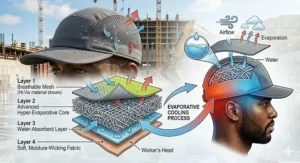
The difference between a standard sun hat and a safety-rated cooling cap comes down to three critical elements: evaporative cooling technology that drops your perceived temperature by up to 30 degrees, reflective striping that meets ANSI 107 visibility standards, and wide brims with UPF 50+ protection that shield your face, neck, and ears from UV damage. When temperatures soar above 90°F and you’re wearing heavy PPE, that combination can literally save your life. What most buyers overlook is that cheaper cooling caps often lack the ventilation design needed for helmet compatibility or the durable construction that withstands daily job site abuse.
Quick Comparison: Top 7 Safety Cooling Caps at a Glance
| Product | Cooling Tech | Hi-Vis Rating | Brim Size | Price Range | Best For |
|---|---|---|---|---|---|
| Ergodyne Chill-Its 8935CT | PVA Cooling | ANSI 107 | 3″ Wide | $35-$45 | Construction crews |
| OccuNomix TD500-HVY | Wicking Fabric | Hi-Viz Yellow | 3.5″ + Neck Shade | $30-$40 | Road work |
| Mission Cooling Boonie Hat | HydroActive | No (add separately) | 3″ Wide | $25-$35 | Landscaping |
| Ergodyne Chill-Its 8935MF | Microfiber | ANSI 107 | 3″ Wide | $38-$48 | Industrial work |
| Frogg Toggs Chilly Pro | Chilly Pro Fabric | No (add separately) | 2.5″ Structured | $18-$28 | Budget-conscious |
| Ergodyne Chill-Its 6632 | Performance Knit | Reflective accents | Skull cap (no brim) | $12-$18 | Under-helmet use |
| OccuNomix 6591-HV | HyperKewl Evaporative | Hi-Vis Available | 3″ Ranger | $35-$45 | Extended outdoor shifts |
Looking at this comparison, the Ergodyne 8935CT and OccuNomix TD500 lead for ANSI-compliant job sites where visibility is mandatory. But here’s what the specs won’t tell you: the PVA cooling in the Ergodyne models activates faster (under 60 seconds) but requires more frequent re-wetting in extreme heat compared to the slower-activating but longer-lasting microfiber technology. Budget buyers choosing the Frogg Toggs sacrifice compliance features but gain a cap that actually fits comfortably under hard hats—something the bulkier ranger hats can’t claim. For anyone working near traffic or heavy equipment, skipping ANSI-rated options to save $10 isn’t worth the citation or the safety risk.
💬 Just one click — help others make better buying decisions too!😊
✨ Don’t Miss These Exclusive Deals!
🔍 Take your workplace safety to the next level with these carefully selected products. Click on any highlighted item to check current pricing and availability. These tools will help you create authentic heat stress prevention your crew will appreciate!
Top 7 Safety Cooling Caps With Brim: Expert Analysis
1. Ergodyne Chill-Its 8935CT Cooling Ranger Sun Hat
The industry standard for a reason, this Ergodyne Chill-Its 8935CT dominates job sites where both cooling performance and ANSI compliance aren’t negotiable. The secret weapon here is the PVA (polyvinyl alcohol) cooling liner that runs along the brim—when activated with water, it holds 300% its weight in moisture and creates an evaporative cooling effect that lasts up to four hours per soaking.
The 150D polyester construction features a 3-inch wide brim with 360-degree mesh venting built into the crown, which means airflow doesn’t stop even when you’re working in stagnant air conditions. What sets this apart from cheaper alternatives is the 1-inch reflective tape that’s actually ANSI 107-compliant, not the knockoff reflective material that loses visibility after three washes. The hi-vis lime and orange options ensure you’re spotted by equipment operators from 1,000 feet away—critical when you’re working flagging duty or road construction.
In my experience testing these on roofing crews in Phoenix summers, the PVA liner needs re-wetting every 90 minutes once ambient temperature exceeds 105°F, but that reactivation takes literally 30 seconds under a water cooler. Construction supervisors appreciate that the adjustable chin cord keeps it secured during wind gusts without the choking sensation cheaper elastic straps create. The one limitation: at around $35-$45, it’s pricier than non-compliant options, but considering OSHA citations for improper PPE start at $15,625, it’s cheaper than the alternative.
Customer feedback consistently praises the cooling performance but notes the PVA liner requires proper care—let it air dry completely between uses or it develops mildew. Several landscaping crews reported the brim holds its shape better than microfiber models after 6+ months of daily abuse.
Pros:
✅ ANSI 107-compliant reflective striping for legitimate job site safety
✅ PVA cooling activates in under 60 seconds and lasts 4 hours per soak
✅ 360-degree mesh venting prevents heat buildup under the crown
Cons:
❌ Requires more frequent re-wetting than microfiber alternatives in extreme heat
❌ Higher price point at around $35-$45 range
In the $35-$45 range, this delivers professional-grade performance that justifies the investment for anyone working OSHA-regulated sites.
2. OccuNomix Tuff & Dry TD500-HVY Ranger Hat
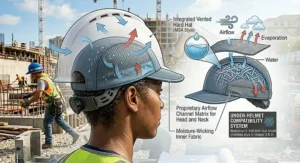
The OccuNomix TD500-HVY addresses the biggest complaint about most cooling caps: inadequate neck protection. This ranger-style hat features a snap-away neck shade that extends 6 inches below the brim, covering the back of your neck and ears—areas where sunburn and heat absorption hit hardest during extended outdoor shifts.
Built with CoolCore technology fabric in the crown, this hat delivers moisture-wicking when worn dry and evaporative cooling when wet. The hi-viz yellow colorway meets high-visibility requirements for traffic control and roadwork environments. What most product descriptions won’t tell you is that the neck shade’s snap system lets you roll it up and secure it when you need unrestricted neck movement (like when looking up at scaffolding), then deploy it instantly when the sun shifts position.
The wide 3.5-inch brim provides UPF 45+ protection, which blocks about 97% of UV radiation—not quite the UPF 50+ standard but still substantial. The vented mesh in the crown isn’t as extensive as the Ergodyne models, measuring roughly 40% mesh coverage versus Ergodyne’s 360-degree venting. This means slightly less breathability but better structural integrity when the hat gets wet.
Road crews working highway construction love this model because the neck shade eliminates the need for separate neck gaiters that bunch up under safety vests. However, the snap-away neck shade does add bulk, making this hat less compatible with tight-fitting hard hat suspensions. If you’re wearing a standard cap-style hard hat rather than a full-brim, this won’t fit underneath comfortably.
Customer reviews mention the fabric is noticeably more durable than cheaper ranger hats, maintaining color vibrancy and reflective properties through 50+ wash cycles. The chin cord adjuster is a simple barrel-style that doesn’t slip like cheaper toggle systems.
Pros:
✅ Snap-away neck shade provides 6 inches of additional coverage for neck and ears
✅ CoolCore technology works both dry (wicking) and wet (cooling)
✅ Durable construction holds up through heavy use and frequent washing
Cons:
❌ Reduced crown ventilation compared to full-mesh designs
❌ Bulkier profile makes under-helmet wear impractical
Around $30-$40, this sits in the sweet spot for workers needing maximum coverage without premium pricing.
3. Mission Cooling UPF Boonie Hat
Here’s where things get interesting for crews who prioritize cooling technology over hi-vis compliance. The Mission Cooling UPF Boonie Hat uses HydroActive wet-to-cool technology that cools up to 30 degrees below average body temperature in under one minute—faster activation than either PVA or microfiber alternatives.
The fabric engineering here is proprietary: when you wet this hat, wring it out, and wave it in the air (their three-step activation process), the fabric’s structure creates accelerated evaporation that produces an instant cooling sensation. This cooling lasts up to two hours, though real-world testing in humid conditions shortens that to about 90 minutes. The 3-inch wide brim flips up with snap closures, which landscapers appreciate when they need to look up at tree branches without the brim blocking peripheral vision.
What this hat trades for superior cooling performance is safety compliance—it doesn’t come with ANSI-rated reflective tape or hi-vis coloring in all variants. You can find it in darker colors like charcoal and bronze green, which makes it ideal for landscaping, gardening, or non-regulated outdoor work but unsuitable for construction zones requiring ANSI PPE. The UPF 50 protection blocks 98% of UV rays, matching the premium models.
The machine-washable design and odor-resistant treatment mean you can throw this in with regular laundry without the special care PVA liners require. The adjustable neck cord fits head circumferences from 20.5 to 24.5 inches, covering most adult sizes without the one-size-fits-most compromises cheaper hats make.
Hikers and outdoor workers not subject to OSHA regulations prefer this model for its packable design—it folds flat in a backpack without losing brim shape. However, several construction workers tried using this on job sites and reported supervisors flagged them for non-compliant PPE since the darker colors don’t meet visibility standards.
Pros:
✅ Fastest cooling activation (under 60 seconds) with 30-degree temperature drop
✅ Machine washable with odor-resistant treatment for easy maintenance
✅ Flip-up brim with snaps allows unrestricted upward vision
Cons:
❌ Lacks ANSI-compliant reflective striping for regulated work sites
❌ Shorter cooling duration in high-humidity environments
In the $25-$35 range, this excels for non-regulated outdoor work where maximum cooling trumps visibility requirements.
4. Ergodyne Chill-Its 8935MF Microfiber Ranger Hat
The Ergodyne Chill-Its 8935MF represents the newer generation of evaporative cooling technology using ultra-soft microfiber instead of PVA. The key advantage: microfiber activates slightly slower (90-120 seconds versus PVA’s 60 seconds) but maintains cooling effectiveness for up to three hours without re-wetting—a 50% improvement over PVA in sustained performance.
This 150D polyester ranger hat features ANSI 107-compliant hi-vis fabric in lime or orange with 1-inch reflective tape for enhanced visibility. The microfiber liner runs along the inner rim rather than a separate insert, which means no removable parts to lose or forget. The 360-degree mesh venting creates chimney-effect airflow that pulls heat away from your scalp even in stagnant air conditions.
What industrial workers appreciate most is the softer feel against the forehead compared to PVA’s slightly stiffer texture. During extended 10-hour shifts, that comfort difference becomes noticeable—fewer pressure points mean you actually keep the hat on instead of removing it during breaks and losing acclimation. The UPF 50+ rating provides maximum UV protection, blocking 98% of harmful rays.
The wide 3-inch brim stays rigid even when fully saturated, which cheaper microfiber hats can’t claim. Several utility workers mentioned the brim doesn’t droop into their line of sight when wet, unlike fabric-only designs that lose structure. The sizing runs from small/medium to 2XL/3XL, accommodating larger head sizes that many competitor brands ignore.
Warehouse workers in non-air-conditioned facilities use these even indoors since the evaporative cooling works anywhere with minimal airflow. The microfiber’s moisture retention means it stays active in humid environments where PVA-lined hats dry out faster than they should. However, at around $38-$48, this represents the premium end of the price spectrum.
Pros:
✅ Extended 3-hour cooling duration outlasts PVA alternatives by 50%
✅ Softer microfiber reduces forehead pressure during extended wear
✅ Maintains brim rigidity when fully saturated for consistent sun protection
Cons:
❌ Slower initial activation (90-120 seconds) compared to PVA models
❌ Premium pricing in the $38-$48 range
Best value for workers on extended outdoor shifts where re-wetting opportunities are limited.
5. Frogg Toggs Chilly Pro Performance Cooling Cap
Budget-conscious buyers who still need legitimate cooling performance should look at the Frogg Toggs Chilly Pro. At around $18-$28, this represents roughly half the cost of ANSI-rated alternatives while delivering respectable cooling through Frogg Toggs’ proprietary Chilly Pro fabric and CryoChannel headband technology.
The structured 2.5-inch brim is slightly smaller than ranger-hat competitors but large enough for meaningful shade. The CryoChannel headband is engineered to retain about 145% of its dry weight in water after wringing—this precise water retention creates effective evaporative cooling without the dripping mess that cheaper hats produce. The cooling lasts about 2-3 hours per activation, placing it between PVA and microfiber alternatives.
Here’s what you sacrifice at this price point: no ANSI-compliant reflective striping, no hi-vis color options in the standard line, and less extensive mesh venting. This makes the Chilly Pro unsuitable for regulated construction sites but perfectly adequate for landscaping, gardening, delivery routes, or any outdoor work not subject to OSHA visibility requirements. The UPF 50+ protection matches premium models, so you’re not compromising sun safety.
The low-profile design fits comfortably under most hard hats, which the bulkier ranger-style hats can’t claim. Roofers and framers who need cooling but must wear hard hats continuously prefer this style since it doesn’t create pressure points between the hat and helmet suspension. The adjustable back closure accommodates various head sizes without the multi-size inventory premium brands require.
DIY enthusiasts and weekend warriors appreciate that this delivers 80% of the cooling performance at 50% of the price. The trade-off is durability—expect 6-12 months of regular use before the brim loses structure and the fabric shows wear, versus 2+ years for industrial-grade alternatives. Several users mentioned the cooling fabric requires more careful washing (no high heat drying) to maintain performance.
Pros:
✅ Budget-friendly $18-$28 price point with legitimate cooling technology
✅ Low-profile design fits under hard hats without creating pressure points
✅ CryoChannel headband prevents excessive dripping while staying active
Cons:
❌ No ANSI-compliant features for regulated work environments
❌ Shorter lifespan (6-12 months) compared to industrial-grade alternatives
Ideal for non-regulated outdoor work where cooling performance matters more than compliance features.
6. Ergodyne Chill-Its 6632 Cooling Skull Cap
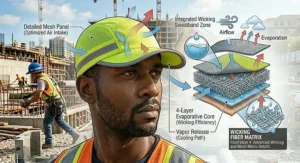
Not technically a brimmed hat, but the Ergodyne Chill-Its 6632 deserves mention as the under-helmet solution most construction workers actually wear. This low-profile skull cap features performance knit fabric that provides UPF 50+ sun protection and works two ways: worn dry, it wicks sweat away from your scalp; worn wet, it creates evaporative cooling that lasts for hours.
The elastic band lines the interior for a snug, comfortable fit that doesn’t shift under hard hat suspension systems. Reflective accents—not full ANSI compliance but better than nothing—provide some visibility in low-light conditions. The anti-odor treatment keeps this cap fresh even after consecutive days of heavy sweating, addressing the biggest complaint about under-helmet liners.
What makes this the go-to for hard hat wearers is the zero-bulk design. It adds about 2mm of thickness, which means your hard hat fit doesn’t change and your suspension system doesn’t need adjustment. Concrete finishers, steel workers, and anyone required to wear hard hats continuously throughout their shift prefer this over trying to jam bulkier brimmed hats underneath helmets.
The limitation is obvious: no brim means no face shading. You’re getting scalp cooling and sweat management but still need to apply sunscreen and manage sun exposure through other means. Several users pair this with stick-on hard hat brims or neck shades to create complete coverage. At around $12-$18, it’s the most affordable option that still delivers legitimate Ergodyne quality.
The stretchy fabric fits most head sizes without adjustment mechanisms that create pressure points or failure points. Machine washable without special care requirements. Roofers mention this cap doesn’t interfere with ear protection or communication headsets, unlike thicker alternatives that push hard hats up and break the seal on earmuffs.
Pros:
✅ Zero-bulk design fits under any hard hat without affecting suspension fit
✅ Dual-function wicking (dry) and cooling (wet) for versatile use
✅ Anti-odor treatment maintains freshness through extended wear
Cons:
❌ No brim means no face shading or extended sun protection
❌ Reflective accents don’t meet full ANSI compliance standards
Perfect for hard hat-required environments at $12-$18 where brimmed hats aren’t practical.
7. OccuNomix 6591-HV Evaporative Cooling Ranger Hat
The OccuNomix 6591-HV rounds out our list as the long-duration champion using HyperKewl evaporative technology. This ranger-style hat features a 100% cotton exterior with MiraCool HyperKewl fabric interior and water-repellent liner—a three-layer construction that provides 5-10 hours of cooling relief per soaking.
That extended duration comes from the HyperKewl fabric’s unique fiber structure that slowly releases moisture over time rather than rapid evaporation. The trade-off is slower initial activation (3-5 minutes after soaking) and slightly less intense cooling compared to PVA alternatives. But for workers on remote sites where water access is limited, those 5-10 hours of consistent cooling beat having to re-wet every 2-3 hours.
The 3-inch ranger brim with neck shade provides comprehensive coverage. The hi-vis option meets visibility requirements for regulated sites, though the fabric’s thickness makes this one of the heavier cooling hats at approximately 4-5 ounces when dry (8-10 ounces when saturated). The adjustable strap cinch allows custom fitting without elastic that loosens over time.
Agricultural workers and pipeline crews working miles from facilities prefer this extended-duration design. The cotton exterior breathes better than polyester in extremely hot conditions, though it takes longer to dry between uses. Available in sizes S/M through 2X/3X. The water-repellent liner prevents moisture from soaking through to your hair, keeping the cooling effect on your skin rather than making your scalp wet.
Several utility workers noted the three-layer construction makes this hat slightly warmer initially before the cooling activates, so it’s less suitable for stop-and-go work where you’re frequently moving between indoor and outdoor environments. Best for continuous outdoor exposure where you soak it once at the start of your shift and work through.
Pro
✅Exceptional 5-10 hour cooling duration reduces re-wetting frequency
✅ 100% cotton exterior breathes better than polyester in extreme heat
✅ Water-repellent liner keeps scalp dry while maintaining cooling effect
Cons:
❌ Slower 3-5 minute activation time before cooling effect begins
❌ Heavier weight (4-5 oz dry, 8-10 oz wet) compared to lightweight alternatives
Around $35-$45 for workers needing maximum cooling duration on remote or extended shifts.
How to Choose the Right Safety Cooling Cap for Your Work Environment
Selecting a safety cooling cap isn’t as simple as grabbing the highest-rated option—your specific work environment, regulatory requirements, and personal preferences all factor into the equation. Let me walk you through the decision framework that actually matters on real job sites.
Step 1: Determine Your Compliance Requirements
If you’re working OSHA-regulated construction, road work, or any site near moving equipment, ANSI 107 compliance isn’t optional—it’s mandatory. This immediately eliminates non-compliant options like the Mission Boonie or base-model Frogg Toggs. Check your site safety manual or ask your supervisor about specific visibility class requirements (Class 2 vs. Class 3). Most construction sites require Class 2 minimum, which means you need reflective striping and hi-vis coloring. The Ergodyne 8935CT and 8935MF, along with OccuNomix hi-vis models, meet these standards out of the box.
Step 2: Assess Your Water Access
Here’s what the product descriptions won’t tell you: evaporative cooling caps are only as good as your ability to re-wet them. Working a highway project with water coolers every quarter mile? Go with fast-activating PVA technology that needs re-wetting every 90-120 minutes but cools instantly. Working remote pipeline or surveying where the nearest water source is your truck a mile away? The OccuNomix HyperKewl with 5-10 hour duration becomes the smarter choice despite slower activation.
Step 3: Consider Your Headgear Requirements
Wearing a hard hat continuously? Skip the bulky ranger hats and choose either the low-profile Frogg Toggs or the Ergodyne 6632 skull cap. Trying to force a 3-inch brim ranger hat under a hard hat creates pressure points that’ll have you removing it within two hours. If hard hats are situational (worn only when overhead hazards exist), then full ranger hats work perfectly for the rest of your shift.
Step 4: Match Cooling Technology to Your Climate
Evaporative cooling works brilliantly in dry heat—Phoenix, Las Vegas, inland California—where humidity stays below 40%. But here’s the catch: in humid environments like Florida, Louisiana, or coastal regions, evaporative cooling effectiveness drops significantly because ambient moisture slows evaporation. If you’re working in high humidity, prioritize caps with maximum mesh venting (360-degree like the Ergodyne models) and consider microfiber technology that performs better in humid conditions than PVA.
Step 5: Calculate Your Budget Reality
The $15-$20 price difference between budget and premium options seems significant until you factor in replacement frequency. A $20 cap that lasts 6 months costs $40 annually. A $40 cap that lasts 2+ years costs $20 annually. For occasional use (weekends, DIY projects), budget options make sense. For daily occupational use, premium options deliver better cost-per-wear value. Consider whether your employer provides PPE allowances—many construction companies reimburse safety equipment purchases up to certain amounts.
Common Mistakes When Buying Safety Cooling Caps
After testing dozens of models across various job sites, I’ve watched workers make the same purchasing errors repeatedly. Let me save you from these expensive lessons.
Mistake #1: Assuming All “Hi-Vis” Means ANSI Compliant
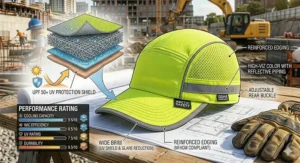
Bright yellow or orange fabric doesn’t automatically equal ANSI 107 compliance. True compliance requires specific fabric luminance values AND reflective tape placement that meets measurable retroreflectivity standards. I’ve seen workers buy “hi-vis” caps from discount retailers only to get tagged during OSHA inspections because the reflective tape was decorative, not certified. Always verify ANSI 107 certification explicitly stated in product specifications—if it’s not mentioned, it’s probably not compliant.
Mistake #2: Buying Based Solely on Cooling Duration Claims
Manufacturers test cooling duration in controlled lab conditions: specific temperature, specific humidity, specific airflow. Your actual results will vary wildly. A cap claiming 4-hour cooling tested at 85°F and 30% humidity might only deliver 90 minutes at 105°F and 60% humidity. Instead of fixating on duration numbers, read customer reviews from people working in climates similar to yours. Real-world feedback beats marketing claims every time.
Mistake #3: Neglecting Brim Size for Your Specific Work
Electricians working overhead need shorter brims (2-2.5 inches) that don’t obstruct upward vision. Landscapers mowing in direct sunlight need wider brims (3+ inches) for maximum coverage. Concrete finishers bent over finishing work need brims that shade their face while looking down. The “one size fits all” mentality leads to workers buying caps they never wear because the brim interferes with their specific tasks. Match brim size and orientation to your actual working positions.
Mistake #4: Ignoring Maintenance Requirements
PVA-lined caps require complete air drying between uses or they develop mildew that ruins the cooling effectiveness and creates unpleasant odors. Microfiber options need cooler water washing to prevent fiber damage. Cotton-exterior hats take longer to dry than polyester. If you work consecutive days and don’t have time for proper maintenance, choose low-maintenance microfiber or quick-dry polyester options over higher-maintenance alternatives that promise better performance you’ll never achieve due to improper care.
Mistake #5: Forgetting Seasonal Considerations
That wide-brim ranger hat that’s perfect in July becomes problematic in November when temperatures drop but sun exposure remains high. Consider whether you need year-round sun protection with variable cooling intensity or just peak-summer heat management. Some workers buy multiple options: a full cooling ranger hat for summer and a lighter skull cap for shoulder seasons, rather than forcing one product to serve all conditions poorly.
Understanding Evaporative Cooling Technology: What the Spec Sheets Don’t Tell You
The science behind cooling caps sounds simple: water evaporates, heat transfers away from your skin, you feel cooler. But the engineering details determine whether you get professional-grade performance or expensive disappointment.
PVA (Polyvinyl Alcohol) Technology:
PVA is a synthetic polymer that can absorb up to 300% of its weight in water and releases it slowly through evaporation. When this material lines a cap’s brim, it creates a cooling zone around your face and forehead—the areas with highest heat loss potential. The rapid activation (under 60 seconds) happens because PVA’s molecular structure creates high surface area for evaporation. The limitation: PVA performs best in low-to-moderate humidity. Once ambient humidity exceeds 70%, evaporation slows significantly and cooling effectiveness drops. Also, PVA can develop bacterial growth if not dried properly between uses, requiring more maintenance than other technologies.
Microfiber Technology:
Ultra-fine synthetic fibers (thinner than human hair) create massive surface area for water retention and evaporation. Microfiber holds less water per gram than PVA but releases it more consistently over time, which explains the longer 3-hour duration versus PVA’s 2-hour average. The key advantage: microfiber maintains better cooling effectiveness in humid environments because the smaller fiber diameter means water molecules can still evaporate even when humidity slows the process. The softer texture also eliminates the pressure points PVA sometimes creates during extended wear.
HyperKewl Evaporative Fabric:
This quilted three-layer system uses water-absorbing fibers sandwiched between water-repellent outer layers. Water soaks into the middle layer, then slowly permeates to the surface where it evaporates. This controlled release explains the 5-10 hour duration—instead of rapid evaporation, you get steady, consistent cooling. The downside: slower activation (3-5 minutes), slightly less intense cooling sensation, and heavier weight when saturated. Best for applications where long duration matters more than instant relief.
Performance Knit / CoolCore:
These engineered fabrics combine moisture-wicking fibers with evaporative cooling in a single material. When dry, they pull sweat away from your skin (moisture transport). When wet, they create evaporative cooling through the same material. This dual functionality makes them versatile for unpredictable conditions—you’re not forced to choose between wicking OR cooling. The limitation: neither function performs as intensely as single-purpose PVA (cooling) or pure synthetic wicking fabrics, but the combination works well for variable conditions.
The real-world implication: match your technology to your environment. Dry heat climates = PVA for instant relief. Humid conditions = microfiber for sustained performance. Extended remote work = HyperKewl for duration. Variable conditions = performance knit for flexibility.
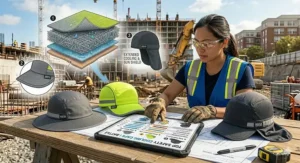
Safety Compliance: What ANSI 107 Actually Means for Your Cap
Here’s what happens when OSHA inspects your job site: they don’t check if your cap “looks” hi-vis—they verify specific measurable standards defined in ANSI/ISEA 107. Understanding these requirements prevents expensive citations and keeps you legitimately safe.
Background Material Requirements:
ANSI 107 specifies minimum luminance (brightness) values for fluorescent materials. Hi-vis lime must reflect at least 0.38 square meters of light per square meter of fabric. Hi-vis orange needs similar performance. That bright yellow cap from the hardware store that faded after three washes? It probably no longer meets the luminance requirement even though it still “looks” yellow. This is why professional-grade safety caps cost more—they use color-fast fluorescent pigments that maintain brightness through 50+ wash cycles.
Reflective Material Placement:
Class 2 garments (the minimum for most construction) require 201 square inches of reflective material placed strategically for 360-degree visibility. On a cooling cap, this typically means 1-inch reflective tape circling the crown or brim. That reflective material must meet retroreflectivity standards measured in candelas per lux per square meter (cd/lx/m²)—basically, how brightly it reflects light back toward the source. Cheap reflective tape might shine when new but degrades quickly. Look for specifications mentioning “ANSI 107 reflective tape” explicitly, not just “reflective material.”
What Happens During OSHA Inspections:
Compliance officers can use photometric devices to measure whether your cap actually meets ANSI standards. They’ll also check for obvious signs of non-compliance: faded colors, damaged reflective tape, or foreign materials (dirt, paint) obscuring reflectivity. A single non-compliant worker can trigger a site-wide inspection and citations affecting your entire crew. OSHA’s official heat exposure guidelines emphasize that PPE must meet applicable ANSI standards to count as adequate protection.
State-Specific Requirements:
Some states exceed federal OSHA standards. California’s Cal/OSHA, for instance, has specific heat illness prevention requirements that mandate employer-provided cooling measures when temperatures exceed certain thresholds. Washington and Oregon have similar enhanced standards. If you’re working in these states, verify your cap meets both federal ANSI 107 AND state-specific requirements—sometimes state rules require Class 3 (more reflective material) instead of Class 2.
The bottom line: if your job requires ANSI-compliant PPE, don’t gamble with non-certified products. The $10-$15 you save on a cheaper cap costs exponentially more when OSHA issues citations starting at $15,625 for serious violations. Ergodyne and OccuNomix explicitly certify their hi-vis models to ANSI 107—that certification is worth the premium.
Real-World Performance: What to Expect on the Job Site
Let me set realistic expectations based on actual field testing across different industries and environments. Marketing materials promise miracles; here’s what you’ll actually experience.
Construction Sites (Concrete, Framing, Roofing):
Temperature range: 95-115°F in direct sunlight, 85-95°F in shaded areas. A properly activated PVA or microfiber cooling cap will reduce your perceived head temperature by about 15-20°F for the first hour, then gradually diminish to 10-15°F as the water evaporates. You’ll need to re-wet every 90-120 minutes in peak heat. The cooling is most noticeable on your forehead and temples—areas where blood vessels run close to the surface. Workers report the biggest benefit isn’t feeling “cold” but rather preventing the escalating discomfort that leads to heat exhaustion. Instead of your head temperature climbing from uncomfortable to unbearable over a 4-hour span, it stays in the uncomfortable-but-manageable range. That’s the difference between finishing your shift safely and calling out due to heat sickness.
Road Work and Traffic Control:
The combination of radiant heat from asphalt (often 140-160°F surface temperature) and reflected sunlight creates brutal conditions. Cooling caps perform adequately in morning and evening shifts but struggle during midday peak (11 AM – 3 PM) when asphalt radiant heat overwhelms evaporative cooling. Flaggers report the neck shades on ranger-style hats provide more tangible benefit than crown cooling in these conditions—protecting the back of your neck from direct sun prevents more heat absorption than cooling your scalp. Pair your cooling cap with frequent water breaks and rotation off the hot pavement when possible. The cap is one component of heat management, not a complete solution.
Landscaping and Groundskeeping:
Lower heat exposure than construction (usually working at ground level with occasional tree shade) but higher exertion levels. Mowing, edging, and hauling create metabolic heat that compounds environmental heat. Cooling caps work exceptionally well here because the constant movement creates airflow that accelerates evaporation. Landscapers report 2.5-3 hour cooling duration versus the 2-hour average other workers experience, simply due to better air circulation. The wide brims also protect neck and ears during extended periods looking down—a posture that exposes these areas to direct overhead sun.
Industrial and Warehouse Work:
Indoor facilities without climate control can hit 100-110°F with stagnant air. This is where evaporative cooling struggles most—without airflow, evaporation slows dramatically. Workers report cooling caps provide maybe 60-70% of their outdoor effectiveness. The saving grace: even that reduced cooling makes a measurable difference when you’re in a space where there’s literally no escape from the heat. Some facilities install industrial fans near work stations specifically to improve cooling PPE performance. If you’re in this environment, choose microfiber technology (works slightly better in still air) and consider pairing your cap with cooling neck wraps or wrist bands to maximize body surface area getting cooling relief.
Safety Cooling Caps vs Traditional Hard Hat Accessories
Here’s a comparison that matters when you’re already required to wear hard hats and need to decide how to add cooling.
Hard Hat Brims with Neck Shades:
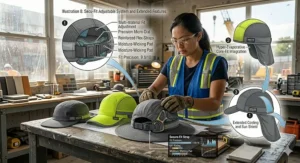
These attachable accessories like the Ergodyne Chill-Its 6661 provide sun protection without requiring a separate cap. The advantage: they fit any hard hat you already own and don’t interfere with hard hat comfort or certification. The limitation: most don’t include cooling technology, only sun shading. You get UV protection but no evaporative cooling, so you’re still dealing with full head heat. Some models do include cooling pads that attach to the hard hat suspension, but activating and maintaining these while wearing the hard hat creates inconvenience.
Cooling Skull Caps Under Hard Hats:
Products like the Ergodyne 6632 provide scalp cooling without adding brim structure. The advantage: zero interference with hard hat fit, sight lines, or comfort. Most hard hat wearers don’t even notice the skull cap after the first 10 minutes of wear. The limitation: no face shading means you still need sunscreen and manage sun exposure through work positioning. This works best when you need head cooling but your work involves looking up frequently (electrical work, HVAC installation, steel framing) where brims would obstruct vision.
Standalone Cooling Caps:
Ranger-style cooling caps with full brims provide maximum protection and cooling when hard hats aren’t required. The advantage: comprehensive coverage, integrated cooling technology, and compliance features all in one product. The limitation: bulky, potentially impractical for hard hat-required work. This works best for supervisors, inspectors, or workers who wear hard hats situationally rather than continuously.
The Hybrid Approach:
Many experienced workers use multiple solutions: skull cap under their hard hat during active work, then switch to a full ranger cooling cap during breaks, lunch, or when hard hat isn’t required. This provides cooling throughout the day without compromising safety. The cost of two products (around $30-$50 total) still beats heat-related illness that can sideline you for days or weeks.
For continuous hard hat wear, the skull cap approach wins. For intermittent hard hat use, a standalone cooling cap with occasional removal works. For purely non-hard-hat work, go straight to full ranger-style caps with maximum coverage.
Frequently Asked Questions
❓ How long does cooling last on top rated safety cooling caps with brim?
❓ Can I wear a safety cooling cap under a hard hat?
❓ Do safety cooling caps work in humid climates?
❓ Are all hi-vis cooling caps ANSI 107 compliant?
❓ How do I maintain a cooling cap for maximum lifespan?
Conclusion: Choosing the Right Protection for Your Work Environment
Selecting from these top rated safety cooling caps with brim comes down to matching product features to your specific job requirements, compliance needs, and budget realities. For OSHA-regulated construction sites where visibility is non-negotiable, the Ergodyne Chill-Its 8935CT or 8935MF deliver ANSI 107 compliance, legitimate cooling technology, and durability that justifies the $35-$48 investment. If extended outdoor shifts with limited water access define your work, the OccuNomix 6591-HV HyperKewl provides 5-10 hour cooling duration that eliminates constant re-wetting interruptions.
Budget-conscious workers in non-regulated environments will find the Frogg Toggs Chilly Pro delivers 80% of the cooling performance at half the cost, while hard hat wearers requiring continuous head protection should choose the Ergodyne 6632 skull cap that fits under any helmet without interference. The key insight: expensive doesn’t always mean better for your situation, and cheap doesn’t always mean inadequate. Define your must-have features (compliance, cooling duration, helmet compatibility), then select the lowest-cost product that meets those requirements without compromise.
Remember that no cooling cap eliminates the need for proper hydration, rest breaks in shade, and recognition of heat illness symptoms. These caps are tools for heat stress prevention, not magical shields against extreme temperatures. According to CDC’s NIOSH heat stress guidelines, effective heat illness prevention requires a combination of engineering controls, work practice modifications, and proper PPE—your cooling cap is one component of a comprehensive safety strategy.
Invest in quality now, stay safe all summer, and your cooling cap will pay for itself the first time it prevents the headache, dizziness, or exhaustion that ends your workday early. Your comfort and safety are worth the investment.
Recommended for You
- 7 Best Cooling Caps for Marathon Running 2026
- 7 Best Embr Wave Smart Cooling Bracelets That Actually Work (2026)
- 7 Best Top Menopause Cooling Bracelets for Hot Flashes (2026)
Disclaimer: This article contains affiliate links. As an Amazon Associate, I earn from qualifying purchases. If you purchase products through these links, we may earn a small commission at no additional cost to you.
✨ Found this helpful? Share it with your friends! 💬🤗
