
In This Article
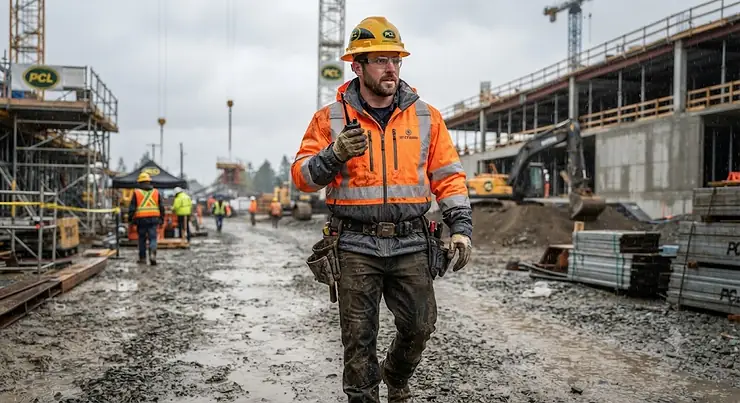
Nobody clocks in hoping for rain. But if your job happens outside — on a roof, a rig, a road crew, a dock — the weather doesn’t ask permission before it ruins your afternoon. A rain jacket for outdoor workers isn’t the same animal as the $40 poncho stuffed in your car’s glovebox for emergencies. It has to survive being crouched on gravel, snagged on rebar, soaked for six straight hours, and washed with a garden hose more often than a washing machine. Most jackets built for hiking trails simply weren’t designed for that kind of abuse, which is exactly why so many crews end up cycling through cheap gear every season instead of buying once and forgetting about it.
What is a rain jacket for outdoor workers? It’s a waterproof, abrasion-resistant outer layer engineered for extended exposure and physical labor — think reinforced seams, tool-friendly pockets, and fabric weights measured in denier rather than ounces of “packability.” Whether you’re chasing a heavy duty work rain jacket men can wear over a tool belt, a waterproof work coat with hood roomy enough for a hard hat, or simply work rain gear that lasts more than one storm season, the right jacket changes the entire tone of a wet shift. Below, we’ve researched seven real, currently available options — spanning budget hi-vis jackets to premium marine-grade shells — and broken down exactly who each one is built for, backed by real specs and aggregated review sentiment rather than guesswork. Under OSHA’s general PPE standard, ordinary weather-protection gear like raincoats generally isn’t something employers are required to supply, which means the choice — and the investment — is often squarely on the worker. Let’s make sure it’s a good one.
Quick Comparison Table
| Jacket | Best For | Price Range | Standout Feature |
|---|---|---|---|
| Carhartt Storm Defender Shoreline Jacket | All-around versatility | $130–$170 range | 10K/10K waterproof-breathable rating |
| Helly Hansen Workwear Voss Jacket | Mobility & stretch | $150–$170 range | 4-way stretch Helox+ fabric |
| Radians RW32-3Z1Y | Budget hi-vis roadwork | $100–$130 range | ANSI Class 3 with 3M reflective tape |
| Ergodyne GloWear 8366 | Ultra-budget layering | $55–$70 range | Lightweight 150D shell over other gear |
| Grundens Weather Watch Jacket | Marine & wet-deck work | $150–$190 range | 10K/5K PU laminate, built for spray |
| Dickies Waterproof Rain Jacket 39577 | Occasional wet-weather use | $40–$80 range | Simple, no-frills waterproofing |
| Viking Professional Journeyman 300D | Oilfield & heavy industrial | $100–$140 range | FR-rated variant + 300D ripstop shell |
Look at this lineup long enough and a pattern jumps out: there’s no single “best” jacket here, only the best match for your specific rain. A roofer fighting wind-driven downpours needs something different than a fishing deckhand getting sprayed sideways for eight hours, and both need something different than an electrician who mostly just needs to survive the walk from the truck to the panel. The Radians RW32-3Z1Y and Ergodyne GloWear 8366 dominate the visibility-first roadwork niche, while the Grundens Weather Watch Jacket and Viking Professional Journeyman 300D trade some comfort for serious abuse resistance. Budget shouldn’t be the only lens you use — a $60 jacket that fails after one season often costs more than a $150 jacket that survives five.
💬 Just one click — help others make better buying decisions too!😊
Top 7 Rain Jackets for Outdoor Workers: Expert Analysis
1. Carhartt Storm Defender Shoreline Jacket — best all-around waterproof-breathable balance
The party trick here is the Storm Defender® membrane, which somehow keeps rain out while letting sweat escape — a balance a lot of cheaper PU-coated shells never quite pull off. Built from 7.3-ounce, 100% nylon oxford with a mesh-lined body and taffeta sleeve lining, the Carhartt Storm Defender Shoreline Jacket carries a 10K/10K waterproof-breathability rating, along with Wind Fighter wind-blocking tech and fully-taped, sealed seams. In practice, that 10K/10K number means it holds up against sustained, driving rain without turning into a personal sauna during active labor — a common failure point for cheap PVC rain shells. Based on the spec comparison with budget alternatives, the detachable hood and adjustable droptail hem give this jacket genuine all-day versatility: you can wear it solo in a downpour or layer a hoodie underneath when temperatures drop. Reviewers consistently report that the fit runs generously roomy for layering, and multiple buyers specifically praised how well it kept them dry and warm through heavy snow, though a few noted the fabric doesn’t breathe quite as well as advertised during high-output tasks like heavy lifting. This is the jacket for the generalist — someone who does a bit of everything outdoors and needs one shell that won’t embarrass them in any single condition.
Pros:
- ✅ Genuine waterproof-breathable membrane, not just a coating
- ✅ Detachable hood and adjustable hem add real versatility
- ✅ Roomy fit accommodates layering in cold rain
Cons:
- ❌ Breathability drops noticeably during heavy physical exertion
- ❌ Bulkier than lightweight shells when packed away
Priced in the $130–$170 range at most retailers, the Shoreline Jacket lands solidly in the mid-tier — a fair trade for a real waterproof-breathable membrane instead of a basic PU coating.

2. Helly Hansen Workwear Voss Jacket — best for mobility on active jobsites
If your day involves more bending, climbing, and reaching than standing still, the Helly Hansen Workwear Voss Jacket is worth a hard look. What most buyers overlook about this jacket is that its 4-way stretch isn’t a gimmick — it’s built into the Helox+ PU-coated polyester itself, meaning the jacket moves with your shoulders instead of restricting them mid-reach. The fabric is 100% polyester at 170 g/m² with a PU coating, fully windproof and waterproof, and the packable hood tucks directly into the collar so it doesn’t flop around uselessly when the rain stops. Here’s what to weigh: Helly Hansen has built a 140-plus-year reputation in Scandinavian foul-weather gear, and the brand’s workwear line counts serious tradespeople and rescue services among its regular wearers. Aggregated customer sentiment is genuinely mixed on one point — the manufacturer’s own site surfaces a review summary flagging inconsistent waterproof performance, with some buyers calling it lightweight and flexible while others report breakage — so quality control on individual units seems to vary more than on some competitors. Still, for tradespeople who value range of motion over maximum bombproof durability, this is one of the few jackets on this list built specifically around movement.
Pros:
- ✅ Genuine 4-way stretch fabric for unrestricted movement
- ✅ Packable hood stores cleanly in the collar
- ✅ YKK zipper and reflective elements add durability and visibility
Cons:
- ❌ Some reported inconsistency in long-term waterproof performance
- ❌ Premium pricing relative to similar-weight competitors
Expect to pay in the $150–$170 range, which is reasonable for stretch fabric but a step above simpler PU-coated shells with less mobility.
3. Radians RW32-3Z1Y Heavy Duty Rip Stop Waterproof Rain Jacket — best budget hi-vis for roadwork
For crews working near traffic or heavy equipment, visibility isn’t optional — it’s survival. The Radians RW32-3Z1Y answers that need with 300-denier, PU-coated, high-visibility ripstop oxford material paired with 3M silver reflective tape, and it’s certified to ANSI 107 Class 3 — the industry’s top visibility tier for roadside and low-light work. Based on the spec sheet, the ripstop weave matters more than it sounds: ordinary polyester tears in a straight line once punctured, while ripstop’s grid reinforcement stops small snags from becoming a six-inch gash after brushing past rebar or a truck bumper. What most buyers overlook is the vented back and front vents, which noticeably cut down on the “trash bag” clamminess that plagues cheaper PVC hi-vis gear during active work. The jacket also includes five total pockets, including a dedicated chest pocket sized for a phone or radio — a small detail that road crews and utility workers will actually use every single shift. Reviewers describe it as heavy but reliably weatherproof, which tracks with the 300-denier build: this isn’t the jacket you grab for a light drizzle, it’s the one you grab when the forecast says “flash flood watch.”
Pros:
- ✅ ANSI/ISEA 107 Class 3 certified for maximum roadside visibility
- ✅ Ripstop 300D fabric resists tears from job-site abrasion
- ✅ Five pockets including a dedicated phone/radio pocket
Cons:
- ❌ Noticeably heavier than lightweight hi-vis alternatives
- ❌ Bulk can feel excessive for light-rain, low-activity days
At around $100–$130, this is genuinely aggressive pricing for Class 3 certification and ripstop durability combined — arguably the best value on this list for anyone required to wear hi-vis.
4. Ergodyne GloWear 8366 Lightweight Hi-Vis Rain Jacket — best ultra-budget layering shell
Sometimes you don’t need armor — you need something quick to throw over your regular workwear the moment the sky opens up. The Ergodyne GloWear 8366 is built for exactly that scenario. It uses 150-denier polyester oxford with a PU coating and fully taped seams, is compliant with ANSI/ISEA 107-2020 Type R Class 3, and includes a vented cape-back along with a stowable drawstring hood. What the spec sheet won’t tell you, but the product’s positioning makes clear, is that this jacket trades bulk and reinforcement for packability and price — it’s explicitly marketed toward road crews, utility workers, emergency responders, and rail and survey teams who need visibility and waterproofing without carrying heavy gear all shift. On the spec comparison against the Radians RW32, the 8366 concedes real durability (150D versus 300D, no ripstop reinforcement) in exchange for a noticeably lighter, more packable shell — a fair trade for anyone whose job is more “in and out of the truck” than “crawling through a trench all day.” Reviewers on retail sites frequently mention it as a solid grab-and-go layer for overnight or unpredictable shifts, though a few flag the lighter material as less confidence-inspiring in sustained downpours compared to heavier options on this list.
Pros:
- ✅ ANSI/ISEA 107 Class 3 certified at a genuinely low price point
- ✅ Vented cape-back and stowable hood aid breathability
- ✅ Packs small enough to keep in a vehicle at all times
Cons:
- ❌ Lighter 150D fabric offers less abrasion resistance than heavier rivals
- ❌ Less confidence-inspiring during multi-hour sustained downpours
At roughly $55–$70, this is the cheapest legitimately certified hi-vis rain jacket on the list — an easy pick for backup gear or infrequent wet-weather duty.
5. Grundens Weather Watch Jacket — best for marine, dock, and wet-deck work
Built by a company that’s been outfitting commercial fishermen since 1911, the Grundens Weather Watch Jacket takes a different approach than most workwear-branded rain shells: it’s engineered for constant spray rather than occasional downpour. The jacket carries a 10K/5K waterproof/breathable rating, uses 100% nylon with a DWR-treated finish to repel liquids and stains, and features fully taped and sealed seams alongside an adjustable hood, hem, and cuffs. Based on the spec comparison, that 10K/5K figure sits below the Carhartt Shoreline’s 10K/10K on paper, but real-world reviewers note the tradeoff makes sense for maritime use — Grundens prioritizes abrasion and salt resistance over maximum breathability, since deckhands are rarely doing high-output cardio between rain showers the way a hiker might. The company positions this specific jacket as comfortable enough for casual sportfishing yet rugged enough for light commercial use, which is honest framing — it’s not their heaviest-duty Bering Sea gear, but a genuinely durable middle option for anyone whose “outdoor work” involves boats, docks, or constant water exposure rather than dry-land construction. Reviewers consistently highlight the adjustable three-point fit (hood, hem, cuffs) as unusually good at sealing out wind-driven spray compared to fixed-fit competitors.
Pros:
- ✅ Purpose-built for sustained spray and marine conditions
- ✅ Adjustable hood, hem, and cuffs seal out wind-driven water
- ✅ DWR-treated nylon resists staining from fish, bait, and grime
Cons:
- ❌ Lower breathability rating than land-focused competitors
- ❌ Premium marine-brand pricing versus general workwear options
Typically found in the $150–$190 range, it’s a specialist’s jacket — worth every dollar if your job happens on or near the water, less essential if it doesn’t.
6. Dickies Waterproof Rain Jacket 39577 — best for occasional wet-weather use
Not everyone needs their rain jacket to survive a decade of abuse — some workers just need something functional for the handful of genuinely wet days each season. The Dickies Waterproof Rain Jacket 39577 keeps things simple: a full zip-on front, roomy double front pockets, and an adjustable hood, without the reinforced seams, ripstop weave, or reflective certification found on the heavier-duty jackets on this list. On the spec comparison, this is the most stripped-down entry in the lineup, and that’s precisely the point — it’s a no-frills waterproof layer at an accessible price for workers who mostly stay dry and occasionally get caught in a passing shower. Reviewer sentiment across retailers is generally positive on basic waterproofing and comfort, with the double front pockets frequently mentioned as a practical touch for holding gloves or small tools. What the spec sheet won’t tell you is that a jacket this simple has fewer failure points, too — no complex membrane to delaminate, no reflective tape to peel off after repeated washing — which can actually translate to a longer functional lifespan for light-duty use, even without heavy-duty branding.
Pros:
- ✅ Simple, accessible price point for occasional wet-weather work
- ✅ Roomy double front pockets for gloves and small tools
- ✅ Adjustable hood improves fit under a hard hat
Cons:
- ❌ No reinforced or ripstop fabric for high-abrasion environments
- ❌ Lacks ANSI hi-vis certification for roadside visibility needs
Generally available in the $40–$80 range depending on retailer, it’s the budget entry point for anyone who needs “waterproof,” full stop, without the heavy-duty extras.
7. Viking Professional Journeyman 300D — best heavy-duty pick for oilfield and industrial crews
When the job involves abrasive equipment, sustained exposure, and sometimes flame-adjacent hazards, the Viking Professional Journeyman 300D is built for that reality. Constructed from heavy-duty 300 Denier Trilobal ripstop polyester, it’s 100% waterproof and windproof, and an FR-treated version is engineered specifically for oilfield and construction professionals. Based on the spec comparison, the “Trilobal” fiber structure is worth understanding: its triangular cross-section fibers reflect light differently than standard round fibers, boosting reflective visibility slightly while also resisting tearing better than flat ripstop weaves — a genuine engineering advantage over more generic 300D competitors. The detachable Stormblaster hood accommodates safety helmets without cutting off peripheral vision, and front-and-back vents let hot air escape without letting rain in, addressing the classic complaint about heavy PU-backed shells turning into a sweatbox. Reviewers describe the fit as generous enough to layer over FR shirts, and multiple buyers specifically called out the price-to-quality ratio as better than expected for a jacket built to CSA Z96-15 Class 1 and ANSI/ISEA 107-2015 Class 3 compliance standards. This is the jacket for the toughest environments on this list — rigs, refineries, and job sites where “durable” isn’t marketing language, it’s a safety requirement.
Pros:
- ✅ Heavy-duty 300D Trilobal ripstop resists tears and abrasion
- ✅ FR-rated variant available for flame-hazard environments
- ✅ Detachable hood fits comfortably over hard hats and safety helmets
Cons:
- ❌ Bulkier fit than lighter hi-vis competitors
- ❌ FR-rated version commands a price premium over standard variant
Priced around $100–$140 for the standard version, it’s a strong value for anyone who needs genuinely industrial-grade toughness without paying niche-marine prices.
How to Choose a Rain Jacket for Outdoor Workers
Picking the right jacket comes down to matching fabric, fit, and certification to your actual job — not just grabbing whatever’s cheapest at the hardware store. Here’s the reasoning, step by step:
- Identify your primary hazard first. Traffic exposure demands ANSI Class 3 hi-vis; abrasive equipment demands ripstop or heavy denier; open flame demands FR-rated fabric like the Viking Journeyman.
- Match waterproof/breathable ratings to your activity level. High-exertion jobs benefit from 10K/10K-class membranes like the Carhartt Storm Defender; lower-activity jobs can get by with simpler PU coatings.
- Prioritize hood design around your headgear. If you wear a hard hat, look for detachable or oversized hoods (Viking, Carhartt) rather than fixed hoods sized for bare heads.
- Count and place the pockets you’ll actually use. Radio clips, phone pockets, and tool storage matter more on a real job site than they do on a hiking trail.
- Weigh denier against mobility. Heavier 300D fabrics (Radians, Viking) survive abrasion better; lighter 150D-170gsm fabrics (Ergodyne, Helly Hansen) move better and pack smaller.
- Check the seams, not just the fabric. Fully taped, sealed seams are non-negotiable — an otherwise great fabric leaks at the stitch lines without them.
- Buy for your worst shift, not your average one. If even one day a month puts you in sustained, driving rain, a mid-tier jacket that handles that day is worth more than a cheap one that only handles drizzle.
Heavy Duty Work Rain Jacket for Men: What “Heavy Duty” Actually Means on the Jobsite
The phrase “heavy duty” gets stamped on packaging so often it’s practically lost meaning, but on a real jobsite, it maps to specific, measurable traits. First, fabric weight and weave: a genuine heavy duty work rain jacket for men typically starts around 300-denier fabric, like the ripstop oxford used in the Radians RW32-3Z1Y and the Viking Professional Journeyman 300D — that denier count roughly measures fiber thickness, and higher numbers mean more resistance to punctures from tools, rebar, or rough equipment surfaces. Second, seam construction matters as much as the fabric itself; fully taped and heat-sealed seams, as found across nearly every jacket on this list, prevent the classic failure mode where rain gets in through stitch holes even though the fabric itself is technically waterproof.
Third — and this is the part marketing copy conveniently skips — heavy duty gear trades some comfort for survivability. The Radians RW32 and Viking Journeyman both run noticeably heavier and stiffer than the Ergodyne GloWear 8366, and that’s by design, not a flaw. Reviewers consistently note that heavier jackets feel like “armor” during abrasive work but overheat faster during high-exertion tasks without adequate venting, which is exactly why front-and-back vents show up on nearly every heavy-duty model reviewed here. If your job involves crawling, kneeling on gravel, or working near sharp edges, that heavier build earns its keep. If your work is mostly upright and low-abrasion, a lighter jacket will serve you just as well while sparing you the extra bulk.
Waterproof Work Coat with Hood: Why Hood Design Makes or Breaks Your Day
A waterproof work coat with hood sounds like a simple checkbox feature until you’ve actually worn one under a hard hat in sideways rain — then the design details suddenly matter enormously. The core tension is fit versus function: a hood roomy enough to fit over safety headgear, like the detachable Stormblaster hood on the Viking Professional Journeyman, needs enough structure to stay put in wind without collapsing over your eyes, but not so much bulk that it blocks peripheral vision near moving equipment.
Reviewers of budget jackets frequently flag this exact failure — one Carhartt buyer specifically noted their jacket’s hood “falls over my eyes no matter what adjustment is made” when worn over a work helmet, a problem that stems from a missing rear drawcord rather than the hood being too large. Compare that to the Helly Hansen Voss Jacket, whose hood packs directly into the collar when not needed, or the Grundens Weather Watch, whose three-point adjustable hood (hood, hem, cuffs) lets wearers cinch out wind-driven spray from multiple directions rather than just one. What most buyers overlook is that a detachable hood, rather than a fixed one, actually solves two problems at once: it lets you skip the hood entirely on calm-but-wet days when peripheral vision matters more than head coverage, and it gives you a tear-away safety feature if the hood ever snags on machinery — a genuine safety consideration on active job sites, not just a comfort one.
✨ Don’t Miss These Exclusive Deals!
🔍 Take your outdoor work gear to the next level with these carefully selected jackets. Click on any highlighted item to check current pricing and availability. These picks will help you stay dry, visible, and protected through whatever the forecast throws at your crew!
Contractor Rain Jacket vs Everyday Rain Jacket: What’s Actually Different
A contractor rain jacket and a casual rain jacket might look similar hanging on a rack, but they’re built around fundamentally different assumptions about how they’ll be used.
| Feature | Contractor Rain Jacket | Everyday/Casual Rain Jacket |
|---|---|---|
| Fabric denier | 150D–300D reinforced | Often under 100D, prioritizes packability |
| Seam construction | Fully taped, reinforced at stress points | Taped, but lighter-duty |
| Pockets | Tool/radio/phone-specific placement | General-purpose, fewer, smaller |
| Visibility | Often ANSI Class 2/3 certified | Rarely certified |
| Best For | Radians RW32, Viking Journeyman, Ergodyne GloWear 8366 | Casual commuting, light hiking |
Looking at the comparison above, the gap isn’t really about waterproofing at all — plenty of casual rain jackets are perfectly waterproof in a shower. The gap is about survivability under repeated abuse and functional job-site details. A contractor rain jacket like the Radians RW32-3Z1Y is built to be snagged, crouched in, washed with a hose, and worn again the next morning; a casual jacket folded neatly into a backpack pocket usually isn’t tested against that kind of daily wear. Reviewers who’ve tried both frequently describe the difference in blunt terms: casual jackets “feel nicer” out of the box, but contractor-grade jackets are still functional a year later when the casual jacket has already delaminated or torn at a pocket seam.
The other major difference is certification. Everyday rain jackets almost never carry ANSI/ISEA 107 ratings, because visibility near traffic simply isn’t a design consideration for a weekend hike. For anyone working near roads, equipment, or low-light conditions, that certification — present on the Radians RW32, Ergodyne GloWear 8366, and Viking Journeyman — isn’t a nice-to-have. It’s the entire point.
Common Mistakes When Buying Work Rain Gear
Even experienced workers make predictable errors when shopping for wet-weather gear, and most of them trace back to optimizing for the wrong variable.
Mistake 1: Buying based on price alone. A $40 jacket that needs replacing every season often costs more over three years than a $130 jacket that survives all three. Reviewers of the Dickies 39577 generally rate it well for occasional use, but nobody expects it to survive daily abrasive work the way the Viking Journeyman 300D does — and pricing accordingly matters.
Mistake 2: Ignoring hood-to-helmet fit. As covered above, a hood that doesn’t accommodate a hard hat becomes useless the moment you actually need it on an active site.
Mistake 3: Skipping hi-vis certification when it’s actually required. Workers near traffic or heavy equipment sometimes assume any bright-colored jacket counts as “hi-vis,” but ANSI/ISEA 107 Class 3 certification, found on the Radians RW32 and Ergodyne GloWear 8366, involves specific tested placement and reflective area requirements that uncertified bright jackets simply don’t meet.
Mistake 4: Overlooking breathability for high-exertion jobs. A jacket with a low breathability rating can leave you soaked in sweat rather than rain — arguably just as uncomfortable, and sometimes just as dangerous in cold conditions.
Mistake 5: Assuming “waterproof” and “water-resistant” mean the same thing. Water-resistant gear handles light drizzle; genuinely waterproof gear with taped seams, like every jacket reviewed here, handles sustained downpours. Reading the actual spec sheet — not just the marketing headline — avoids this confusion entirely.
Work Rain Gear That Lasts: Long-Term Cost & Maintenance
Thinking in terms of cost-per-wear changes the entire buying calculus for work rain gear that lasts. A $60 jacket worn 40 times before failing costs $1.50 per wear; a $150 jacket worn 200 times before failing costs $0.75 per wear — half the real cost, despite the higher sticker price. This is exactly why the Radians RW32-3Z1Y‘s ripstop reinforcement and the Viking Journeyman’s 300D Trilobal fabric represent genuinely better long-term value than their price tags initially suggest, assuming your job puts real abrasive stress on the garment regularly.
Maintenance directly determines how close a jacket gets to its theoretical lifespan. Durable water repellent (DWR) coatings — used across nearly every jacket in this guide — wear down with regular washing, dirt buildup, and UV exposure, and regular reapplication is essential to keep that surface beading effect working over time. As Wikipedia’s overview of waterproof fabric explains, this DWR layer is a separate treatment from the waterproof membrane itself, which is why a jacket can lose its beading effect and start to “wet out” on the surface long before the membrane underneath actually fails. Practically, that means washing work rain gear with a mild detergent (never fabric softener, which clogs the microscopic pores in waterproof-breathable membranes) every few months, followed by a DWR reapplication spray or wash-in treatment once beading visibly weakens. Taped seams should be inspected periodically for peeling tape, particularly around high-stress zones like underarms and pocket edges — a small tape repair kit costs a few dollars and can add a full season of life to a jacket that would otherwise need replacing. For jackets with reflective tape, like the Ergodyne GloWear 8366, avoid high-heat drying, which accelerates reflective material degradation faster than air-drying does. None of this maintenance is complicated, but skipping it consistently cuts years off a jacket’s functional life — turning what should have been “gear that lasts” into gear replaced every single season.
Durable Work Outerwear: Practical Usage Guide for the First 30 Days
Getting the most out of durable work outerwear starts before the first storm even hits. On day one, before wearing a new jacket on the job, test the zipper and storm flap under mild conditions rather than discovering a sticking zipper during a downpour — most workwear zippers, including the YKK units on the Helly Hansen Voss Jacket, benefit from a light zipper lubricant applied at the outset to prevent grit buildup later.
In the first week, resist the urge to wash the jacket unless it’s visibly dirty; overwashing accelerates DWR breakdown faster than normal wear does. Instead, hang-dry it fully after each wet shift rather than balling it up in a truck cab, since trapped moisture against PU coatings can encourage delamination over time — a common complaint across budget PVC-style rain gear.
By week two or three, check the hood adjustment under your actual headgear — hard hat, welding hood, whatever you wear — and mark the cord-lock position that works, since factory settings rarely match individual fit needs out of the box. This single step resolves the most common early complaint reviewers report across nearly every jacket in this guide.
A common first-30-days mistake: storing a wet jacket folded in a truck toolbox overnight. Trapped humidity encourages mildew growth on the interior lining and speeds up membrane breakdown, particularly on mesh-lined jackets like the Carhartt Storm Defender. A cheap collapsible hook mounted inside a truck cab solves this permanently for a few dollars. Finally, once you’ve worn the jacket through two or three real rain events, do a full inspection of seams and reflective tape — catching a small peeling seam early means a $5 repair instead of a jacket replacement six months down the line.
All-Day Rain Protection Workwear by Trade: Real-World Scenarios
The road crew flagger. Working roadside shifts near moving traffic all day, visibility isn’t optional. The Radians RW32-3Z1Y‘s ANSI Class 3 certification and ripstop durability make it the clear pick — the reflective tape placement is engineered specifically for driver sightlines, something a bright-but-uncertified jacket simply can’t replicate.
The residential electrician. Mostly moving between a truck and a job site, with occasional but not constant rain exposure, and rarely doing high-exertion physical labor. The Ergodyne GloWear 8366 fits this profile well — lightweight enough to keep in a truck permanently, hi-vis certified for the occasional roadside call, and inexpensive enough that replacing it isn’t a big deal if it wears out.
The commercial fishing deckhand. Constant spray, salt exposure, and long shifts on a moving deck define this job, and general workwear jackets simply aren’t built for it. The Grundens Weather Watch Jacket‘s marine-specific DWR treatment and adjustable three-point seal (hood, hem, cuffs) address exactly this environment, in a way land-focused competitors don’t.
The oilfield roughneck. Working around abrasive equipment, potential flame hazards, and genuinely brutal weather conditions, this worker needs maximum durability over comfort. The FR-rated Viking Professional Journeyman 300D matches that reality directly, with ripstop fabric engineered for exactly this kind of abuse.
Buyer’s Decision Framework
Use this simple framework to cut through the options quickly:
- If you work near traffic or heavy equipment, choose an ANSI Class 3 certified jacket — the Radians RW32 or Ergodyne GloWear 8366 — because visibility is a safety requirement, not a preference.
- If your job involves heavy exertion and layering, choose a true waterproof-breathable membrane like the Carhartt Storm Defender Shoreline Jacket, because a simple PU coating will leave you soaked in sweat regardless of the rain outside.
- If you need maximum mobility for climbing or reaching, choose a stretch fabric option like the Helly Hansen Voss Jacket, because rigid heavy-duty shells restrict range of motion.
- If your work happens on or near water, choose a marine-specific jacket like the Grundens Weather Watch, because land-focused workwear won’t handle sustained spray as well.
- If your budget is tight and use is occasional, choose a simple, accessible option like the Dickies 39577, because paying for heavy-duty features you won’t stress-test doesn’t make financial sense.
- If your environment includes abrasive equipment or flame hazards, choose the FR-rated Viking Professional Journeyman 300D, because standard fabric simply isn’t rated for that level of risk.
Safety, Hi-Vis & OSHA Compliance for Outdoor Work Rain Gear
Understanding the regulatory landscape helps explain why some jackets on this list carry certifications and others don’t. Under OSHA’s general PPE rules, employers generally aren’t required to supply ordinary weather-protection clothing such as raincoats, jackets, or rubber boots used solely for protection from the elements — which is why the cost of a quality rain jacket often falls on the individual worker, making the buying decisions in this guide genuinely consequential rather than academic.
Where regulation gets stricter is visibility. The ANSI/ISEA 107 standard governs high-visibility apparel, and jackets like the Radians RW32-3Z1Y and Ergodyne GloWear 8366 are independently certified to Type R, Class 3 — the highest roadside visibility tier, typically expected for workers regularly exposed to higher-speed traffic or complex traffic patterns. The Viking Professional Journeyman adds an extra layer of compliance relevant to specific industries: its Canadian-market variant meets CSA Z96-15 Class 1, Level 2, a standard frequently referenced in oil, gas, and utility contracts even for U.S.-based crews working cross-border projects.
For cold, wet conditions specifically, OSHA’s winter weather guidance recommends engineering controls like radiant heaters and wind shielding alongside proper PPE selection, and encourages employers to know how their local community communicates severe weather alerts through NOAA Weather Radio and similar channels. Practically, that means a quality rain jacket is one piece of a larger cold-and-wet safety plan, not a standalone solution — pairing it with proper breaks, dry layering options, and awareness of hypothermia symptoms matters just as much as the jacket itself. For a deeper look at how waterproof-breathable membranes actually manage that moisture balance, Wikipedia’s entry on fabric breathability is a solid technical starting point.
Frequently Asked Questions
❓ What's the difference between waterproof and water-resistant work jackets?
❓ How often should I reapply DWR to a work rain jacket?
❓ Is a heavy duty work rain jacket worth it for occasional rain exposure?
❓ Do rain jackets for outdoor workers need ANSI hi-vis certification?
❓ Can I wash a waterproof work jacket in a regular washing machine?
Conclusion
There’s no universal best rain jacket for outdoor workers — only the best jacket for your specific rain, your specific job, and your specific tolerance for bulk versus mobility. The Carhartt Storm Defender Shoreline Jacket earns its spot as the strongest generalist thanks to a real waterproof-breathable membrane, while the Radians RW32-3Z1Y and Ergodyne GloWear 8366 dominate anywhere hi-vis certification is non-negotiable. Marine and industrial workers have their own specialists in the Grundens Weather Watch Jacket and Viking Professional Journeyman 300D, and anyone facing occasional rain rather than daily exposure can reasonably save money with the Dickies 39577 or lean on the Helly Hansen Voss Jacket for stretch and mobility.
What matters more than any single spec sheet is matching the jacket to the actual conditions you’ll face — abrasion, traffic, spray, or flame hazards each demand different priorities, and no amount of marketing language substitutes for checking real denier ratings, seam construction, and certification levels against your own job site. Buy for your worst shift, maintain the DWR coating and seams over time, and a genuinely good work rain jacket will outlast several cheap replacements combined — both in dollars and in dry, comfortable shifts.
Recommended for You
- Hiking Rain Poncho With Hood: 7 Ultralight Picks for 2026
- Reusable Rain Poncho 2026: 7 Picks That Actually Hold Up
- Emergency Rain Poncho Bulk: 7 Life-Saving Picks for 2026
Disclaimer: This article contains affiliate links. As an Amazon Associate, I earn from qualifying purchases. If you purchase products through these links, we may earn a small commission at no additional cost to you.
✨ Found this helpful? Share it with your friends! 💬🤗
