
In This Article
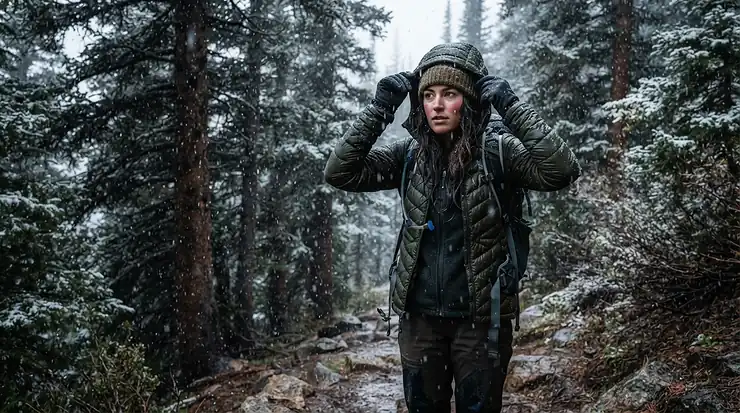
Picture mile three of a snowy ridge hike. You’re sweating on the climb, the clouds drop, and sleet starts ticking off your hood. Which puffy do you wish you’d packed? That single question is the whole down jacket vs synthetic jacket for winter hiking debate, and the honest answer is more nuanced than most gear forums admit.
Here’s the short version. Down wins on warmth for the weight and packs tiny, so it rules cold, dry days. Synthetic wins when moisture shows up, because it keeps insulating when damp and generally breathes better. REI’s buying guide and the independent testers cited below land in the same place.
The real story lives in the details: fill weight, face fabrics, hydrophobic treatments, hybrid mapping. This guide builds on real specs and aggregated findings from published reviews. It invents no personal anecdotes or customer quotes. You’ll get seven specific jackets (four down, three synthetic) and a clear look at down vs synthetic insulation for hiking. You’ll also get a wet weather hiking jacket comparison, a deep dive on moisture resistance, and practical guidance on layering, care, and safety.
Quick Comparison Table: Down Jacket vs Synthetic Jacket for Winter Hiking
| Factor | Down | Synthetic |
|---|---|---|
| Warmth for the weight | Best in class (think Rab Neutrino Pro) | Good, slightly heavier (think Patagonia Micro Puff Hoody) |
| When damp | Loses loft unless treated | Keeps insulating |
| Packability | Compresses smallest | Bulkier |
| Sweaty climbs | Traps moisture, easy to overheat | Breathes better (think Arc’teryx Atom Hoody) |
| Best For | Cold, dry, weight-sensitive days | Wet, mixed, high-output days |
The table boils down to a trade: down buys you ounces and compressibility, synthetic buys you forgiveness. If your winter trails are mostly cold and dry, the Rab Neutrino Pro category of jacket makes sense. If your forecast flips between snow, drizzle, and slush, the Arc’teryx Atom Hoody style of jacket is the safer bet.
💬 Just one click — help others make better buying decisions too!😊
What Is Down Jacket vs Synthetic Jacket for Winter Hiking?
The down jacket vs synthetic jacket for winter hiking choice pits two insulation families against each other. Natural goose or duck down offers the highest warmth for its weight and compresses small. Polyester-based synthetic fill keeps insulating when damp and tolerates sweat, abuse, and wet snow better. Neither is universally superior, because conditions and effort level decide the winner.
Down gets its warmth from air trapped between feather clusters. As Wikipedia’s overview of the down jacket explains, loft is rated by fill power, the cubic inches one ounce of down occupies. When down absorbs water, it collapses and loses warmth until it dries.
Synthetic fills such as PrimaLoft, Coreloft, and PlumaFill use fine polyester filaments engineered to mimic those clusters. Newer hybrids narrow the gap from both sides: hydrophobic-treated down resists moisture, and loose-fill synthetics like PlumaFill chase down-like loft. Think of it as two rival bakeries slowly copying each other’s best recipe.
Top 7 Winter Hiking Jackets: Expert Analysis
Below are four down jackets and three synthetics, spanning budget-friendlier to premium. Specs come from published tester data and manufacturer listings. Review sentiment is aggregated from published expert reviews and retailer ratings, not from hands-on testing by us.
1. Patagonia Down Sweater Hoody — the do-it-all classic
The standout here is balance: it handles cold hikes, town errands, and airport duty without feeling like specialist kit. Switchback Travel lists about 5.3 oz of 800-fill down, a 20D shell, and roughly 14.8 oz in men’s sizes. That fill weight puts it in the “comfortable on brisk, steady hikes” class rather than the “stand on a windy summit” class. The 20D face fabric also shrugs off pack straps and brush better than 15D ultralights.
Based on the spec comparison, it suits hikers who keep moving and want one jacket for many jobs. Its roomier cut also makes layering a fleece underneath easy, unlike the trim Arc’teryx Cerium Hoody. Reviewers consistently call it comfortable and well built, but also not ultralight. Better Trail’s review scored its weather resistance low (2 out of 5), which is the key caveat for wet trails.
Pros:
- ✅ Roomy, comfortable fit that layers easily
- ✅ Tougher 20D shell than ultralight rivals
- ✅ Warm enough for most steady winter hikes
Cons:
- ❌ Limited weather resistance in sustained wet
- ❌ Heavier than backcountry-focused competitors
Price range: mid-$300s at the time of research. Verdict: strong value if one jacket must do everything, weaker if wet snow dominates.

2. Arc’teryx Cerium Hoody — hybrid down that guards the wet spots
Its hook is the hybrid build: premium down plus synthetic insulation in moisture-prone zones. Switchback Travel’s table lists 850-fill down with Coreloft synthetic, a 15D shell, and about 11.9 oz in men’s sizes. That makes it one of the lightest warm jackets here. The mapping means damp-prone areas keep working when condensation or drizzle creeps in.
On paper, this is a technical piece for alpine starts and ounce-counting backpackers. Better Trail notes the trim fit and thin fabrics make it less ideal for rough everyday use at this price. CleverHiker named it its top down/synthetic hybrid. If your hikes involve scrambling, treat that 15D face fabric kindly.
Pros:
- ✅ Exceptional warmth for roughly 12 ounces
- ✅ Synthetic mapping where moisture hits first
- ✅ Packs small enough for any summit bag
Cons:
- ❌ Thin face fabric needs careful handling
- ❌ Trim cut limits bulky layering underneath
Price range: around $400. Verdict: premium, but justified for weight-obsessed hikers in variable weather.
3. Rab Neutrino Pro — winter-weight warmth with hydrophobic down
The headline is sheer insulation: 800-fill hydrophobic goose down in serious quantity. Reviewers cite fill weights between about 6.4 and 7.5 oz, depending on size and version. Expect a jacket a little over a pound, and one reviewer measured close to 20 oz. The Pertex Quantum Pro shell adds wind and light-moisture resistance.
Here’s what the spec sheet won’t tell you: this jacket is built for standing around in the cold, not for powering uphill. Testers note a “packability tax,” limited breathability, and less versatility in spring or fall. Reviewers also say the shell handles light rain and frozen precipitation, but it isn’t waterproof. Outdoor GearLab scored the men’s version 4.8 out of 5, praising it for bone-chilling winters.
Pros:
- ✅ Massive warmth for cold, static breaks
- ✅ Hydrophobic down plus a tough Pertex shell
- ✅ Compresses well for its loft
Cons:
- ❌ Too warm and bulky for hard climbing
- ❌ Heavier than most hiking-focused puffies
Price range: $425-$450. Verdict: a specialist buy that earns its price in deep cold.
4. Outdoor Research Helium Down Hoodie — moisture-resistant down
The stand-out feature is built-in weather armor: waterproof Pertex Shield on the hood, shoulders, and upper sleeves, plus a 30D Pertex Quantum body. REI lists 800-fill RDS goose down, 3.9 oz of fill, and about 16.2 oz in men’s sizes (15.4 oz women’s). Outdoor GearLab rated its weather resistance 9.1, praising how reliably the fabric beads water. Water hits shoulders and hood first, so putting protection there is smart design.
The trade-off is warmth. Fill weight is modest, and GearJunkie scored warmth 6.5 out of 10, so treat it as a shoulder-season to moderate-winter layer. Retailer reviewers average 4.7 out of 5 across several hundred ratings on REI. A minority felt it ran cooler than the fill rating implied, and some testers found the fabric crinkly.
Pros:
- ✅ Waterproof panels where rain hits hardest
- ✅ Tough 30D shell resists snags
- ✅ Strong retailer ratings across hundreds of reviews
Cons:
- ❌ Modest warmth for deep-winter use
- ❌ Crinkly fabric and only moderate packability
Price range: $300-$350. Verdict: arguably the best value among down jackets for wet-leaning trails.
5. Arc’teryx Atom Hoody — breathable synthetic for active climbs
Its calling card is breathability: Outdoor GearLab chose it as its most versatile layer and GearJunkie crowned it best overall synthetic. It uses 60 g Coreloft insulation, a 20D Tyono shell with DWR, and a breathable lining, weighing roughly 12.5-13.1 oz. That insulation level means moderate warmth, ideal for moving, not for lingering.
In practice, it works as a standalone jacket in cool conditions and a mid-layer under a shell in deep winter. During stop-and-go ascents, it vents better than most down, so you’re less likely to soak your base layer. The caveat is simple: for long static breaks at brutal temperatures, pair it with something warmer.
Pros:
- ✅ Excellent breathability on uphill efforts
- ✅ Keeps insulating when damp
- ✅ Versatile as shell-layer or midlayer
Cons:
- ❌ Not warm enough for static deep-cold stops
- ❌ Less compressible than comparable down
Price range: around $300. Verdict: great value for active winter hikers.

6. Patagonia Micro Puff Hoody — lightest synthetic, down-like loft
The standout is the weight: about 10.5 oz for the men’s hoody, powered by 65 g PlumaFill insulation that mimics down clusters. Better Trail says its warmth-to-weight rivals many down jackets, and it packs to roughly football size. Switchback Travel notes that for weight savings above all else, it can’t be beat among synthetics.
This one suits ounce-counters who still want a wet-weather safety net. Better Trail adds that it’s not the most breathable or durable synthetic, and recommends the sturdier DAS Light for demanding alpine use. So reserve it for low-output hiking, camp, and summit breaks rather than hard climbing.
Pros:
- ✅ Down-like warmth-to-weight with synthetic safety
- ✅ Packs remarkably small for a synthetic
- ✅ Insulates reliably when moisture appears
Cons:
- ❌ Breathability lags behind active-insulation rivals
- ❌ Less durable than sturdier synthetic options
Price range: mid-$300s. Verdict: pricey, but unmatched in its niche.
7. Patagonia Nano Puff Hoody — budget-friendlier wet-weather workhorse
Its hook is durability: Outdoor GearLab calls it durable, with good water resistance, and ranks it for wet-weather warmth. It uses 60 g PrimaLoft Gold Eco insulation in a 20D recycled ripstop shell with DWR. Reviewers measured about 12.4-14.1 oz.
Based on the specs, it’s the sensible pick for damp, brushy trails and commuting, where abuse is guaranteed. Reviewers describe it as a legendary crossover piece, and GearJunkie rated it its budget pick. It’s a bit heavier and less packable than the Patagonia Micro Puff Hoody, and warmth is moderate.
Pros:
- ✅ Durable shell shrugs off brush and snags
- ✅ Good water resistance for a puffy
- ✅ Often the least expensive option here
Cons:
- ❌ Heavier and bulkier than Patagonia Micro Puff Hoody
- ❌ Moderate warmth needs a shell in deep cold
Price range: roughly $230-$300. Verdict: the best entry point for wet-weather synthetic insulation.
| Jacket | Insulation | Approx. weight | Price range | Best For |
|---|---|---|---|---|
| Patagonia Down Sweater Hoody | 800-fill down | ~14.8 oz | Mid-$300s | All-round dry-cold use |
| Arc’teryx Cerium Hoody | 850-fill down + Coreloft | ~11.9 oz | Around $400 | Lightweight variable weather |
| Rab Neutrino Pro | 800-fill hydrophobic down | ~1 lb+ | $425-$450 | Deep-cold static warmth |
| Outdoor Research Helium Down Hoodie | 800-fill down | ~16.2 oz | $300-$350 | Wet-leaning shoulder-season trails |
| Arc’teryx Atom Hoody | 60 g Coreloft | ~12.5-13.1 oz | Around $300 | Sweaty, high-output hikes |
| Patagonia Micro Puff Hoody | 65 g PlumaFill | ~10.5 oz | Mid-$300s | Ultralight wet-weather backup |
| Patagonia Nano Puff Hoody | 60 g PrimaLoft Gold Eco | ~12.4-14.1 oz | $230-$300 | Budget wet-weather durability |
Looking at the comparison above, the Rab Neutrino Pro delivers the most warmth, but the Arc’teryx Cerium Hoody gets close at a lot less weight. Budget-conscious hikers should note that the Patagonia Nano Puff Hoody sacrifices some warmth and packability for its lower price and sturdier build. If moisture is your main enemy, the Outdoor Research Helium Down Hoodie is the down option designed with it in mind.
✨ Ready to Gear Up for the Trail?
🔍 Take your winter hiking layering to the next level with these carefully selected jackets. Click on any highlighted item to check current pricing and availability. The right insulation will help you stay warm and dry on every cold-weather adventure!
Down vs Synthetic Insulation for Hiking: What Really Separates Them
Down vs synthetic insulation for hiking comes down to structure. Down clusters trap enormous air volume per ounce, which is why fill power matters. Synthetic filaments hold their shape because polyester doesn’t absorb much water, which is why they keep working when damp. Think of down as a soufflé and synthetic as a sturdy loaf: one is airier, the other survives a rough day.
Better Trail’s down-versus-synthetic breakdown makes a useful point on durability. Synthetic insulation tends to pack out over its lifespan, especially if compressed frequently, while down keeps its loft if treated with care. One gear guide estimates 10-15 years for well-kept down versus 5-8 for synthetic, though those figures vary. Down also tends to cost more per warmth unit. Meanwhile, synthetic is easier to wash, though it may need washing more often.
The practical read: if you hike most winter weekends in dry cold, down pays you back through weight and longevity. If you hike regardless of weather, synthetic’s tolerance probably wins.

Insulation Type for Winter Trails: Matching Fill to Conditions
Choosing an insulation type for winter trails means matching the fill to your effort level, not just the thermometer. REI’s guide to insulated outerwear notes that down and down/synthetic blends tend to be warmer and lighter, while synthetic suits cold, wet environments and high-output activities like winter running or cross-country skiing. That framework maps neatly onto trail decisions.
- Dry cold, long static breaks: down, such as the Rab Neutrino Pro.
- Steady climbing with sweat: synthetic, such as the Arc’teryx Atom Hoody.
- Mixed or unpredictable days: a hybrid like the Arc’teryx Cerium Hoody, or moisture-resistant down like the Outdoor Research Helium Down Hoodie.
Another sensible approach is two jackets: a synthetic for the climb and a big down for camp or summit stops. Many experienced hikers do exactly that, reasoning that the combination covers every weather window.
Wet Weather Hiking Jacket Comparison: Rain, Sleet, and Slush
A wet weather hiking jacket comparison needs honest scenarios, because “wet” isn’t one condition. Better Trail’s guide notes that synthetic insulation keeps providing warmth when wet and is its top choice for humid environments or forecasts with moisture.
| Condition | Treated down | Synthetic |
|---|---|---|
| Light drizzle | Fine with a DWR shell (Outdoor Research Helium Down Hoodie) | Fine (Patagonia Nano Puff Hoody) |
| Wet snow or slush | Risky if the shell saturates | Safer choice |
| Sweat-soaked climb | Slow to dry, can clump | Dries faster, breathes better (Arc’teryx Atom Hoody) |
| Best For | Cold, dry or lightly damp trails | Wet, humid, or high-output days |
Treated down narrows the gap in light precipitation, but synthetic still has the edge once water arrives in volume. Neither is a rain jacket, so carry a real shell for sustained downpours. Notably, the Outdoor Research Helium Down Hoodie gets closest to dual-purpose status among the down options. For repeated soakings, a synthetic like the Patagonia Nano Puff Hoody is the more forgiving choice.
Moisture Resistance: Hydrophobic Down, DWR, and Shell Fabrics
Moisture resistance isn’t a single feature. It’s a stack of three defenses, and understanding them keeps you from over-trusting any label.
- Shell DWR. A durable water repellent finish beads water off the face fabric. It wears down and needs reapplication.
- Hydrophobic down treatment. The down itself is treated to absorb less water and dry faster. Makers cite figures like roughly 30% less moisture absorption and 60% more retained loft than untreated down. Those are manufacturer lab claims, not field guarantees, and treatments wash out over time. Products like Nikwax let you retreat at home.
- Panel mapping. The Outdoor Research Helium Down Hoodie uses waterproof panels on the hood and shoulders, and the Arc’teryx Cerium Hoody puts synthetic where moisture hits first.
Hydrophobic down is not waterproof down. Heavily soaked, it still wets out. Also remember that sweat counts as moisture. Down traps vapor if you overheat, so venting early matters as much as the label.
How to Choose a Down Jacket vs Synthetic Jacket for Winter Hiking
Follow these six steps:
- Define your typical conditions. Mostly dry and cold favors down; wet, humid, or mixed favors synthetic.
- Rate your effort level. Fast, sweaty hiking calls for breathable synthetic or lightly insulated layers; slow, steady hiking tolerates down.
- Check fill weight, not just fill power. Reviewers credit the Rab Neutrino Pro‘s warmth to its generous fill weight, not only its 800-fill rating.
- Count your ounces. Compare weights: Patagonia Micro Puff Hoody around 10.5 oz versus heavier winter-weight options.
- Inspect the shell. 15D saves weight; 20D-30D handles abuse better.
- Decide your budget and care tolerance. Synthetic is generally cheaper; down rewards careful maintenance.
Features That Actually Matter (And Those That Don’t)
What matters: a hood that fits over a hat, zippered hand pockets, an adjustable hem, and a shell denier matched to how roughly you treat gear. Fill weight matters more than fill power alone. One tester notes that synthetic insulation numbers can’t be compared across brands because the grams don’t reveal how much insulation is actually in the jacket.
What doesn’t: chasing the highest fill-power number. A 900-fill jacket with little fill won’t beat a well-stuffed 800-fill one. Color rarely matters either, unless you want to be easy to spot on snow.
What is overhyped: the word “waterproof” attached to a puffy. The Outdoor Research Helium Down Hoodie has waterproof panels, but the rest of it is only water-resistant. Read the fine print.
Long-Term Cost & Maintenance
Cost-per-use tells a better story than sticker price. Say you spend $300-$450 and wear a jacket 25 winter days a year for eight years. That’s 200 days, or roughly $1.50-$2.25 per day, assuming it holds up. A pricier jacket you wear constantly can beat a bargain you hate.
Maintenance differs by fill. Down needs gentle washing with a down-specific cleaner, slow low-heat drying, and uncompressed storage. REI notes synthetics are easier to wash but may need washing more often. Synthetics also lose loft if compressed constantly. Refresh DWR once water stops beading, and retreat hydrophobic down treatments when they fade.
Treat the jacket well, and the gap between down and synthetic lifespan narrows.
Practical Usage Guide: Layering and Care for the First 30 Days
Here’s how to get the most from either type.
Week one: Wear it on short hikes to learn your heat output. Layer a merino base, a light fleece, then your puffy. Vent the zipper before you feel hot, because the CDC advises removing layers when you start to sweat.
Weeks two to three: Practice the “stop-and-layer” habit. Put your puffy on at breaks, then take it off before you resume climbing. This keeps insulation dry from the inside.
Week four: Check for DWR beading and clean if dirt is mattering the shell. Store the jacket loosely, not in its stuff sack.
Common first-month mistakes: wearing a puffy as the outer layer in steady rain, stuffing it into a pack under wet gear, and washing down with ordinary detergent. Avoid these and you’ll protect both insulation and investment.
Real-World Scenarios: Which Jacket for Which Winter Hiker?
Three hypothetical profiles show how the reasoning plays out.
The weekend ridge hiker (dry cold, moderate budget, twice a month). Long summit breaks mean static cold. The Patagonia Down Sweater Hoody or Rab Neutrino Pro fits, depending on how cold the ridge gets.
The Pacific Northwest hiker (damp, slushy, weekly). Constant humidity favors synthetic. The Patagonia Nano Puff Hoody offers durability and moisture tolerance on a manageable budget; the Arc’teryx Atom Hoody adds more breathability.
The ounce-counting backpacker (variable weather, premium budget, monthly). The Arc’teryx Cerium Hoody gives hybrid protection at low weight, while the Patagonia Micro Puff Hoody adds wet-weather insurance.
Notice the pattern: environment and effort drive the choice, more than price or brand.
Problem → Solution: Fixing Common Winter Jacket Problems
Problem: I overheat on climbs. Solution: switch to a breathable synthetic like the Arc’teryx Atom Hoody, or wear your puffy only at stops.
Problem: My down jacket got damp. Solution: air it out, dry it on low heat with clean tennis balls if the care label allows, and reapply hydrophobic treatment.
Problem: My synthetic feels thinner each season. Solution: store it uncompressed and avoid long-term stuffing. Packout is normal over time, but it slows with good storage.
Problem: Wet snow keeps soaking my sleeves. Solution: add a waterproof shell or choose a jacket with protected shoulders and sleeves like the Outdoor Research Helium Down Hoodie.
Safety Guide: Wet, Cold, and Hypothermia Risk
Insulation choice is a safety decision. The CDC’s cold weather guidance stresses staying dry, noting that sweat and wet clothing chill the body rapidly. It also notes hypothermia can occur at mild temperatures, around 50°F, if you become chilled from rain, sweat, or cold water.
Practical takeaways for hikers:
- Carry an emergency layer that stays warm when wet, or one you can keep dry.
- Pack spare dry gloves and a hat in a waterproof bag.
- Don’t ignore shivering; it’s an early warning.
- Turn back early if your insulation gets soaked and the temperature is dropping.
A synthetic backup layer is a cheap insurance policy for any down-heavy kit.

FAQ
❓ Is a synthetic jacket warm enough for winter hiking?
❓ Can you wear a down jacket in the rain?
❓ Is hydrophobic down worth paying more for?
❓ Should I buy a hybrid jacket instead of choosing down or synthetic?
❓ How do I decide between a down jacket and synthetic jacket on a budget?
Conclusion
So, which wins the down jacket vs synthetic jacket for winter hiking showdown? It depends on the weather you actually hike in. Down is the better pick for cold, dry, weight-sensitive trips, and the Rab Neutrino Pro and Patagonia Down Sweater Hoody show the range. Synthetic is the better pick for wet, humid, sweaty days, and the Arc’teryx Atom Hoody, Patagonia Micro Puff Hoody, and Patagonia Nano Puff Hoody each cover a different slice of that territory. Hybrids and moisture-resistant down like the Arc’teryx Cerium Hoody and Outdoor Research Helium Down Hoodie fill the middle ground.
If you can only own one, pick the jacket that matches your worst-case winter day, not your best. If you can own two, pair a breathable synthetic for climbs with a warm down for stops. Either way, remember the basics from the CDC guidance: stay dry, vent early, and carry a backup layer.
Prices change, so check current price and availability, and match the jacket to your trails, not to someone else’s.
Recommended for You
- Down Jacket For Dog Walking in Winter: 7 Best Warm Picks 2026
- Lightweight Down Jacket For Travel: 7 Proven Picks (2026)
- Down Facket For Plus Size Women – 7 Warm Picks For 2026
Disclaimer: This article contains affiliate links. As an Amazon Associate, I earn from qualifying purchases. If you purchase products through these links, we may earn a small commission at no additional cost to you.
✨ Found this helpful? Share it with your friends! 💬🤗
