
In This Article
A lightweight down jacket for travel is a compact, packable insulated jacket, usually filled with 550- to 850-fill-power duck or goose down. It typically weighs about 7 to 15 ounces, squeezes down to roughly the size of a water bottle, and delivers real warmth without eating your luggage space or weight allowance.

Now picture the alternative. You’re at the airport, a bulky parka draped over your arm like a very sad sleeping bag, while your carry-on sits one sock away from its weight cap. Winter travel has a talent for turning your warmest layer into your biggest liability. A travel-friendly down jacket flips that script. It earns its space on the coldest morning, then folds into almost nothing when the sun comes out.
That flexibility is why a lightweight down jacket for travel has become the default cold-weather layer for frequent flyers, backpackers, and commuters. It works as a lightweight winter coat for flights, because cabins run cold and airline blankets are thin. It fits a compact down jacket for carry-on packing plan. It helps you stay under strict luggage weight limits on budget and international carriers. It anchors smart layering for variable climates, so you’re ready for a frozen departure city and a mild arrival. And it’s a quiet hero of airport comfort during long layovers.
This guide compares seven real jackets using manufacturer specs and published expert reviews, not invented anecdotes. Where a data point can’t be verified, we say so. Prices appear as ranges only, so check current pricing before you buy.
Quick Comparison: Seven Lightweight Down Jackets for Travel at a Glance
| Jacket | Insulation | Comfort Zone (per reviewers) | Price Range | Best For |
|---|---|---|---|---|
| Orolay Packable Down Jacket | 90/10 duck down/feather | Mild to cool (no independent tests found) | Under $150 | Style-first budget shoppers |
| Eddie Bauer CirrusLite Down Jacket | 650-fill RDS down | Mild to cool; great mid-layer | $60–$130 | First-time down buyers |
| Uniqlo Ultra Light Down Jacket | 750+ fill RDS down | Around 40°F and up | Under $100 | City commuters, budget flyers |
| REI Co-op 650 Down Jacket | 650-fill down | Around 45°F and up | Low-$100s | Casual, athleisure travel |
| Patagonia Down Sweater Hoody | 800-fill RDS down | Cool to cold with layers | Mid-$300s | Frequent flyers who want one jacket |
| Mountain Hardwear Ghost Whisperer | 800-fill treated down | Mild; best as a layering piece | Premium tier (roughly $300+) | Ultralight packers |
| Arc’teryx Cerium | 850-fill goose + synthetic | Around 20°F when stationary, layered | Around $400 | Cold, damp destinations |
Looking at the table, the Eddie Bauer CirrusLite Down Jacket and Uniqlo Ultra Light Down Jacket deliver the strongest warmth-per-dollar for mild-to-cool trips. The Patagonia Down Sweater Hoody justifies its premium if one jacket has to handle everything from Denver to Reykjavik. Budget buyers should note that the cheapest options trade cold-weather ceiling for price, which is a fair deal if your destinations rarely dip below freezing.
The column that matters most is “Comfort Zone.” A jacket that looks perfect on paper but tops out at 45°F won’t rescue you on a January layover in Chicago. Match the jacket to your coldest realistic day, not your average one.
💬 Just one click — help others make better buying decisions too!😊
Top 7 Lightweight Down Jackets for Travel: Expert Analysis
Each jacket below is judged on what matters when you’re moving through airports: weight, packed size, real warmth, and how it handles the inevitable drizzle between gate and taxi. Every spec gets translated into practical meaning, because a number on a tag means little until you know what it does for you.
1. Orolay Packable Down Jacket — style-first warmth on a tight budget
The standout here is silhouette. The stand collar and gently cinched waist look like a real coat rather than camping gear, which matters when your travel day ends at dinner instead of a trailhead.
The listing describes a 90% duck down and 10% feather fill inside a nylon or polyester shell, with elastic cuffs, zippered side pockets, and an included pouch. That ratio is common in budget puffers and means decent warmth for the money. The brand doesn’t headline a fill-power number, though, so you can’t compare its loft against the 650–850 figures elsewhere on this list. The pouch helps for a compact down jacket for carry-on packing, since it turns the coat into a tidy bundle.
Based on the spec comparison, this is a shoulder-season and mild-winter city layer for first-time buyers who want lightweight winter coat for flights comfort without a premium bill. It’s a poor match for alpine cold.
On reviews: this research did not turn up a large, consistent pool of independent expert tests for this specific model. Treat listing claims as claims, and read recent verified-purchase reviews on sizing and down leakage before buying.
Pros:
- ✅ Polished stand collar and waist shaping
- ✅ Duck-down fill at a budget tier
- ✅ Included pouch simplifies carry-on packing
Cons:
- ❌ No published fill power to compare
- ❌ Few independent expert tests available
Price range: under $150. Value verdict: good if looks and packing ease outweigh certified specs.

2. Eddie Bauer CirrusLite Down Jacket — the proven budget benchmark
Ask gear editors for a first down jacket and this one keeps surfacing, mostly because it doesn’t punish beginners for being beginners.
The jacket uses 650-fill down that Eddie Bauer lists as Responsible Down Standard certified, a recycled shell with a StormRepel water-repellent finish, and secure zip pockets. OutdoorGearLab measured the hooded version at 9.9 ounces and compressed it to roughly softball size. At 650 fill, the jacket needs more down by weight than pricier 800-fill models to reach the same warmth. In mild weather you’ll barely notice.
Here’s what to weigh: this is a mid-layer or standalone jacket for cool days, and it shines under a rain shell. OutdoorGearLab called it a great way to enter the ultralight category for less, while noting the supple recycled nylon is thinner and less durable. Reviewers consistently point to modest warmth in colder climates as the main limit.
Pros:
- ✅ Strong warmth-to-weight for the price
- ✅ RDS-certified down and recycled shell
- ✅ Soft, comfortable fabric against the skin
Cons:
- ❌ Thin shell needs gentle handling
- ❌ Not warm enough for serious cold
Price range: about $60–$130, depending on hooded or hoodless versions and promotions. Value verdict: arguably the safest low-risk entry point.
3. Uniqlo Ultra Light Down Jacket — featherweight and disarmingly soft
The hook is feel. CNN Underscored’s reviewer was surprised by how soft the fabric is for a budget puffer, then packed it into a carry-on for holiday trips.
Uniqlo lists 750+ fill power (measured by the IDFB method), RDS-certified down, an anti-static lining, and a pocketable pouch with a buckle. CNN clocked the weight at about 7.5 ounces. That’s lighter than most paperbacks-plus-a-water-bottle combos, which is exactly what helps under strict luggage weight limits. The water-repellent finish handles light rain but isn’t permanent, so it will fade with washing.
The honest take: CNN suggested it’s best above roughly 40°F, ideal for shoulder-season travel and city strolling, and not the warmest jacket tested. Airport comfort is where it wins, since it’s soft enough to nap in and small enough to stash.
Customer reviews on Uniqlo’s site are mixed. Some reviewers praise the warmth and packability, while others report down leaking from seams and snags that tore the delicate shell.
Pros:
- ✅ Roughly 7.5 ounces and very packable
- ✅ Soft, anti-static lining feels premium
- ✅ Budget price with RDS-certified down
Cons:
- ❌ Shell tears and down leakage reported
- ❌ Best only in mild, cool weather
Price range: under $100 (CNN noted roughly $80 in 2024; confirm current price). Value verdict: hard to beat for mild-weather flyers, though it’s sold mainly through Uniqlo, so check availability.
4. REI Co-op 650 Down Jacket — the value benchmark for casual travel
This is the “why is this so cheap?” jacket. Switchback Travel notes it undercuts many competitors by $150 or more.
It carries 3.3 to 3.5 ounces of 650-fill down in a windproof, water-resistant ripstop nylon shell, with a drawcord hem and classic horizontal baffles. In plain terms, you get a cozy, no-nonsense layer that resists wind, which is what actually chills you on a jet bridge. The catch: the lower-fill down is less lofty than premium models, and it doesn’t stuff into its own pocket or ship with a stuff sack, so you’ll want your own pouch.
Better Trail’s tester loved the slightly cropped, boxy, hoodless cut for everyday wear and recommended it above about 45°F. That tester also found the water-repellent finish underwhelming and the boxy fit not for everyone. It makes an excellent airport-to-office layer, but you’ll want a shell in real rain.
Pros:
- ✅ Outstanding price-to-warmth ratio
- ✅ Wind-resistant ripstop shell
- ✅ Clean, casual styling works everywhere
Cons:
- ❌ No built-in stuff sack or pocket
- ❌ Weaker water repellency than premium models
Price range: low-$100s. Value verdict: excellent for casual travelers who want warmth without brand-name markups.
5. Patagonia Down Sweater Hoody — the do-everything classic with a conscience
The standout is versatility. It’s warm enough for a cold commute, slim enough to wear under a shell, and presentable enough for a client dinner.
It’s filled with 5.3 ounces of 800-fill RDS-certified down, wrapped in a recycled NetPlus nylon ripstop shell with a PFC-free water-repellent finish. Switchback Travel lists weights of 14.8 ounces (men’s) and 12.1 ounces (women’s). It packs into its own interior chest pocket, and repair patches come in the box. The jacket is heavier than ultralight rivals, but that extra fill means noticeably more warmth per wear.
This is the frequent-flyer pick: one reviewer reported staying comfortable around 15°F during moderate activity with just a base layer, though that’s one person’s experience and individual warmth varies. CleverHiker points out the down isn’t hydrophobic, so if it soaks through, it loses loft. Pair it with a shell in wet climates.
Pros:
- ✅ Warm 800-fill down with a snug hood
- ✅ Packs into its own chest pocket
- ✅ Repair patches and recycled materials
Cons:
- ❌ Heavier than ultralight competitors
- ❌ Untreated down struggles when soaked
Price range: mid-$300s. Value verdict: premium, but the durability and versatility spread the cost across many trips.

6. Mountain Hardwear Ghost Whisperer — featherweight champion of packability
If your carry-on is already a game of Tetris, this is the jacket that hands you back your space.
Mountain Hardwear lists roughly 8 ounces (size medium) with 2.6 ounces of insulation and a 10D recycled ripstop shell. CleverHiker rated it the most packable jacket they’d tested, and it stuffs into its own hand pocket. Cutting weight this far means less total insulation, so it’s a layering piece rather than a standalone winter coat. Reviewers on Outdoor Life and CleverHiker describe treated down and synthetic-reinforced cuffs that cope with light moisture.
The tradeoff is fragility. Better Trail’s reviewer warned that the wispy shell would be easy to puncture and disliked the idea of climbing in it. It’s brilliant for planes, packed and pampered, and less ideal for bushwhacking.
Pros:
- ✅ Among the lightest, most packable options
- ✅ Treated down copes with light moisture
- ✅ Stuffs into its own hand pocket
Cons:
- ❌ Shell is fragile against snags
- ❌ Limited warmth for true winter
Price range: premium tier, roughly $300 and up (confirm current price). Value verdict: worth it only if every ounce and cubic inch matters.
7. Arc’teryx Cerium — warmest-per-ounce with rain insurance
The standout is hybrid insulation. Arc’teryx puts 850-fill RDS-certified goose down in the core and synthetic Coreloft in wet-prone zones like cuffs, collar, and shoulders.
Switchback Travel lists 11.9 ounces (men’s) and 10.2 ounces (women’s) with about 4.3 ounces of down, inside a recycled Arato 15D nylon shell. That means better warmth than the ultralight class without a big weight penalty, plus a safety net when sweat or drizzle hits the edges. CleverHiker reported comfort down to around 20°F when stationary with moderate wind.
The trim fit suits layering under a shell but leaves little room over bulky sweaters. Better Trail also flagged the thin front zipper and delicate shell. Reviewers agree it can feel warm and less breathable during high-output activity, so it’s a travel jacket first and a hiking jacket second.
Pros:
- ✅ Excellent warmth for roughly 10–12 ounces
- ✅ Synthetic patches guard wet-prone zones
- ✅ Sleek profile works in cities
Cons:
- ❌ Trim fit limits bulky layering
- ❌ Expensive, with a delicate zipper and shell
Price range: around $400. Value verdict: pricey, but the top pick for cold, damp destinations.
Top 7 Specs Side by Side
| Jacket | Fill Power | Shell | How It Packs | Best For |
|---|---|---|---|---|
| Orolay Packable Down Jacket | Not published (duck down) | Nylon/polyester | Included pouch | Budget style |
| Eddie Bauer CirrusLite Down Jacket | 650 | Recycled fabric | About softball-sized | Beginners |
| Uniqlo Ultra Light Down Jacket | 750+ | Fine-yarn polyester | Buckle pouch | Commuters |
| REI Co-op 650 Down Jacket | 650 | Ripstop nylon | No stuff sack | Casual wear |
| Patagonia Down Sweater Hoody | 800 | Recycled nylon ripstop | Interior chest pocket | One-jacket travelers |
| Mountain Hardwear Ghost Whisperer | 800 (treated) | 10D nylon ripstop | Own hand pocket | Ultralight packers |
| Arc’teryx Cerium | 850 + synthetic | Arato 15D nylon | Detachable stuff sack | Cold, damp trips |
The pattern is clear: fill power climbs with price, but shell fabric and packing design matter just as much for travel. The Uniqlo Ultra Light Down Jacket punches above its price on fill power, while the REI Co-op 650 Down Jacket trades convenience for savings. If your trips involve real cold, the Arc’teryx Cerium and Patagonia Down Sweater Hoody offer the strongest cold-weather margin.
Airport Comfort: How to Wear, Pack, and Care for a Compact Down Jacket for Carry-On
Airport comfort is mostly logistics. Wear the jacket through check-in, since it’s the bulkiest item you own and it doesn’t count as “bag.” At many checkpoints you’ll be asked to remove outerwear for screening, so empty the pockets first and drop a phone, passport, and earbuds into your personal item instead of losing them in a gray bin.
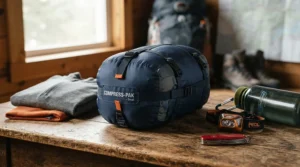
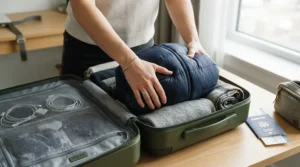
On the plane, treat the jacket like a cabin blanket. Drape it over your lap and drop your arms in when the air conditioning goes arctic. For a compact down jacket for carry-on packing, roll it loosely and stuff it into its pouch or a packing cube instead of crushing it. Down bounces back, but weeks of hard compression can dull loft over time.
Common mistakes in the first 30 days:
- Over-washing. Spot-clean small marks and follow the care label.
- Ignoring sharp objects. Thin shells snag on zippers, Velcro, and belt buckles.
- Storing it compressed. After the trip, hang it or loosely store it.
- Skipping a shell. Untreated down needs a rain layer in wet weather.
A quick maintenance schedule: shake it out after each trip, air it overnight, and wash only once or twice per season.
Real-World Scenarios: Matching the Right Jacket to Your Trip
The budget backpacker. Three weeks across Europe on low-cost carriers with a 7 kg carry-on cap, about 10 flights, temperatures from 35°F to 60°F. The Eddie Bauer CirrusLite Down Jacket or Uniqlo Ultra Light Down Jacket fits here: light enough to wear onto the plane, cheap enough that a snag isn’t a crisis, and warm enough when layered under a rain shell.
The frequent business flyer. Two or three trips a month, Chicago to New York to London, with meetings in between. The Patagonia Down Sweater Hoody is the practical choice: it looks sharp over a blazer, stays warm on freezing platforms, and durable enough for 40 or more trips a year. At a mid-$300s price, cost-per-use drops quickly.
The winter adventurer. A one-week trip to Norway or Iceland, with wind and drizzle. The Arc’teryx Cerium under a proper shell handles the swings between cold and wet better than pure down, thanks to its synthetic-reinforced zones.
The ultralight packer. Carry-on only, always. The Mountain Hardwear Ghost Whisperer leaves room for everything else, assuming your destinations skew mild and you treat the shell gently.
✨ Don’t Miss These Exclusive Deals!
🔍 Take your travel wardrobe to the next level with these carefully selected jackets. Click on any highlighted item to check current pricing and availability. These layers will help you create comfortable, stress-free trips your whole family will love! ✈️
Buyer’s Decision Framework: If Your Trip Looks Like This, Choose That
Skip the scroll and run this simple checklist:
- If your coldest day is above 45°F, choose the REI Co-op 650 Down Jacket or Uniqlo Ultra Light Down Jacket, because extra insulation is dead weight.
- If you fly budget carriers with tight weight caps, choose the Uniqlo Ultra Light Down Jacket or Mountain Hardwear Ghost Whisperer, since every ounce counts.
- If you want one jacket for everything, choose the Patagonia Down Sweater Hoody, because its balance of warmth and looks works across trips.
- If you’ll face cold and wet, choose the Arc’teryx Cerium, because synthetic zones hedge against moisture.
- If it’s your first down jacket, choose the Eddie Bauer CirrusLite Down Jacket, because low cost lowers the risk.
- If style and budget lead, consider the Orolay Packable Down Jacket after checking recent reviews.
A useful tiebreaker: imagine the worst hour of your trip, usually waiting outside in wind. Pick the jacket that gets you through that hour comfortably.
How to Choose a Lightweight Down Jacket for Travel
Choosing a travel-friendly down jacket comes down to seven decisions:
- Set your coldest realistic temperature. A jacket built for 40°F won’t rescue a Minneapolis January.
- Check fill power against your budget. Higher fill means more warmth per ounce and a smaller packed size, but 650 works fine for mild trips.
- Weigh the jacket. Under 12 ounces is comfortably packable; under 9 ounces is ultralight territory.
- Look at shell fabric. Thinner shells (10D–15D) save weight but tear more easily.
- Consider water resistance. Treated down or synthetic-reinforced zones help, but no down jacket replaces a rain shell.
- Test the fit with layers. You should fit it over a sweater without pinching.
- Confirm packing method. A stuff sack or interior pocket saves fuss when you’re rushing a connection.
Experts at Switchback Travel note that budget options often forgo built-in stuff sacks or higher-fill down, which is a worthwhile compromise for mild trips. Treat the choice as a fit for your itinerary, not a search for a “best” jacket in the abstract.
Luggage Weight Limits: How the Right Down Jacket Keeps You Under the Cap
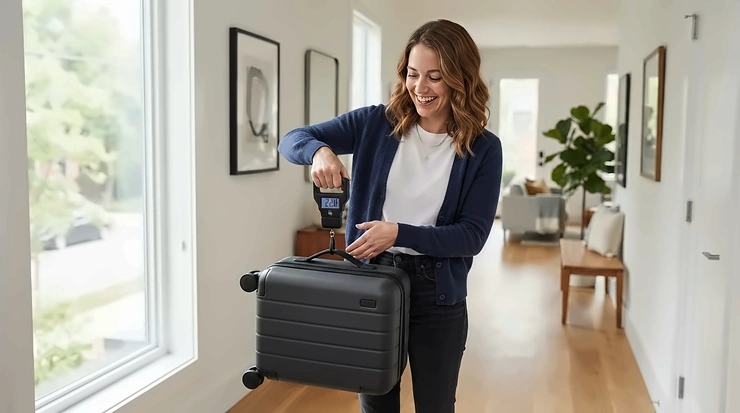
Luggage weight limits are where the smart jacket choice pays for itself. Most major U.S. airlines don’t publish a carry-on weight limit and enforce only size, but international and budget carriers often cap cabin bags around 7 to 10 kg (15 to 22 lb), and some weigh bags at the gate. The baggage allowance rules also vary by fare class, so a Basic or Light fare can shrink your allowance.
The math is simple. A bulky parka can weigh three pounds or more; a 10-ounce jacket saves roughly two pounds, about 13% of a 7 kg cap. Multiply that by a laptop, chargers, and shoes, and you can see why the jacket decides whether you check a bag.
A few honest cautions:
- Many airlines don’t weigh a coat you’re wearing, but enforcement varies, and staff can ask you to place items in your bag.
- Some carriers now combine carry-on and personal-item weight, so weigh everything at home.
- On connecting itineraries, the strictest airline’s rules generally apply.
Bottom line: a lightweight down jacket for travel is the cheapest weight-limit insurance you can buy. Confirm your airline’s current policy before you fly.
Layering for Variable Climates: A Three-Part System
Layering for variable climates works because you adjust it in minutes. Think of three parts: a base layer that manages sweat, a mid-layer that traps heat, and a shell that blocks wind and rain. A lightweight down jacket for travel is your mid-layer, and it’s the star.
Consider a trip from a 25°F morning departure to a 55°F afternoon arrival. Start with a merino or synthetic base, add the down jacket for the airport and plane, and stash it in your bag when you land. If it rains, layer a shell over the top rather than relying on a jacket’s water-repellent finish.
Trim jackets like the Arc’teryx Cerium layer best under a shell, while boxier models like the REI Co-op 650 Down Jacket suit over-the-sweater wear. The Patagonia Down Sweater Hoody sits in between. The rule of thumb: dress for the transitions, not the extremes, and keep the down layer reachable. Pack it in the top of your bag so you’re not unzipping everything at the baggage claim.

Lightweight Winter Coat for Flights: Down vs Synthetic vs Wool
Choosing a lightweight winter coat for flights means weighing three insulation families. Here’s the quick answer: down wins on warmth per ounce, synthetic wins when it’s wet, and wool wins on looks but loses on weight.
| Option | Weight & Bulk | Warmth per Ounce | Wet Weather | Best For |
|---|---|---|---|---|
| Lightweight down jacket | Very light, packs small | Highest | Weak unless treated | Cold, dry, weight-limited trips |
| Synthetic puffer | Light, bulkier | Good | Better when damp | Rainy destinations |
| Wool overcoat | Heavy, doesn’t pack | Moderate | Decent | Formal city travel |
| Fleece plus shell | Moderate | Moderate | Good with the shell | Active, changeable weather |
For most flyers, down’s small packed size and low weight make it the strongest lightweight winter coat for flights, especially on carriers that enforce luggage weight limits. If you’re headed somewhere persistently wet, a synthetic puffer or a hybrid like the Arc’teryx Cerium reduces risk. Wool looks good on a city itinerary but rarely earns its space in a carry-on.
Features That Actually Matter (And Those That Don’t)
Marketing loves a long feature list. Travel reality prefers a short one.
Features that matter:
- Fill power and fill weight. Together they tell you real warmth. Fill power alone doesn’t.
- Packed size and weight. These decide whether the jacket fits your carry-on plan.
- Secure pockets. A zippered chest or hand pocket keeps passports and phones safe through security.
- A wind-blocking shell. Wind steals warmth faster than cold air alone.
Features that don’t:
- A glossy shell. It looks sharp but rarely improves performance.
- Endless pockets. Extra pockets add weight and stitching, which mean more leak points.
- Extreme fill power for mild trips. An 850-fill jacket is overkill above 50°F.
Note that the Mountain Hardwear Ghost Whisperer proves the tradeoff: fewer features, less weight, more fragility. If you value durability over grams, the Patagonia Down Sweater Hoody offers a sturdier compromise.
Common Mistakes When Buying a Lightweight Down Jacket for Travel
Most regret comes from a handful of avoidable errors.
Buying for the wrong temperature. A 650-fill jacket rated for cool days will disappoint on a January layover, and an 850-fill parka will make you sweat in April.
Ignoring fit over layers. A trim cut looks great until you try it over a sweater. Test with the thickest layer you’ll actually wear.
Trusting the water-repellent finish. Finishes like the one on the Uniqlo Ultra Light Down Jacket handle light rain but aren’t permanent. Carry a shell.
Forgetting the shell’s fragility. Ultra-thin fabrics on jackets like the Mountain Hardwear Ghost Whisperer snag easily. Avoid tight carry-on corners and sharp zippers.
Skipping availability checks. Some options, such as the REI Co-op 650 Down Jacket and Uniqlo Ultra Light Down Jacket, sell mainly through their own retailers, so confirm stock before planning a purchase.
Chasing the lowest price. A jacket that leaks down after five wears costs more per use than a sturdier one. Think cost per trip, not sticker price.
Long-Term Cost and Care: What Your Jacket Really Costs Per Trip
Total cost of ownership matters more than checkout price. A jacket in the $100 range worn on 40 trips costs roughly $2.50 per trip, while a mid-$300s jacket worn 100 days lands at about $3.50 per wear, and often lasts longer. Durability, repairability, and warmth all shift that math.
| Tier | Examples | Price Range | What You’re Paying For | Best For |
|---|---|---|---|---|
| Budget | Orolay Packable Down Jacket, Eddie Bauer CirrusLite Down Jacket, Uniqlo Ultra Light Down Jacket | Under $150 | Basic warmth, light weight | Occasional flyers |
| Mid-range | REI Co-op 650 Down Jacket | Low-$100s | Solid value, casual styling | Casual travelers |
| Premium | Patagonia Down Sweater Hoody, Mountain Hardwear Ghost Whisperer, Arc’teryx Cerium | $300–$400+ | Higher fill, better shells, repairability | Frequent flyers |
The table shows that premium buyers are really paying for longevity and warmth-to-weight, not just brand names. Budget buyers accept a shorter lifespan in exchange for a low entry price, which is a smart trade if trips are occasional.
Care is cheap insurance. According to the American Down and Feather Council, sewn-through construction helps keep down from shifting, but the fabric and stitching still deserve gentle handling. Wash rarely with down-safe detergent, dry on low with clean tennis balls to restore loft, and patch small tears quickly. Patagonia includes repair patches, which is a quiet bonus for long-term value.
FAQ
❓ Is a lightweight down jacket for travel warm enough for winter trips?
❓ Can I wear my jacket instead of packing it to save on luggage weight limits?
❓ How small does a compact down jacket for carry-on actually pack?
❓ Is down or synthetic better for airport comfort on rainy trips?
❓ How do I clean a packable down jacket after a long trip?
Conclusion
A lightweight down jacket for travel is the rare piece of gear that gets better the more you fly. It shrinks your bag, warms your gate, and works as the middle layer in nearly any climate. The right choice depends on your coldest day, your airline’s luggage weight limits, and how gentle you’ll be with a thin shell.
For most people, the Eddie Bauer CirrusLite Down Jacket and Uniqlo Ultra Light Down Jacket are the smart, low-risk entries for mild trips. The REI Co-op 650 Down Jacket suits casual travelers on a budget, and the Orolay Packable Down Jacket is worth a look once you’ve checked recent reviews. If you want one jacket for a decade of trips, the Patagonia Down Sweater Hoody is the versatile all-rounder. Ultralight packers should look at the Mountain Hardwear Ghost Whisperer, while cold, damp destinations reward the Arc’teryx Cerium.
Whichever you pick, layer smartly, protect the shell, and confirm current pricing and availability before you buy.
Recommended for You
- Down Facket For Plus Size Women – 7 Warm Picks For 2026
- Down Jacket For College Students: 7 Best Picks For Winter 2026
- Down Jacket For Tall Men: 7 Best Picks For 2026 (Big & Tall Guide)
Disclaimer: This article contains affiliate links. As an Amazon Associate, I earn from qualifying purchases. If you purchase products through these links, we may earn a small commission at no additional cost to you.
✨ Found this helpful? Share it with your friends! 💬🤗
