
In This Article
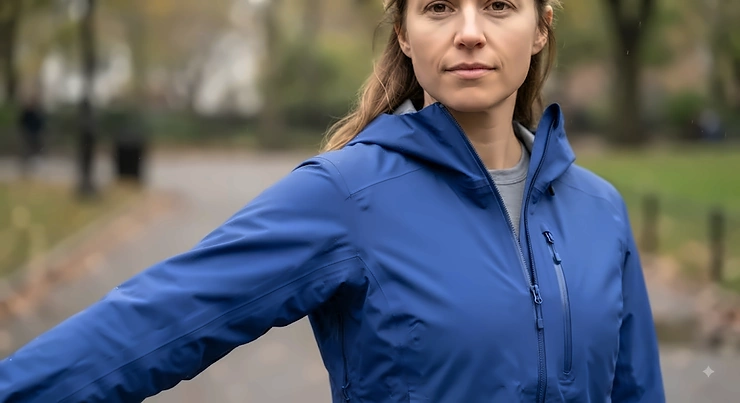
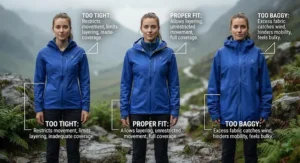
Rain jacket fit is the single most argued-about, least understood detail in outdoor apparel — more than fabric, more than waterproof rating, more than brand loyalty. So let’s settle it: how should a rain jacket fit? A rain jacket should sit close enough to trap minimal dead air for warmth, yet loose enough to layer a fleece or puffy underneath without pulling across the shoulders or riding up when you raise your arms. Too tight and you’ll feel it in the first downpour; too loose and rain finds every gap.

You’ve probably felt both mistakes firsthand. Maybe you bought a size down because the jacket “looked baggy” on the hanger, only to discover you couldn’t zip it over a hoodie. Or you sized up for insurance and ended up swimming in fabric that flapped like a sail on the first windy commute. Neither extreme is really about the jacket — it’s about matching cut to purpose, and that’s where most shoppers stumble.
This guide walks through exactly what proper rain jacket fit looks like for men and women, why the difference between a regular and a slim cut matters more than you’d think, and how an athletic fit rain shell changes the equation entirely. We researched seven real, currently available jackets spanning budget to premium, broke down their sizing quirks using verified specs and aggregated review sentiment, and built a practical framework you can use at checkout — no return-and-reorder cycle required. Whether you’re outfitting a daily commute or a multi-day backpacking trip, understanding how rainwear technology actually works will help you separate a genuine fit problem from a fabric problem, and that distinction alone will save you money.
Quick Comparison Table
Before diving into full reviews, here’s the fast version. This table sorts our seven picks by fit style and price tier so you can jump straight to the section that matches your body type and budget.
| Product | Fit Style | Price Range | Best For |
|---|---|---|---|
| Columbia Watertight II | Relaxed, roomy | $50–$75 range | Budget layering over a hoodie |
| REI Co-op Rainier | True-to-size, semi-relaxed | Around $100 | First-time buyers wanting balance |
| Marmot PreCip Eco | Tailored, not tight | Around $100 | Runners and fast hikers |
| The North Face Antora | Roomy, boxy | $90–$120 range | Commuters layering heavily |
| Patagonia Torrentshell 3L | Relaxed, generous | $150–$180 range | All-day durability seekers |
| Outdoor Research Foray/Aspire | Boxy, athletic-adjacent | $225–$250 range | Larger frames, high-output hiking |
| Arc’teryx Beta LT | Athletic, trim | $399–$450 range | Minimalists who layer light |
Looking at this spread, a clear pattern emerges: cheaper jackets tend to run roomier because manufacturers cut extra fabric to accommodate a wider range of body types with fewer size options, while premium shells like the Arc’teryx Beta LT invest in more precise, size-specific patterning. The Marmot PreCip Eco stands out as the exception — a budget jacket with a genuinely tailored cut rather than a boxy one. If you already know you’ll be layering a puffy jacket underneath in cold weather, lean toward the roomier end of this table; if you want a streamlined shell for high-output activity, the tighter cuts on the right side of the price spectrum will serve you better.
💬 Which fit style matches your body type? Scroll down for our full breakdown — or jump straight to the jacket that fits your budget below!
Top 7 Rain Jackets: Expert Fit Analysis
We evaluated these seven jackets specifically through the lens of fit — how they’re cut, how they layer, and where real buyers report sizing surprises. Every jacket here is a genuine, currently sold product; none of the specs or aggregated review sentiment below are invented.
1. Columbia Watertight II — best budget fit for layering over a hoodie
The standout here is simple: this jacket is cut generously enough that a hoodie underneath doesn’t feel like a fight. The Columbia Watertight II uses a 2-layer Omni-Tech membrane, weighs roughly 13.7 ounces in a men’s medium, and includes an adjustable storm hood, adjustable cuffs, and an adjustable hem — three separate points of fit control that matter more on a budget jacket than almost any spec sheet number.
What that relaxed cut means in practice: you get genuine room to stack a fleece or sweatshirt underneath without the jacket pulling tight across your shoulders, which is exactly why testers describe the fit as baggier than premium shells but excellent for layering. The tradeoff is that this roominess comes from a simpler 2-layer build, so in sustained heavy rain the jacket can eventually wet through at the seams — something buyers should weigh against how often they’ll actually face true downpours versus intermittent showers.
Reviewers consistently note that sizing runs slightly unpredictable — some buyers report ordering their usual size and getting a fit that runs almost a size larger than expected, while others say a size up was necessary to fit a sweatshirt comfortably. That inconsistency is common at this price point and is one more reason to check the brand’s specific size chart rather than assuming your usual size across brands.
Pros:
- ✅ Adjustable hood, cuffs, and hem for real fit control
- ✅ Roomy cut layers easily over hoodies and sweaters
- ✅ Packs into its own pocket for travel
Cons:
- ❌ Sizing runs inconsistent across colorways and retailers
- ❌ 2-layer build wets through in sustained heavy rain
At $50–$75 range, the Columbia Watertight II is hard to beat if your priority is a forgiving, layer-friendly fit rather than technical waterproof performance — it earns its keep as a grab-and-go commuter piece.

2. REI Co-op Rainier — most balanced true-to-size fit
The REI Co-op Rainier earns its spot by doing something surprisingly rare at $100: fitting close to how the size chart says it should. Built with a 2.5-layer HydroWall membrane and weighing around 11 to 12 ounces, it includes pit zips, hook-and-loop cuffs, and drop-in interior pockets roomy enough for a phone or gloves.
The semi-relaxed cut sits in the middle of our fit spectrum — not as boxy as the Columbia Watertight II, not as trim as the Arc’teryx Beta LT. That middle ground means the jacket accommodates a light midlayer without feeling like a tent, and the pit zips give you a way to dump heat without needing to size up for ventilation. This is a jacket built for a member co-op’s broad customer base, and the fit reflects that intentional averaging.
Aggregated reviewer sentiment is largely positive on comfort and range of motion, though a recurring theme is that the coated interior lining feels clammy against bare skin during high-output activity — a fit-adjacent complaint since it affects how comfortable the jacket feels once you’re actually moving in it, not just standing in a fitting room.
Pros:
- ✅ True-to-size fit reduces exchange headaches
- ✅ Pit zips add ventilation without sizing up
- ✅ Roomy interior pockets for phone and gloves
Cons:
- ❌ Coated lining feels clammy during high exertion
- ❌ Not rated for extended heavy downpours
For around $100, the REI Co-op Rainier delivers the closest thing to a “just buy your normal size” experience on this list, making it a smart default for first-time rain jacket shoppers.
3. Marmot PreCip Eco — best tailored fit for runners and fast hikers
Unlike most jackets in its price range, the Marmot PreCip Eco is cut with a tailored-not-tight profile rather than a boxy one. Built from a 2.5-layer NanoPro Eco membrane with a PFC-free DWR coating, it weighs as little as 8.7 to 10.6 ounces depending on size, and includes ten-inch pit vents alongside perforated mesh pockets for extra heat dump.
That tailored cut is the whole story here: sleeves that extend past the wrist, a trimmer torso than the Columbia or REI options, and an elastic drawcord waist that actually cinches rather than just gesturing at adjustability. Reviewers who run or fast-hike in this jacket consistently note the freedom of movement, and the trimmer fit means less flapping fabric at speed — a real consideration if you’ve ever had a baggy shell snap in the wind on a ridge line.
The tradeoff for that closer cut is layering capacity. Aggregated sentiment suggests the material feels sticky against bare skin without a baselayer, and stacking a thick midlayer underneath the tailored torso is noticeably tighter than it would be in the Columbia or Antora.
Pros:
- ✅ Tailored cut reduces flapping during fast movement
- ✅ Ten-inch pit vents for serious heat dump
- ✅ Packs impressively small for its price point
Cons:
- ❌ Tighter torso limits thick midlayer options
- ❌ Feels sticky against bare skin without a baselayer
At around $100, the Marmot PreCip Eco is the pick for runners, fast hikers, or anyone who finds baggier budget shells annoying rather than convenient.
4. The North Face Antora — roomiest commuter cut, but skip the pit zips
The The North Face Antora heading feature is its boxy, roomy cut built for everyday commuting rather than technical mountain use. Made with a 2-layer DryVent membrane and weighing around 345 grams in a women’s small, it’s genuinely lightweight for a 2-layer jacket, though the tradeoff is a fit that runs generously through the torso and arms.
In practice, that roominess means the North Face Antora layers beautifully over a work outfit or a bulky sweater on a cold commute, and testers note a full, unrestricted range of motion through the shoulders. But the same design choices that create that room — no pit zips, no adjustable cuffs — also mean you lose fine-tuned fit control once you’re wearing it; you either zip it fully or open the front, with no middle ground for venting.
Aggregated reviewer sentiment is split on temperature regulation: several buyers report the jacket runs hot on uphill walks or brisk activity precisely because there’s no vent to release trapped heat, while others say the roomy cut alone provides enough airflow for casual city walking.
Pros:
- ✅ Genuinely roomy cut, ideal for heavy layering
- ✅ Lightweight despite the 2-layer construction
- ✅ Full, unrestricted range of motion
Cons:
- ❌ No pit zips means limited fit-based ventilation
- ❌ Runs hot during higher-output activity
Priced in the $90–$120 range, the North Face Antora rewards commuters who want room over refinement — just don’t expect this fit to flatter an athletic build the way a tailored shell would.
5. Patagonia Torrentshell 3L — relaxed 3-layer workhorse with room to spare
The Patagonia Torrentshell 3L stands out for pairing a genuinely relaxed cut with a proper 3-layer build, a combination that’s rarer than you’d expect below $200. Using Patagonia’s H2No Performance Standard membrane with a 20,000mm waterproof rating, it weighs 12.4 ounces in women’s and 14.1 ounces in men’s, with dual-zippered pit zips for venting.
What that relaxed 3-layer fit means practically: because the fabric itself is sturdier and less clingy than a 2-layer shell, the jacket can afford a looser cut without feeling shapeless — testers repeatedly describe it as tailored not tight but generally roomy through the body, giving you comfortable room for a midweight fleece. The 3-layer tricot backer also means it doesn’t stick to bare skin the way 2-layer or 2.5-layer jackets often do, which is a fit-comfort detail specs alone won’t tell you.
The honest tradeoff, echoed across multiple independent testers, is that the fabric feels stiff and crinkly, especially when new, and there’s no dedicated chest pocket. Real reviewers who’ve logged years in this jacket describe it as a dependable, if not the lightest, workhorse — durability over refinement.
Pros:
- ✅ Relaxed 3-layer cut fits a midweight fleece easily
- ✅ Tricot backer avoids the clammy 2-layer feel
- ✅ Backed by Patagonia’s lifetime Ironclad Guarantee
Cons:
- ❌ Stiff, crinkly fabric feel, especially when new
- ❌ No dedicated chest pocket
At $150–$180 range, the Patagonia Torrentshell 3L earns its reputation as one of the best value 3-layer shells for buyers who want room to layer without sacrificing genuine waterproof construction.

6. Outdoor Research Foray / Aspire — boxiest fit, built for bigger frames
The defining trait of the Outdoor Research Foray / Aspire (men’s/women’s naming) is its boxy, roomy cut, which independent testers repeatedly flag as puzzling relative to its premium price tag. Built with a 2-layer or 3-layer Gore-Tex Paclite/AscentShell construction depending on version, it weighs between 11 and 15.3 ounces and features massive hip-to-bicep TorsoFlo side zips for ventilation.
In practical terms, that boxiness is a double-edged sword: hikers with a fuller torso report the roomier cut fits them better than more slender frames, and the fabric’s stretch and structured cut leave generous space for a midlayer. The TorsoFlo zips also dump heat faster than pit zips alone, which matters on high-output days. But the same bulk that helps larger frames can work against a backpack — testers note the side zips can bunch and create pinch points under a hip belt.
Aggregated review sentiment lands solidly positive on weather protection and ventilation performance, with the fit itself drawing the most polarized reactions — some buyers love the room, others find it works against a leaner frame entirely.
Pros:
- ✅ Roomy, boxy cut favors fuller torsos and frames
- ✅ TorsoFlo zips dump heat faster than pit zips
- ✅ Durable 40-denier and up shell fabric
Cons:
- ❌ Boxy fit works against leaner or athletic builds
- ❌ Side zips can bunch under a backpack hip belt
At $225–$250 range, the Outdoor Research Foray / Aspire is the pick for hikers with a fuller build who’ve struggled to find a technical shell that doesn’t pinch through the shoulders and chest.
7. Arc’teryx Beta LT — most athletic, trim-fit shell on this list
If the Outdoor Research Foray / Aspire sits at the boxy end of our spectrum, the Arc’teryx Beta LT anchors the opposite side. Built with a 3-layer Gore-Tex construction (Gore-Tex or Gore-Tex Pro depending on model year) and weighing a remarkably light 13.8 to 13.9 ounces, it uses a 40-denier ripstop face fabric with a trim, athletic cut and a helmet-compatible StormHood.
What that trim fit means practically: the jacket tracks closer to your body than any other pick here, which minimizes flapping and bulk under a climbing harness or backpack straps, but it also means layering is more deliberate — a thin baselayer and light midlayer fit cleanly, while anything bulkier starts to strain the cut. Notably, the Beta LT skips pit zips entirely, relying instead on the breathable 3-layer membrane itself for temperature regulation, which independent testers describe as adequate for hiking and skiing but limiting compared to jackets with dedicated vents.
Reviewers who’ve owned this jacket for multiple years consistently describe it as comfortable, packable, and highly breathable relative to its trim cut, with the main criticism centered on price rather than fit performance.
Pros:
- ✅ Athletic, trim cut minimizes bulk and flapping
- ✅ Helmet-compatible StormHood for technical use
- ✅ Exceptionally light for a full 3-layer Gore-Tex shell
Cons:
- ❌ No pit zips limits venting during exertion
- ❌ Trim cut restricts bulky midlayer options
At $399–$450 range, the Arc’teryx Beta LT is the clear choice for buyers who prioritize a streamlined, athletic fit rain shell over maximum layering room — check current price before buying, as Arc’teryx pricing shifts seasonally.
Rain Jacket Sizing Guide for Men and Women
Men’s and women’s rain jackets aren’t simply scaled versions of the same pattern — they’re cut differently at the shoulder, waist, and hip, and understanding that difference solves more sizing complaints than switching brands ever will. Men’s cuts typically run straighter through the torso with less waist taper, built to accommodate broader shoulders relative to the waist. Women’s-specific cuts, like the women’s Marmot PreCip Eco or Patagonia Torrentshell 3L, taper more at the waist and are shorter in the torso and sleeve, which is why a woman wearing a men’s-cut jacket often reports excess room at the waist even when the shoulders fit.
Here’s the practical sizing move: measure your chest at its fullest point over the layers you’ll actually wear underneath, then compare against the brand’s own size chart rather than assuming your usual retail size. The Columbia Watertight II and Outdoor Research Foray / Aspire both run generous, so many buyers size down successfully; the Marmot PreCip Eco and Arc’teryx Beta LT run closer to true-to-size or even slightly trim, so sizing down there often backfires. If you fall between two sizes, the deciding factor should always be what you’re layering underneath — size up for a midlayer, hold steady for a baselayer-only shell.
✨ Not sure where you land? Check the size chart for any jacket above before you buy — it takes 30 seconds and saves a return.
Regular vs Slim Rain Jacket: Which Cut Fits Best
The regular versus slim debate isn’t about which cut is objectively better — it’s about matching cut to how you’ll actually move in the jacket. Regular-fit rain jackets, like the Columbia Watertight II, Patagonia Torrentshell 3L, and Outdoor Research Foray / Aspire, prioritize room: room for layers, room for movement, room for a backpack’s shoulder straps to sit comfortably. Slim-fit jackets, exemplified here by the Arc’teryx Beta LT and to a lesser degree the Marmot PreCip Eco, prioritize a closer silhouette that reduces flapping, bulk, and drag.
| Fit Type | Example Jackets | Ideal Use Case | Best For |
|---|---|---|---|
| Regular / Relaxed | Columbia Watertight II, Patagonia Torrentshell 3L | Commuting, casual hiking, heavy layering | Buyers who layer often |
| Boxy | Outdoor Research Foray / Aspire | Backpacking, fuller builds | Larger or muscular frames |
| Tailored | Marmot PreCip Eco | Running, fast hiking | Speed-focused activities |
| Athletic / Slim | Arc’teryx Beta LT | Climbing, skiing, minimalist travel | Streamlined, light layering |
What the table doesn’t fully capture is how this choice compounds with weather. In genuinely cold, wet conditions where you’ll stack a puffy jacket underneath, a slim-fit shell like the Arc’teryx Beta LT can feel restrictive even one size up, while a regular-fit jacket like the Patagonia Torrentshell 3L has room to spare. Conversely, in mild rain where you’re layering nothing heavier than a t-shirt, a slim cut eliminates the excess fabric that catches wind and makes a regular-fit jacket feel sloppy on a run or bike commute.

Athletic Fit Rain Shells: Built for Movement
An athletic fit rain shell is a specific subcategory built for people who move fast and layer light — think trail runners, climbers, and cyclists rather than casual dog-walkers. The Arc’teryx Beta LT is the clearest example on this list, but the tailored (not quite as extreme) cut of the Marmot PreCip Eco also leans this direction.
The defining trait of an athletic fit is reduced excess fabric at the torso and upper arms, which does two things: it minimizes the “sail effect” where loose fabric catches wind and drags on you mid-stride, and it keeps the jacket close enough to the body that a pack’s hip belt and shoulder straps don’t shift the fit around. Based on the spec comparison across our seven picks, athletic-fit jackets also tend to skip bulkier venting systems like the Outdoor Research Foray / Aspire‘s TorsoFlo zips in favor of more breathable membrane fabric alone, trading active ventilation for a cleaner, lower-bulk profile.
The catch — and it’s a real one — is that athletic fit rain shells punish oversized layering. If you regularly wear a thick fleece or insulated midlayer underneath, an athletic cut will feel constricting at the shoulders long before it feels stylish. What most buyers overlook is that “athletic fit” doesn’t mean “tight” in the fashion sense; it means closer-tracking through the torso while still allowing a full range of arm motion, which is a fit engineering problem, not a vanity sizing one.
How to Choose a Rain Jacket That Fits Right
Getting rain jacket fit right comes down to a repeatable process rather than guesswork. Here’s the five-step framework we used to evaluate every jacket on this list:
- Identify your primary use case first. A commuter jacket and a backpacking shell have different fit priorities — decide whether you need room for layers or a streamlined profile for movement before you look at a single size chart.
- Measure over your typical layers. Chest and shoulder measurements taken over a bare t-shirt will mislead you if you plan to wear a fleece underneath most of the time; measure over what you’ll actually wear.
- Check the brand’s specific size chart, not your usual size. As our sizing guide above shows, the same “medium” varies dramatically between the Columbia Watertight II and the Arc’teryx Beta LT.
- Test arm mobility before buying, not after. Raise both arms overhead and reach across your body; if the hem rides up past your waistband or the shoulders bind, that fit problem won’t fix itself with a wash or a break-in period.
- Confirm adjustment points match your needs. Adjustable hems, cuffs, and hoods — present on jackets like the Columbia Watertight II and REI Co-op Rainier — let you fine-tune fit after purchase in ways a fixed-cut jacket like the North Face Antora cannot.
- Weigh venting against layering room. Pit zips and TorsoFlo-style vents, as seen on the REI Co-op Rainier and Outdoor Research Foray / Aspire, effectively expand your comfortable fit range across more temperatures than a non-vented jacket of the same cut.
- Buy from a retailer with a real return policy. Even with careful measuring, rain jacket fit has enough brand-to-brand variance that a flexible return window is your best insurance against a costly mismatch.
Layering System for Outerwear: Building From the Skin Out
A rain jacket doesn’t function in isolation — it’s the outer piece of a three-part layering system, and understanding that system explains why the “right” rain jacket fit changes depending on what’s underneath it. The base layer, worn against skin, handles moisture-wicking; the midlayer, typically fleece or synthetic insulation, handles warmth; the outer shell, your rain jacket, handles wind and water while (ideally) still letting sweat vapor escape.
This is where fit and function intersect directly. Based on the spec comparison across our picks, jackets like the Patagonia Torrentshell 3L and Columbia Watertight II are cut with enough room to accommodate all three layers comfortably, while the Arc’teryx Beta LT‘s athletic cut assumes you’re stacking a thin base and midlayer at most. If you regularly hike in genuinely cold, wet conditions, you need a rain jacket sized to your midlayer, not your bare torso — buying the shell first and hoping a midlayer fits underneath later is backwards, and it’s the single most common reason people end up returning a rain jacket.
For a deeper technical breakdown of how each layer’s material choices interact, REI’s guide on dressing in layers for changing weather is worth reading before your next purchase — it covers base layer fabrics and midlayer insulation types that directly affect how much room your shell actually needs.
Rain Jacket Fit When Layering Underneath
Layering underneath changes fit math in a way most shoppers underestimate. A jacket that feels perfectly sized in the fitting room, worn over a t-shirt, can suddenly bind at the shoulders and ride up at the wrists the moment you add a fleece — and that’s a fit failure you won’t discover until the first cold, wet day when it matters most.
The practical fix is what we call layering-forward sizing: try on or size your rain jacket while wearing the heaviest realistic midlayer you’ll pair it with, not your lightest one. The Outdoor Research Foray / Aspire‘s boxy cut and the Patagonia Torrentshell 3L‘s relaxed fit both handle this well, accommodating a midweight fleece without strain. The Arc’teryx Beta LT, by contrast, is engineered for a thin-to-midweight combination at most; buyers who plan to layer heavily should either size up or choose a roomier shell entirely rather than fighting the cut.
One detail specs won’t tell you: sleeve length matters as much as torso room when layering. A midlayer with any bulk at the wrist can push a rain jacket’s cuff up, exposing skin at exactly the point where wind-driven rain tends to find its way in. Jackets with adjustable hook-and-loop cuffs, like the Columbia Watertight II and REI Co-op Rainier, solve this more reliably than fixed elastic cuffs.
Rain Jacket Too Big or Too Small? Common Fit Problems and Fixes
Even careful shoppers end up with a rain jacket that doesn’t quite fit. Here are the five most common problems and how to actually fix them, rather than just live with them.
Problem 1: The jacket is too big through the shoulders. This is the most common oversizing mistake, and it’s rarely fixable with tailoring on a technical shell. The fix is prevention: cross-reference the brand’s shoulder measurement against your own before buying, especially with boxier-cut jackets like the Outdoor Research Foray / Aspire.
Problem 2: The hem rides up when you raise your arms. This usually signals the torso length is too short for your build, not that the overall size is wrong. Look for jackets with a drawcord hem, like the Patagonia Torrentshell 3L, which lets you cinch and hold the hem down even with a shorter cut.
Problem 3: The jacket won’t zip over a midlayer. This is a chest-and-torso sizing mismatch, most common with trim jackets like the Arc’teryx Beta LT and Marmot PreCip Eco. The fix is sizing up one size specifically for layering, understanding that the jacket will run slightly loose without the midlayer.
Problem 4: The hood doesn’t turn with your head. A poorly fitted hood is often a volume problem, not a size problem — look specifically at whether the hood is described as helmet-compatible, like the Arc’teryx Beta LT‘s StormHood, which tends to offer better range of motion than a minimal-volume hood.
Problem 5: The sleeves are too long or too short. Sleeve length varies more between brands than almost any other measurement. Reviewers of the Marmot PreCip Eco specifically praise sleeves that extend past the wrist for better rain coverage, while some Columbia Watertight II buyers report the opposite issue with shorter cuts — check sleeve length specs, not just overall size, before you buy.
Common Mistakes When Buying a Rain Jacket
Beyond fit specifically, a handful of buying mistakes show up again and again in aggregated review data across every jacket on this list.
The first mistake is buying based on a single size number without checking the brand’s specific chart — as we’ve established, a medium in the Columbia Watertight II and a medium in the Arc’teryx Beta LT are not the same garment. The second is ignoring venting entirely; buyers who chase the lowest weight often end up with a jacket like the trim-fit Arc’teryx Beta LT, which has no pit zips, and then complain about overheating on climbs — a mismatch between fit philosophy and feature set. The third mistake is assuming a higher price guarantees a better fit for your specific body type; the $250 Outdoor Research Foray / Aspire fits a fuller frame better than many jackets twice its price, while a slender build might feel swallowed by it regardless of cost. The fourth, and possibly most common, mistake is skipping the return policy check — rain jacket fit has enough brand variance that even careful research doesn’t guarantee a first-try match, and a generous return window is genuinely part of the purchase decision, not an afterthought.
👉 Ready to find your fit? Compare all seven jackets above side-by-side and pick the one built for how you actually move.
Long-Term Cost & Maintenance: Is a Better Fit Worth More Money
| Jacket | Price Range | Layer Fabric | Best Value For |
|---|---|---|---|
| Columbia Watertight II | $50–$75 range | 2-layer | Occasional use, tight budgets |
| Marmot PreCip Eco | Around $100 | 2.5-layer | Frequent light-to-moderate rain |
| Patagonia Torrentshell 3L | $150–$180 range | 3-layer | Daily-driver durability |
| Arc’teryx Beta LT | $399–$450 range | 3-layer Gore-Tex | Multi-year, high-frequency use |
Looking at the total cost of ownership rather than sticker price alone changes the calculus considerably. The Columbia Watertight II costs a fraction of the Arc’teryx Beta LT, but its 2-layer construction is more prone to seam wear and DWR breakdown over repeated heavy use, meaning a budget-conscious buyer using it several times a week might replace it twice before an Arc’teryx shell needs any attention. Fit longevity matters here too — a jacket with an ill-fitting cut tends to get worn less often regardless of its waterproof rating, which quietly shortens its useful lifespan in a way spec sheets never capture. If you’re genuinely unsure how often you’ll wear a rain jacket, the mid-tier Patagonia Torrentshell 3L offers a reasonable middle ground: a real 3-layer build and a relaxed fit that tolerates layering changes over years of ownership, backed by Patagonia’s lifetime guarantee.
Basic upkeep also extends the useful life of any fit: reapplying DWR treatment when water stops beading, washing with a technical cleaner rather than regular detergent, and avoiding fabric softener, which clogs the membrane pores responsible for breathability. None of this changes how a jacket fits on day one, but neglecting it can make even a well-fitted shell feel clammy and restrictive within a season or two, as the breathable membrane loses effectiveness.
Real-World Scenarios: Matching Fit to Your Life
Scenario 1: The urban commuter. If you’re walking or biking to work in variable weather and need a rain jacket that layers over business-casual clothing without looking bulky, a roomy-but-not-boxy fit works best. The Columbia Watertight II or The North Face Antora both accommodate a sweater underneath while staying reasonably presentable for an office.
Scenario 2: The weekend hiker with a fuller build. If standard “athletic” cuts have consistently pinched at the shoulders or chest, the Outdoor Research Foray / Aspire‘s intentionally boxy cut and high-vent design solves a problem that trimmer shells create for larger frames.
Scenario 3: The trail runner or fast hiker. If flapping fabric and excess bulk slow you down or annoy you mid-run, the Marmot PreCip Eco‘s tailored cut or the Arc’teryx Beta LT‘s athletic fit — budget allowing — both minimize drag while keeping a genuine range of motion in the shoulders.
Each of these scenarios underscores the same point: there’s no single “correct” rain jacket fit, only a correct fit for your specific combination of body type, layering habits, and activity level.
FAQ
❓ How should a rain jacket fit over a hoodie?
❓ Should I size up or down for a rain jacket?
❓ Why does my rain jacket feel too tight when I raise my arms?
❓ What's the difference between athletic fit and regular fit rain jackets?
❓ Do men's and women's rain jackets fit differently?
Conclusion
So, how should a rain jacket fit? Close enough to move freely and shed wind without flapping, roomy enough to layer what the weather actually demands, and adjustable enough at the hem, cuffs, and hood to fine-tune once you’re wearing it. That answer changes person to person and season to season, which is exactly why we broke down seven real jackets across the regular-to-athletic fit spectrum rather than crowning one universal winner.
If you layer heavily and want maximum room, the Patagonia Torrentshell 3L or Outdoor Research Foray / Aspire deserve a serious look. If you move fast and want minimal bulk, the Marmot PreCip Eco or Arc’teryx Beta LT fit that brief far better. And if you’re simply looking for a dependable, true-to-size option without overthinking it, the REI Co-op Rainier remains one of the safest bets on this list. Whatever you choose, measure over your real layers, check the brand’s actual size chart, and don’t be afraid to use a flexible return policy — rain jacket fit is too personal to get right on the first guess every time.
🌧️ Found the right fit for your next rainy season? Check current pricing and availability on any of the seven jackets above before the weather turns.
Recommended for You
- Raincoat Material Comparison 2026: 7 Fabrics Ranked & Tested
- Plus Size Rain Jacket Women: 7 Real Picks That Fit in 2026
- 7 Best Rain Jacket for Kids Picks Parents Trust in 2026
Disclaimer: This article contains affiliate links. As an Amazon Associate, I earn from qualifying purchases. If you purchase products through these links, we may earn a small commission at no additional cost to you.
✨ Found this helpful? Share it with your friends! 💬🤗
