
In This Article
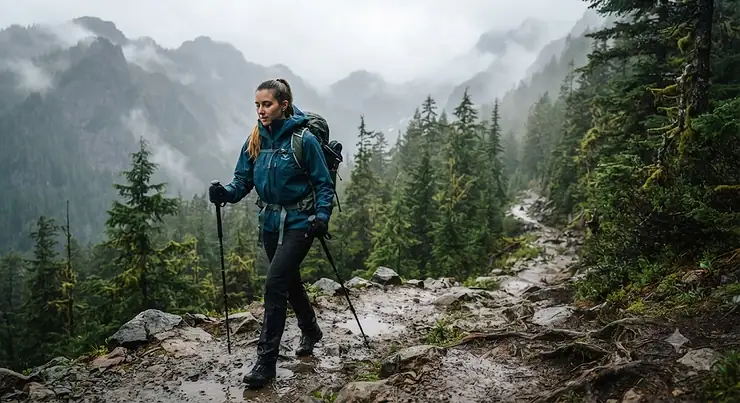
Somewhere around mile six of a “clear” forecast, the sky changes its mind. You feel the first fat drop hit your neck, then another, then the kind of steady curtain rain that doesn’t care about your plans — and suddenly the only piece of gear standing between you and a genuinely miserable, possibly dangerous hike is whatever you shoved into the top of your pack that morning. A rain jacket for hiking is a waterproof, breathable outer shell built specifically to keep precipitation and wind off your body while venting the heat and sweat you generate on the move, so you stay both dry and warm rather than trading one problem for the other. That single design tension — keep water out, let moisture escape — is what separates a genuine hiking shell from a cheap poncho or a fashion raincoat, and it’s the thread running through everything below. This guide walks through seven real, currently available jackets spanning budget to premium, plus the comparison tables, feature breakdowns, and buying logic you need to pick correctly the first time. We researched specs, aggregated review sentiment, and current regulatory context so you’re not just staring at a wall of technical fabric names wondering what any of it actually means on the trail.
Quick Comparison Table
Before the deep dive, here’s the fast answer for people who want to skim and go. This table is deliberately short — five rows, the essentials only — because that’s usually all you need to narrow seven options down to two or three real contenders.
| Jacket | Best For | Weight | Price Range |
|---|---|---|---|
| REI Co-op Rainier Rain Jacket | Budget-conscious hikers | ~13 oz | Under $100 |
| Patagonia Torrentshell 3L | Best all-around hiking jacket | ~12 oz | $150–$180 |
| Outdoor Research Helium UL | Packable ultralight backpacking | ~5.7 oz | $170–$200 |
| Montbell Versalite | Ultralight in wet climates | ~6.5 oz | $200–$260 |
| Arc’teryx Beta SL | Premium hardshell hiking jacket | ~10 oz | $350–$400 |
At a glance, the spread tells its own story: weight and price climb together almost in lockstep, and the jump from a 13-ounce budget shell to a 5.7-ounce ultralight one costs roughly double the money for less than half the fabric. That’s not a coincidence — thinner, more advanced membranes cost more to engineer and manufacture, but they also pack smaller and disappear in your pack until you actually need them. If you’re doing occasional day hikes, the weight difference barely registers. If you’re logging 20-mile days on a thru-hike, those ounces compound into real fatigue by week three.
💬 Bookmark this table now — you’ll want it later when you’re comparing your shortlist.
Top 7 Rain Jackets for Hiking: Expert Analysis
We picked these seven to cover every realistic hiking budget and use case: dependable budget shells, the reigning do-it-all favorite, and the featherweight options serious backpackers obsess over.
1. REI Co-op Rainier Rain Jacket — best budget pick under $100
The Rainier is proof that a jacket doesn’t need a four-figure R&D budget to keep you dry on a normal day hike. Built with REI’s in-house HydroWall waterproof-breathable coating over a 2.5-layer construction, it trades the ultra-premium membrane tech of pricier shells for a straightforward, no-drama build that gets the fundamentals right: fully taped seams, a wired, adjustable hood, and pit zips that actually vent when you’re huffing up a switchback. Based on the spec comparison against other sub-$100 shells, the Rainier punches noticeably above its price class — most jackets this cheap skip taped seams entirely, which is where budget rain gear usually fails first. Reviewers consistently note that it holds up well through a full thru-hike’s worth of wear, which is a genuinely rare claim for gear at this price point. This is the jacket for someone doing weekend day hikes, car camping, or a first backpacking trip who doesn’t want to gamble $400 on gear they’re not sure they’ll use every month. The tradeoff is honest: HydroWall isn’t as consistently reliable as Gore-Tex in sustained, driving rain, and the pockets aren’t hipbelt-compatible, so if you’re running a hipbelt with pockets of its own, expect some overlap friction.
Pros:
- ✅ Full taped seams and pit zips at a sub-$100 price
- ✅ Durable enough to survive an entire thru-hike
- ✅ Adjustable hood, cuffs, and hem for a dialed fit
Cons:
- ❌ In-house coating less reliable than Gore-Tex in sustained rain
- ❌ Pockets aren’t compatible with hipbelt pack straps
The REI Co-op Rainier Rain Jacket typically runs under $100, and for occasional hikers, that’s close to the best dollar-per-dry-day ratio on this entire list — check current price and availability before you head out.
2. Marmot PreCip Eco — best entry-level pick with full pit zips
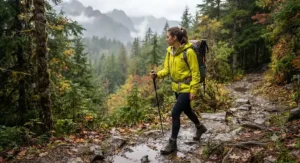
Marmot’s PreCip line has been a gateway rain jacket for backpackers for close to two decades, and the Eco version updates that legacy with a recycled face fabric and a PFC-free DWR (durable water repellent) finish, without abandoning the low price that made the original a staple. What most buyers overlook about this model is that “full pit zips” — as opposed to the half-length zips some budget jackets use — genuinely change how the jacket performs on a climb, letting you dump heat from your entire underarm rather than a six-inch slit. The 2.5-layer construction keeps weight reasonable while the fabric itself does the double duty of blocking rain and wicking condensation outward. This is a strong first rain jacket for someone stepping up from a poncho or windbreaker into real backpacking, especially in humid climates where pit zip airflow matters as much as the waterproof rating on the tag. Aggregated review sentiment across major retailers points to consistent praise for value and fit, with the recurring complaint being that the interior liner can feel slightly clammy on long, sweaty climbs compared to pricier 3-layer builds. Reviewers frequently mention it as their go-to for shoulder-season trips where conditions swing between drizzle and full sun in the same afternoon.
Pros:
- ✅ Recycled, PFC-free fabric with genuine sustainability credentials
- ✅ Full-length pit zips for real ventilation, not token slits
- ✅ Proven, long-running design with a loyal following
Cons:
- ❌ Interior can feel clammy during high-exertion climbs
- ❌ 2.5-layer build is less durable than 3-layer alternatives
Priced generally under $150, the Marmot PreCip Eco sits in the sweet spot between disposable rain gear and a serious investment piece — verify the current price before adding it to your cart.
3. Patagonia Torrentshell 3L — best overall hiking jacket
If you asked ten thru-hikers which rain jacket they’d grab if they could only own one, an outsized number would say the Torrentshell 3L, and the reasoning holds up under scrutiny. This is a genuine 3-layer laminated Gore-Tex shell — not a 2.5-layer coating dressed up to look like one — which means the waterproof membrane is bonded between an outer face fabric and an inner protective layer, adding durability and a noticeably less clammy feel against the skin. On paper this means a jacket that shrugs off sustained downpours rather than just short showers, and the roughly 28,000mm waterproof rating backs that up on the high end of what hikers actually need. Here’s what to weigh: at 12 ounces for the men’s cut (10.6 oz women’s), it’s not the lightest jacket on this list, but it’s light enough to disappear in a daypack while offering more real-world durability than most ultralight competitors. The hood’s oversized visor and roll-away design are the kind of small detail that separates a jacket designed by people who actually hike from one designed purely on a spec sheet. Reviewers consistently highlight the hood staying put in high wind — a detail that matters far more on an exposed ridgeline than any number on a tag — and the PFAS-free membrane means it’s already compliant with the wave of state chemical regulations discussed later in this guide.
Pros:
- ✅ Genuine 3-layer Gore-Tex construction, not a coated 2.5L
- ✅ Hood stays secure in high wind, unusual at this price
- ✅ PFAS-free membrane, ahead of incoming state regulations
Cons:
- ❌ Pricier than 2.5-layer budget alternatives
- ❌ Sizing runs narrower than some competing brands
Expect the Patagonia Torrentshell 3L to land in the $150–$180 range depending on color and size — check current pricing, since Patagonia periodically retires colorways at a discount.
4. Mountain Hardwear Stretch Ozonic — best for comfort and mobility
Most rain jackets fight you a little when you reach overhead to grab a branch or scramble up a rock step — the fabric is stiff, the cut is boxy, and you feel every seam. The Stretch Ozonic solves that with genuine four-way stretch fabric that moves with your shoulders instead of against them, which reviewers who’ve logged hundreds of miles in it describe as feeling closer to a soft-shell than a traditional hard rain shell. Based on the spec comparison, the tradeoff for that stretch and softness is a slightly lower hydrostatic head rating than the stiffer, more technical shells on this list — this isn’t the jacket for a multi-day monsoon, but for typical trail conditions it’s more than sufficient. What stands out is the quiet factor: because the face fabric isn’t the crinkly, drum-tight nylon common on hardshells, you can actually hear your hiking partner talk with the hood up, which sounds trivial until you’ve spent a windy afternoon shouting over jacket noise. This is the pick for hikers who prioritize all-day comfort and freedom of movement over maximum waterproof performance — trail runners, scramblers, and anyone doing technical terrain where mobility outranks bombproof protection. Underarm gussets add extra range of motion for reaching and climbing that a standard-cut shell simply can’t match.
Pros:
- ✅ Genuine four-way stretch fabric moves with your body
- ✅ Noticeably quieter than stiff, crinkly hardshell fabrics
- ✅ Underarm gussets add real range of motion for scrambling
Cons:
- ❌ Lower waterproof rating than 3-layer Gore-Tex competitors
- ❌ Not built for multi-day sustained downpours
The Mountain Hardwear Stretch Ozonic generally sits in the $180–$220 range — check current pricing, since Mountain Hardwear runs seasonal promotions fairly often.
5. Outdoor Research Helium UL — best packable ultralight pick
At 5.7 ounces, the Helium UL barely registers as weight in your pack, and that’s the entire point: this is a “just in case” jacket built for hikers who want waterproof insurance without dedicating pack space or shoulder fatigue to it. The 2.75-layer Toray Dermizax fabric is a genuinely newer low-bulk construction, and reviewers who thru-hiked long trails in it describe excellent value for a jacket that packs down small enough to double as a stuff sack via its own chest pocket. What the spec sheet won’t tell you, but long-distance hikers note repeatedly, is that this jacket shines specifically in shorter exposure windows — a passing thunderstorm, a misty morning descent — rather than days of continuous soaking, where its minimalist single-pocket, no-liner design has less margin than heavier shells. The wired brim on the hood is a small but meaningful detail: it holds its shape instead of collapsing into your peripheral vision the moment wind picks up. For trail runners and fastpackers who need waterproof protection they’ll forget is even in the pack until the sky opens up, this is close to the benchmark. It’s not the jacket for someone expecting days of Pacific Northwest winter rain, but for the vast majority of three-season hiking, the weight savings are hard to argue with.
Pros:
- ✅ Just 5.7 oz — barely noticeable in a daypack
- ✅ Packs into its own chest pocket as a mini stuff sack
- ✅ Wired hood brim holds shape in wind, unlike soft brims
Cons:
- ❌ Minimalist single-pocket design, no interior storage
- ❌ Less margin for multi-day sustained rain exposure
Pricing on the Outdoor Research Helium UL typically runs $170–$200 — check current availability, as OR periodically updates the exact fabric spec between production runs.
6. Montbell Versalite — best ultralight jacket for wet climates
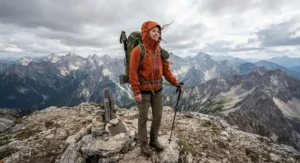
The Versalite occupies a specific and slightly contradictory niche: genuinely ultralight at roughly 6.5 ounces, yet built with full 3-layer construction rather than the 2.5-layer compromise most jackets use to hit similarly low weights. Montbell’s proprietary nylon ballistic-weave face fabric is the reason it can claim both credentials at once, and it’s part of why long-distance hikers in famously wet regions — the Pacific Northwest, coastal trails, shoulder-season alpine routes — gravitate toward it specifically. Reviewers consistently note that it handles genuinely sustained rain better than most jackets in its weight class, which is the exact gap this jacket is designed to fill: most ultralight shells sacrifice real waterproofing for weight, and the Versalite tries to have both. Here’s what to weigh if you’re comparing it against the Helium UL above: you’re paying a real premium and giving up a small amount of weight savings in exchange for meaningfully better performance when the rain doesn’t stop after twenty minutes. That makes it the stronger pick for anyone hiking regions where “chance of rain” functionally means “guaranteed rain for six hours,” rather than the brief squalls a true minimalist shell is built around.
Pros:
- ✅ Full 3-layer build at a genuinely ultralight ~6.5 oz
- ✅ Handles sustained rain better than most ultralight peers
- ✅ Purpose-built for wet-climate, shoulder-season conditions
Cons:
- ❌ Premium price for the weight class
- ❌ Minimalist features compared to heavier all-rounders
Expect the Montbell Versalite to fall in the $200–$260 range — check current pricing directly, since Montbell’s US stock and colorways shift seasonally.
7. Arc’teryx Beta SL — best premium hardshell hiking jacket
The Beta SL is the jacket long-distance hikers name when money isn’t the deciding factor and they simply want the best hardshell they can put on their back for a year-round trail habit. Built with Gore-Tex ePE — Gore’s newer, PFAS-free membrane technology — it delivers the waterproof-breathable performance the Gore-Tex name has represented for decades, now updated to meet the regulatory direction the entire outdoor industry is moving toward. What most buyers overlook about premium hardshells is that the price isn’t really paying for waterproofing alone — cheaper jackets can hit similar hydrostatic head numbers — it’s paying for construction quality: reinforced high-wear zones, a hood adjustment system that reviewers repeatedly single out as the cleanest and most intuitive in the category, and seam-taping that holds up season after season rather than degrading after a year of regular use. Based on the spec comparison against every other jacket on this list, the Beta SL is the one built to be worn hard, year-round, for a decade rather than replaced every few seasons — which changes the actual math on value even at nearly four times the price of the budget picks above. This is the jacket for hikers who are outside constantly, in genuinely variable mountain weather, and who’ve already burned through two or three cheaper shells and are done buying the same jacket twice.
Pros:
- ✅ Gore-Tex ePE membrane, PFAS-free and future-regulation-ready
- ✅ Reviewer-praised hood adjustment, cleanest in its category
- ✅ Built for year-round, multi-season durability
Cons:
- ❌ Significant price jump over mid-range competitors
- ❌ Minimalist pocket layout for the price point
The Arc’teryx Beta SL generally runs $350–$400 — check current pricing and size availability, since premium colorways sell out fastest each season.
Practical Usage Guide: Getting the Most From Your Rain Jacket
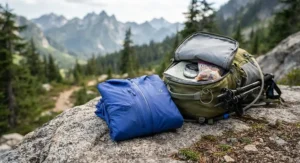
Buying the right jacket is half the equation; using it correctly is the other half, and it’s the part most product pages skip entirely. On first use, treat your new shell to a quick “wet-out” test at home: run it under a shower for two minutes and watch whether water beads and rolls off (good DWR) or soaks in and darkens the fabric (DWR needs refreshing, even on a brand-new jacket in humid storage conditions). During the first 30 days on trail, resist the urge to overpack it in the very bottom of your bag — the fastest way to lose a rain jacket’s usefulness is not having it accessible when the sky turns in the next ten minutes. Set a maintenance rhythm: wash technical shells every 10–15 wears using a technical cleaner (never standard detergent, which coats the membrane’s pores and kills breathability), then tumble dry on low heat, which actually reactivates most DWR coatings better than air drying alone. Reapply a spray-on or wash-in DWR treatment once beading noticeably slows, typically every 20–30 wears for regular hikers. One optimization trick most listings never mention: unzip pit zips fully before you start climbing, not after you’re already sweating — ventilation works far better as prevention than as damage control. Finally, store your jacket loosely hung or loosely folded, never stuffed permanently in a stuff sack, since long-term compression breaks down the membrane’s laminate bond faster than normal wear does.
✨ Don’t Miss These Exclusive Deals!
🔍 Take your hiking rain gear to the next level with these carefully selected picks above. Click on any highlighted jacket to check current pricing and availability. The right shell turns a soggy, miserable trail day into just another good hike — 🌧️ don’t let bad weather decide your season for you.
Real Trail Scenarios: Matching Hikers to the Right Jacket
Spec sheets are abstract; trail conditions aren’t. Here are three realistic profiles to help you see yourself in the decision. First, the weekend day-hiker on a budget: someone doing 5–8 mile trails a few times a month, mostly in unpredictable but not extreme conditions, who doesn’t want to drop $300 on gear used a dozen times a year. For this hiker, the REI Co-op Rainier Rain Jacket or Marmot PreCip Eco covers the real use case without over-investing in performance that will never get tested. Second, the aspiring thru-hiker prepping for a multi-week trip through variable terrain and genuinely unpredictable weather windows: this hiker needs something that balances pack weight against real durability over hundreds of miles, which points toward the Patagonia Torrentshell 3L as the workhorse choice, or the Montbell Versalite if the route runs through consistently wet regions like the Pacific Northwest. Third, the ounce-counting ultralight backpacker doing big-mile days where every gram in the pack gets scrutinized: this is exactly the buyer the Outdoor Research Helium UL was designed around — a jacket you forget is even there until you desperately need it. None of these profiles is objectively “better” gear; they’re different math problems, and the right jacket is whichever one solves your specific equation of budget, mileage, and climate.
How to Choose a Rain Jacket for Hiking
Cutting through marketing language, here’s the actual decision framework, in order of importance for most hikers:
- Match waterproof rating to your actual climate. A hydrostatic head around 10,000–15,000mm handles typical showers; anyone hiking regions with sustained multi-hour rain should look toward 20,000mm or higher, like the Patagonia Torrentshell 3L or Montbell Versalite.
- Weigh weight against mileage, not against ideal. A half-pound difference feels irrelevant on a day hike and very relevant on day nine of a thru-hike — be honest about which trip you’re actually buying for.
- Check ventilation features, especially pit zips. Breathability specs on a tag rarely tell the full story; full-length pit zips like those on the Marmot PreCip Eco do more real-world temperature regulation than most fabric claims.
- Confirm the hood adjusts independently at crown and face. A hood that only cinches at the hem will blind you in wind; look for a two-point adjustment system.
- Consider layer construction: 2.5L vs. 3L. 2.5-layer jackets like the REI Co-op Rainier Rain Jacket save money and weight; 3-layer builds last longer and feel less clammy against skin.
- Look for taped seams, not just “waterproof fabric.” An untaped seam is a guaranteed leak point regardless of how good the face fabric is.
- Factor in packability if it’s living in a daypack. If the jacket only comes out occasionally, packed size (like the Outdoor Research Helium UL‘s self-stuffing pocket) matters as much as performance.
Hardshell Hiking Jacket vs. Softshell: What’s the Real Difference
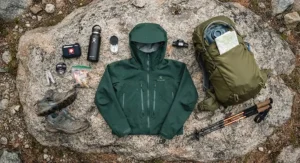
This comparison confuses a lot of first-time buyers, and the terminology genuinely is inconsistent across brands, so it’s worth untangling directly. A hardshell hiking jacket — like the Arc’teryx Beta SL or Patagonia Torrentshell 3L — uses a fully waterproof, non-breathable-feeling membrane bonded to a stiffer face fabric. It’s built to be a complete barrier against rain and wind, at the cost of some breathability and flexibility. A softshell trades some of that waterproofing for stretch, breathability, and comfort, using a water-resistant (not fully waterproof) treated fabric that handles light rain and wind but will eventually wet through in sustained downpours; the Mountain Hardwear Stretch Ozonic sits in a genuine middle ground, technically a hardshell but built with softshell-like stretch fabric.
| Category | Hardshell | Softshell / Stretch Hybrid |
|---|---|---|
| Waterproofing | Full barrier, handles sustained rain | Water-resistant, wets through eventually |
| Breathability | Good, but membrane-limited | Excellent, fabric breathes naturally |
| Mobility | Stiffer, less give | Stretches with movement |
| Best For | Multi-day trips, unpredictable weather | Scrambling, high-output activity, mild rain |
| Example | Arc’teryx Beta SL | Mountain Hardwear Stretch Ozonic |
The practical takeaway: if you’re choosing one jacket to handle everything from a light drizzle to an unexpected all-day downpour, a true hardshell is the safer default. If your hiking leans toward scrambling, trail running, or regions where “rain” usually means brief showers rather than storms, a softshell-hybrid buys you comfort you’ll actually notice on every single trip, not just the rare bad-weather one.
Common Mistakes When Buying a Rain Jacket for Hiking
The single most common mistake is buying based on price alone and assuming “waterproof” on the tag means the same thing across every brand — as the comparison above shows, it doesn’t, and a $40 jacket calling itself waterproof is measuring against a much lower bar than a $300 one. A close second is buying a size too small to look streamlined; a hiking rain jacket needs to fit over a base layer and sometimes a midlayer, so if you can only wear it over a t-shirt, it’s the wrong size. Third, people frequently skip checking hood adjustability entirely, then discover on an exposed, windy ridge that the hood collapses over their eyes precisely when visibility matters most. Fourth is ignoring pit zips as a “nice to have” rather than a functional necessity — without them, you either overheat and sweat through the jacket from the inside, or you unzip the whole front and let rain in, which defeats the purpose. Finally, hikers routinely underestimate maintenance: a jacket’s DWR coating degrades with dirt, body oil, and washing detergent residue, and skipping reapplication is why a perfectly good jacket starts “leaking” after eighteen months when the membrane itself is fine — it’s the surface coating that failed, not the waterproof barrier underneath.
Rain Jacket for Hiking for Different Trail Types and Audiences
Not every hiker needs the same jacket, and matching gear to your actual pattern of use matters more than chasing the “best” jacket in the abstract. Beginners doing occasional day hikes are almost always better served by a budget or mid-range 2.5-layer shell like the REI Co-op Rainier Rain Jacket — spending premium money before you know your hiking habits and climate is a common and avoidable overspend. Ultralight backpackers and thru-hikers, by contrast, are optimizing an entirely different variable: total pack weight over hundreds of miles, where a jacket like the Outdoor Research Helium UL earns its higher per-ounce cost through cumulative fatigue savings. Hikers in consistently wet regions — coastal trails, the Pacific Northwest, alpine shoulder seasons — need to prioritize sustained waterproof performance over weight or price, making the Montbell Versalite or Patagonia Torrentshell 3L the more sensible category regardless of budget. Older hikers or anyone managing joint mobility issues often benefit from the stretch and reduced restriction of something like the Mountain Hardwear Stretch Ozonic, since a stiff hardshell can genuinely limit range of motion on scrambles or uneven terrain. And year-round hikers who are outside constantly across every season are the buyer profile premium hardshells like the Arc’teryx Beta SL are actually built for — the cost amortizes very differently over 200 wears a year than it does over 10.
Pit Zip Ventilation and Other Features That Actually Matter (And Those That Don’t)
Marketing copy loves to list features, but not all of them earn their place on a hiking jacket, and it’s worth being blunt about which ones do real work. Pit zip ventilation matters enormously — full-length zips under the arms, like those on the Marmot PreCip Eco, are often the single biggest factor in whether you overheat on a climb, more impactful than the fabric’s technical breathability rating itself. A properly adjustable hood with both a crown cinch and a face cinch matters just as much, since a hood that can’t be dialed in becomes useless the moment wind picks up. Taped, fully sealed seams matter — full stop, non-negotiable. On the other hand, a long list of pocket configurations mostly doesn’t matter for hiking specifically; extra zippered pockets add weight and cost without meaningfully improving performance, and several ultralight jackets on this list, like the Outdoor Research Helium UL, deliberately strip pockets down to almost nothing for exactly that reason. Reflective trim looks nice in product photos and rarely changes anyone’s actual hiking experience. And while brands love to tout specific denier (fabric thickness) numbers, a slightly higher or lower denier rating within the same product category tells you less than the actual layer construction (2.5L vs. 3L) does — don’t let a marketing spec sheet distract from the fundamentals covered in the buying framework above.
Long-Term Cost & Maintenance
The sticker price on a rain jacket is only part of its real cost, and thinking in cost-per-wear changes the math considerably. A $90 jacket like the REI Co-op Rainier Rain Jacket that needs replacing after two to three seasons of regular use works out to roughly $30–$45 per season of service. A $370 jacket like the Arc’teryx Beta SL, built to last a decade of heavy year-round use with proper maintenance, can work out to under $40 per season — genuinely comparable or cheaper on a long horizon, despite the intimidating upfront number. The variable that actually determines this math isn’t the price tag, though — it’s maintenance discipline. A premium jacket neglected for years, never rewashed, never re-treated with DWR, will underperform a budget jacket that’s properly cared for. Budget roughly $15–$20 a year for a technical wash-in DWR treatment, and factor in that washing itself (which most owners skip out of fear of “damaging” the jacket) actually restores performance rather than degrading it, provided you use a technical cleaner rather than standard laundry detergent. The realistic total cost of ownership calculation is: (jacket price) ÷ (expected seasons of service, extended by proper maintenance) + (annual maintenance cost) — and running that math before you buy often flips which jacket is actually the better value.
Safety, PFAS Regulations & Compliance Guide
Rain gear isn’t just a comfort item — it’s genuine safety equipment, because wet clothing accelerates heat loss dramatically and is a well-documented contributor to hypothermia risk even in temperatures that don’t feel dangerously cold. NOAA’s outdoor weather safety guidance specifically notes that a waterproof, breathable outer layer paired with moisture-wicking base layers is one of the most effective defenses against cold-weather exposure risk, since staying dry preserves your body’s insulating air layers far better than staying merely warm in wet fabric. Separately, there’s a regulatory shift worth knowing about if you’re shopping in 2026: several states have enacted or are phasing in restrictions on PFAS (“forever chemicals”) historically used in some waterproof DWR coatings. New York’s PFAS apparel law, for example, restricts intentionally added PFAS in general apparel already, with outdoor apparel for severe wet conditions facing a further restriction phasing in over the next couple of years. Jackets built with PFAS-free membranes and DWR — like the Patagonia Torrentshell 3L and Arc’teryx Beta SL‘s Gore-Tex ePE — are already ahead of that curve, which is worth factoring into a long-term purchase even if you don’t live in an affected state, since manufacturing trends tend to shift nationally once major markets require it.
What is “Waterproof,” Really? Understanding Ratings Before You Buy
Every jacket on this list lists a hydrostatic head number, and it’s worth understanding what that figure actually measures before you use it to compare products. As SectionHiker’s breakdown of hydrostatic head testing explains, the test measures the water pressure a fabric can withstand before it leaks — under laboratory static pressure, not the dynamic, wind-driven conditions you’ll actually hike through. That distinction matters: a jacket rated at 20,000mm isn’t necessarily going to feel twice as dry as one rated 10,000mm on an actual trail, because real-world factors like seam quality, DWR condition, and wind-driven rain angle affect performance as much as the raw lab number. REI’s own explainer on how rain gear works makes a similar point: the rainwear industry has no single agreed-upon test standard the way the sleeping bag industry has temperature ratings, so a spec-for-spec comparison between brands is inherently a little apples-to-oranges. Use hydrostatic head as one directional data point, not a definitive ranking — the buying framework above weighs it alongside construction quality, ventilation, and layer type for exactly this reason.
Frequently Asked Questions
❓ What is the best rain jacket for hiking under $100?
❓ Is a hardshell or softshell better for hiking?
❓ How often should I re-treat my rain jacket's DWR coating?
❓ What's the difference between 2.5-layer and 3-layer rain jackets?
❓ Do ultralight rain jackets actually keep you dry in real rain?
Conclusion
There’s no single “best” rain jacket for hiking — there’s only the best jacket for your specific trail pattern, climate, and budget, and that’s genuinely good news, because it means you don’t need to overspend on features you’ll never use. Weekend hikers get real value from the budget-friendly REI Co-op Rainier Rain Jacket or Marmot PreCip Eco, both of which nail the fundamentals without the premium price tag. Anyone looking for a single do-it-all workhorse should seriously consider the Patagonia Torrentshell 3L, which earns its reputation through genuinely balanced performance rather than marketing hype. Ounce-counters chasing big mileage owe it to their shoulders to look hard at the Outdoor Research Helium UL or Montbell Versalite, and hikers who live outdoors year-round in serious mountain weather will get real, measurable value out of investing in the Arc’teryx Beta SL. Whichever you choose, the framework in this guide — waterproof rating matched to climate, weight matched to mileage, ventilation taken seriously, and maintenance actually followed through — will serve you regardless of which specific jacket ends up in your pack. Stay dry out there, and let the next surprise storm be a non-event instead of an emergency.
✨ Ready to Gear Up for Your Next Trail?
🔍 Compare your shortlist one more time using the table above, click through to check current pricing, and get one of these jackets into your pack before the next forecast turns on you. A dry hiker is a happy hiker — 🥾 don’t let weather cut your next trip short.
Recommended for You
- 7 Best Rain Jacket for Commuting Picks in 2026
- Casual Waterproof Jacket Under $80: 7 Picks Worth Buying (2026)
- Waterproof Trench Coat Women: 7 Best Rain-Proof Picks (2026)
Disclaimer: This article contains affiliate links. As an Amazon Associate, I earn from qualifying purchases. If you purchase products through these links, we may earn a small commission at no additional cost to you.
✨ Found this helpful? Share it with your friends! 💬🤗
